


Academics gathered at National Taiwan University on Friday made a number of proposals on government energy policy and plans to reduce carbon emission, but failed to reach a consensus.
Among the subjects discussed at the forum, held at the Public Economics Research Center, were current and future energy policies, policy dilemmas, industrial development and renewable energy.
The meeting was held amid increasing concern over energy policy in the wake of serious leaks at the Fukushima Dai-ichi nuclear power plant in Japan in March, said Chen Tain-jy (陳添枝), former chairman of the Council for Economic Planning and Development and a professor at the department of economics at the university.
“Taiwan’s energy policies are contradictory,” Chen said, adding that although the government was urging the public to save energy, it was unwilling to increase electricity, gas and oil prices as an incentive to do so.
The main problem is that energy policy today is still directed by lower-ranking government agencies and both the budget and personnel for energy research is inadequate, he said.
Gloria Hsu (徐光蓉), a professor at the school’s department of atmospheric sciences, said that current energy policies relied too much on energy imports (import dependence was 99.3 percent in 2009), overly high total electricity consumption, low energy efficiency, disproportionate energy use by -energy-intensive industries relative to their contribution to GDP growth, and a lack of tangible targets or a timetable for carbon emissions reduction.
Liang Chi-yuan (梁啟源), president of the Chung-Hua Institution for Economic Research and a research fellow at the Institute of Economics at Academia Sinica, said that the dilemma faced by current energy policies was that while over dependence on energy imports was a problem, the limited availability of renewable energy made it too expensive and ensured erratic supply.
Renewable energy power facilities require more space, but Taiwan is a densely populated and mountainous country, Liang said, adding that a disproportionate level of energy consumption and carbon emissions in Taiwan was accounted for by industrial units that manufacture products for exports.
Tso Chunto (左峻德), a research division director at the Taiwan Institute of Economic Research, said current energy sources should be replaced with renewable energy, including solar energy, bioethanol (a kind of alcohol that can be produced from agricultural feedstock and used as motor fuel) and wind power.
As Taiwan has a comprehensive chain of wind power facilities, the government should seek to enhance its potential by adding wind power to public construction projects, Tso said.
Moreover, plans for bioethanol should be made an integral part of rural regeneration plans, to balance economic growth with environment sustainability, he said.
Hsu was more focused on opposing pro-nuclear power policies in Taiwan, adding that energy demand growth estimates provided by the Bureau of Energy were exaggerated.
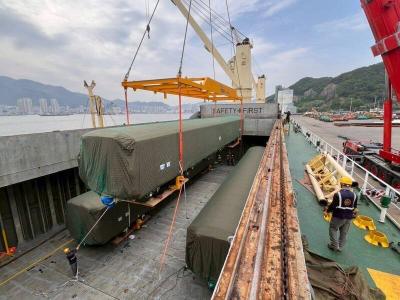
The first of 10 new high-capacity trains purchased from South Korea’s Hyundai Rotem arrived at the Port of Taipei yesterday to meet the demands of an expanding metro network, Taipei Rapid Transit Corp (TRTC) said yesterday. The train completed a three-day, 1,200km voyage from the Port of Masan in South Korea, the company said. Costing NT$590 million (US$18.79 million) each, the new six-carriage trains feature a redesigned interior based on "human-centric" transportation concepts, TRTC said. The design utilizes continuous longitudinal seating to widen the aisles and optimize passenger flow, while also upgrading passenger information displays and driving control systems for a more comfortable
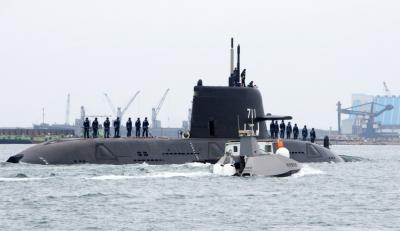
Taiwan's first indigenous defense submarine, the SS-711 Hai Kun (海鯤, or Narwhal), departed for its 13th sea trial at 7am today, marking its seventh submerged test, with delivery to the navy scheduled for July. The outing also marked its first sea deployment since President William Lai (賴清德) boarded the submarine for an inspection on March 19, drawing a crowd of military enthusiasts who gathered to show support. The submarine this morning departed port accompanied by CSBC Corp’s Endeavor Manta (奮進魔鬼魚號) uncrewed surface vessel and a navy M109 assault boat. Amid public interest in key milestones such as torpedo-launching operations and overnight submerged trials,
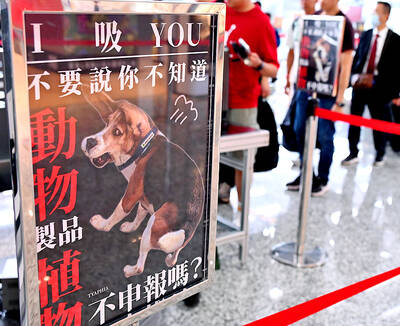
Quarantine awareness posters at Taiwan Taoyuan International Airport have gone viral for their use of wordplay. Issued by the airport branch of the Animal and Plant Health Inspection Agency, the posters feature sniffer dogs making a range of facial expressions, paired with advisory messages built around homophones. “We update the messages for holidays and campaign needs, periodically refreshing materials to attract people’s attention,” quarantine officials said. “The aim is to use the dogs’ appeal to draw focus to quarantine regulations.” A Japanese traveler visiting Taiwan has posted a photo on X of a poster showing a quarantine dog with a

Taiwan’s coffee community has launched a “one-person-one-e-mail” campaign, calling for people to send a protest-e-mail to the World Coffee Championships (WCC) urging it to redesignate Taiwanese competitors as from “Taiwan,” rather than “Chinese Taipei.” The call followed sudden action last week after the WCC changed all references to Taiwanese competitors from “Taiwan” to “Chinese Taipei,” including recent World Latte Art champion Bala (林紹興), who won the World Latte Art Championship in San Diego earlier this month. When Bala received the trophy, he was referred to as representing Taiwan, as well as in the announcement on the WCC’s Web site, until it


 RSS
RSS