


Taiwan will assess whether it should shut down any of its three active nuclear power plants after the completion of related reviews, Atomic Energy Council (AEC) Minister Tsai Chuen-horng (蔡春鴻) said.
Tsai said the council has asked Taiwan Power Co, which operates the nuclear power plants, to conduct a survey of the Sanchiao (山腳) and Hengchun (恆春) fault lines.
The Sanchiao fault line is located between the first and second nuclear power plants in New Taipei City (新北市), while the Hengchun fault line is not far from the third nuclear power plant in the south.
The surveys are expected to take two years, Tsai said.
The National Science Council is also conducting a nationwide earthquake source survey, which is to be completed at the end of the year.
“We have to wait for the completion of all these surveys to be able to work out a strategy on dealing with multiple disasters such as the combination of an earthquake and tsunami,” Tsai said.
He was responding to reports that Japanese Prime Minister Naoto Kan had ordered the shutdown of the aging Hamaoka nuclear power plant southwest of Tokyo because of its location near a tectonic fault line.
Seismologists have warned that a major quake is long overdue in the Tokai region southwest of Tokyo where the Hamaoka plant is located, about 200km from Tokyo in Shizuoka Prefecture.
Japanese authorities, including the country’s science ministry, have concluded that the possibility of a magnitude 8 earthquake hitting the area within the next 30 years is 87 percent, Kan said.
Meanwhile, officials from Taiwan and China yesterday discussed a cross-strait cooperation and communication mechanism to address nuclear energy safety issues.
Liu Hua (劉華), director of China’s Nuclear Safety and Radioactive Environment Management Department, said he fully supports the signing of a cross-strait nuclear energy safety agreement and the establishment of an official hotline on the issue.
Speaking at a nuclear safety seminar, Liu said Taiwan’s and China’s state-owned power companies have exchanged nuclear power technology over the past several years, but realized the importance of closer cooperation on the issue in the wake of Japan’s nuclear crisis.
“Cross-strait dialogue on nuclear safety will be raised to an official level,” he said at the seminar.
The seminar was one of eight conferences being held during a cross-strait economic and cultural forum organized by the Chinese Nationalist Party (KMT) and the Chinese Communist Party that opened on Saturday in Chengdu, China.
Also speaking at the seminar, Chen Pu-tsan (陳布燦), a Taipower department director in charge of nuclear energy safety, said both Taiwan and China are members of the World Association of Nuclear Operators (WANO) and have maintained regular exchanges under the WANO framework on nuclear technology and equipment maintenance.
Several Taipower officials met their counterparts recently and reached a consensus on establishing an information exchange platform on nuclear energy safety in the near future, he said.
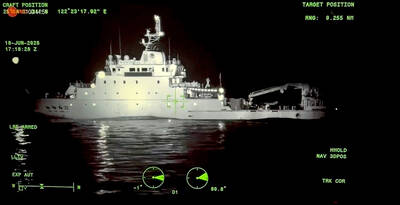
EXCUSES: Beijing is using government and research vessels as a pretext to harass the nation and enter its EEZ, and engage in ‘hegemonic expansion,’ the coast guard said The Coast Guard Administration yesterday said it drove away Chinese oceanographic research vessel Xiang Yang Hong 22 (向陽紅33) from restricted waters after warning it that it was in Taiwan’s exclusive economic zone (EEZ). The Chinese vessel entered restricted waters off the coast of Yilan County’s Suao (蘇澳) at 11:35pm on Thursday, the coast guard said, adding that it dispatched the Lanyu patrol vessel and the boat PP-10077 to shadow the Chinese ship and issue radio warnings ordering it to leave. China has no sovereignty over waters off Taiwan’s east coast, Lanyu’s crew told Xiang Yang Hong 22 over the radio, and demanded
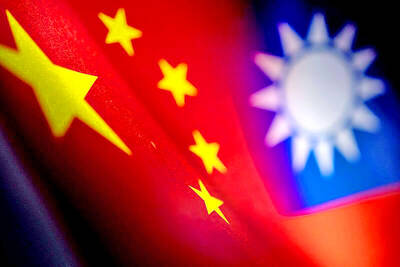
BAIT AND SWITCH: Allowing KMT-run counties to sell to China while the threat of abrupt cancelations hangs overhead is another form of coercion, officials said Beijing is using agricultural purchase offers announced during the Straits Forum to deepen Taiwan’s dependence on the Chinese market, a Taiwanese official said yesterday as they criticized the Taitung County commissioner’s participation in the initiative. During the Straits Forum held in Xiamen on Saturday, Chinese officials announced a sales and purchase agreement for agricultural products from some counties led by the Chinese Nationalist Party (KMT). Taitung County Commissioner Yao Ching-ling (饒慶鈴), who was barred from attending the event in person by the Mainland Affairs Council, participated via video. Under the agreement, China would purchase atemoyas, pomeloes, tea and grouper harvested in Taitung,
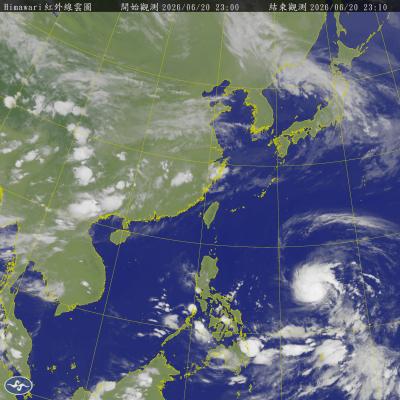
Tropical Storm Mekkhala is forecast to strengthen into a typhoon tomorrow and could come close enough to Taiwan later in the week to prompt a sea warning, the Central Weather Administration (CWA) said yesterday. As of 2 pm, the storm was located 1,870 kilometers southeast of Taiwan's southern tip and moving west- northwest at 23 km per hour. CWA forecaster Cheng Chieh-jen (鄭傑仁) said Mekkhala is expected to continue moving west-northwest through Tuesday under the influence of the Pacific high- pressure system before gradually turning north toward waters east of Taiwan or south of the Ryukyu Islands. The timing and angle of the
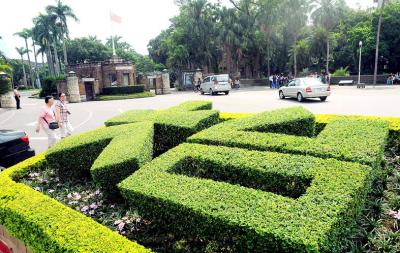
Four Taiwanese universities have been ranked among the world's top 200 institutions in the Quacquarelli Symonds (QS) World University Rankings for next year, the highest Taiwan has ever placed in the category, with National Taiwan University (NTU) achieving its best performance at 54th globally and 17th in Asia. The four Taiwanese institutions in the global top 200 are NTU (54th), National Tsing Hua University (142nd), National Yang Ming Chiao Tung University (177th) and National Cheng Kung University (191st), the rankings showed. All four universities achieved their highest-ever global rankings this year, QS data showed. National Cheng Kung University entered the top 200 for


 RSS
RSS