


As the nuclear crisis at Japan’s Fukushima Dai-ichi nuclear power plant continues to threaten the health of millions of Japanese, the safety of Taiwan’s three operational nuclear power plants and how well managed those plants are has come under greater scrutiny, especially in light of reports that leaks at the Japanese plant may have partly been the result of years of neglect and corruption.
On June 19 last year, the Taipei Times exposed problems at the Guosheng Nuclear Power Plant in Wanli (萬里), New Taipei City (新北市), after a US diving company alleged that staff were treating the suppression pool as a “garbage dump.”
Robert Greenspan, president of South Dakota-based Midco Diving and Marine Services, told the Taipei Times that the pool, which would play a critical coolant role during a nuclear emergency (when the energy produced by the reactor core is greater than the energy removed), had contained inordinate amounts of silt and various foreign objects, such as cable spools, oxygen tanks and masks — all highly radioactive. According to foreign material exclusion rules, any object that is taken into a suppression pool must be taken out, as foreign objects can disturb the flow of water in the tank and cause jamming.
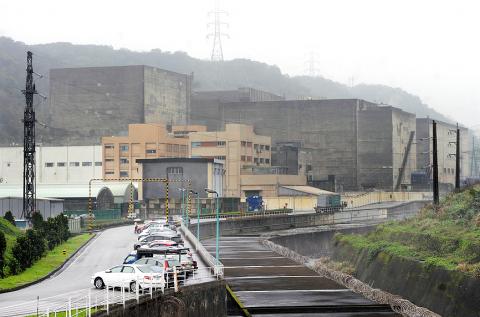
Photo: Liao Chen-huei, Taipei Times
Contracted by Ming Tai (閩台), a Taiwanese firm, Midco conducted underwater maintenance in Unit 2 at the plant in November 2008 and Unit 1 in March 2009. However, Greenspan said there was so much foreign material in the Unit 1 pool that divers were unable to complete their work in the 10 days given them. An ensuing contractual dispute prevented Midco from returning to the site.
Contacted for a follow-up late last month, Greenspan provided more details of the situation back then.
“When we were cleaning, they were still dropping garbage into the pools. We would clean an area and go back through it later, and there would be more debris,” he said. “They also used it as a spittoon for the beetle nut they chew on.”
Prior to Midco, another US diving firm, Connecticut-based Underwater Construction Corp (UCC), had conducted similar underwater cleaning work at the plant’s Unit 2 during the 18th refueling outage in April and May 2007. Contacted in June last year and again last month, UCC did not respond, but the Taipei Times has obtained a copy of the company’s final report on its maintenance work at the unit.
Before the work in 2007, the vent annulus — the area between the reactor’s steel container, or the primary containment structure, and the concrete building surrounding it — at Unit 2 had never been desludged or inspected in the immersion area, the report said. Unit 2 went operational on March 15, 1983. During desludging and inspection, all foreign material found was removed from the annulus and suction strainers.
The sludge in the pool consisted mainly of fine particulate mixed with large amounts of corrosion products from system piping and welding slag, and evidence of fibrous material was noted, the report said. Typical sludge depths ranged from 150mm to 450mm. In all, 50 bags of foreign material, weighing about 9kg each, were removed from the annulus area. The majority of the foreign objects found were identified as tape, wire, welding rods, welding slag and tie-wraps, as well as a tool box with tools inside, a piece of grating, several scaffold poles and a scaffolding platform.
Contact dose rates on the suppression chamber liner at the conclusion of the cleaning work showed a significant decrease in radiation levels, from 10 millisieverts per hour to more than 80 millisieverts per hour (or the equivalent of 800 chest X-rays) before work to 0.15 millisieverts per hour to 2 millisieverts per hour after its conclusion, the report said, a sign that the foreign material removed was highly radioactive.
While most foreign materials were removed, the area from panels 14 through 19 (of a total of 34) were not cleaned because of the high dose rates of 50 millisieverts per hour to more than 80 millisieverts per hour.
John Wang (王重章), an official at state-owned Taiwan Power Co (Taipower, 台電), which operates the nation’s nuclear power plants, confirmed to the Taipei Times that UCC could not complete its cleaning work because of high radiation in some areas of the annulus base.
Removal of rust staining at numerous areas throughout the annulus floor and walls could only be done partially, again because of high radioactive dose rates, the report said.
Commenting on the report by UCC, Greenspan said Taipower had dropped the ball on maintenance.
“The pools had never been cleaned ... Lots of silt [should not be there]. High radiation [should not be that high] and lots of debris [should not be there],” he said.
“It is my understanding the UCC crew did not finish because of extremely high radiation doses,” Greenspan said.
“A radiation worker, including divers, is only allowed so much radiation per year. Once a radiation worker or diver hits that limit, [it means] no more work in a nuclear plant,” he said.
“Because the plant was so dirty, the divers from UCC — and I don’t blame them — essentially decided not to dive anymore so they could continue working at other plants. They have families to support and do not want to be out of work because Taipower cannot do proper maintenance,” he said.
Another important point was the amount of radioactive garbage that had to be disposed of, Greenspan said.
“Hundreds of pounds of debris, and hundreds upon hundreds of the sediment filters, all highly radioactive, because Taipower will not follow proper protocol,” he said.
“Most nuclear plants are more akin to a surgical center, very neat, regulated and clean. Taipower plants are more like the back room of a lousy auto parts store. If the Fukushima situation happened at the Guosheng plant, I am sure it would have been way worse, much faster,” he said.
Taiwan’s first two nuclear power plants use reactors — water boiler reactors (BWR) — similar to those at Fukushima Dai-ichi, while Ma-anshan Nuclear Power Plant in Ma-anshan (馬鞍山), Pingtung County, uses a more stable, and reportedly safer, pressurized water reactor (PWR).
The first two plants use different containment designs, Mark-I and Mark-III respectively. Five of the six reactors at Fukushima use a Mark-I design.
Asked if Taipower had completed the cleanup at Guosheng after UCC and Midco failed to finish their work, Wang said the suppression pools were cleaned by a Taiwanese company, Fuermosha Co (福爾摩沙公司).
The cleanup of the vent annulus and the suppression pools at the first and second reactors at Guosheng is complete and no silt remains, he said on March 30.
As to when similar work had been done at the Jinshan Nuclear Power Plant in Shihmen District (石門), New Taipei City, Wang said US company S.G. Pinney had used divers to clean the suppression chamber at reactors one and two in 1999 and 2000 respectively.
Unit 1 at Jinshan went online on Dec. 6, 1978, while Unit 2 did so on July 16, 1979.
In 2005, Taipower itself discharged the water and completed a cleanup of the suppression pools at the first and second reactors, he said, adding that the inside of the suppression pools was in very good shape.
Late this year and next year, Taipower will discharge the water and clean up the suppression pools at reactors one and two, he said.
However, as staff enter and exit for maintenance work, mud and dirt will still enter the suppression pools, Wang said, adding that the future strategy at Guosheng would be to adopt regular cleaning, one of the recommendations found in the UCC report and fully supported by Greenspan.
Experts say it should be done every one or two years.
Furthermore, beginning in the second half of this year, a remote controlled underwater cleaning method will be adopted to keep the vent annulus and the suppression pools clean, with the interval between cleanings to be decided depending on the circumstances, Wang said.

FUKUOKA SITUATION: Japanese media reported that the pathogen is expected to be identified by the summer, while the CDC downplayed the idea that it was hMPV A “mysterious cold-like illness” reported in Japan’s Fukuoka Prefecture does not seem to be a new disease, but Japanese authorities have been asked about the situation, the Centers for Disease Control (CDC) said yesterday. The Fukuoka Prefectural Medical Association on Wednesday told a news conference that a “mystery cold” that has become a hot topic on social media is “highly likely to be caused by some kind of viral infection,” Japan’s KBC News reported. “Many people are experiencing symptoms starting with a sore throat, followed by a runny nose, phlegm and a severe cough,” KBC News reported, citing association officials. Health authorities are

Nvidia Corp CEO Jensen Huang (黃仁勳) arrived in Taiwan yesterday ahead of upcoming AI and technology events, saying he plans to meet with clients and Taiwan Semiconductor Manufacturing Co Chairman C.C. Wei (魏哲家) during his visit. After landing at Taipei Songshan Airport, Huang posed for photos with fans and handed out Yakult drinks to reporters and supporters waiting at the scene, saying he has “a lot to do” during the trip. Asked about reports that Nvidia’s planned headquarters site in Taipei’s Beitou Shilin Technology Park could break ground on May 27, Huang said that if the company holds an event, he would

The Ministry of Finance this afternoon announced the winning numbers for the March-April uniform invoice lottery. The winning number for the NT$10 million (US$318,060) special prize is 19531471, and the winning number for the NT$2 million grand prize is 85941329. Three numbers were drawn for the NT$200,000 first prize: 07225810, 20231230 and 83518781. Those with receipts matching the last seven digits of any of the first-prize numbers will win the NT$40,000 second prize, while those matching the last six digits will win the NT$10,000 third prize. Those whose receipts match the last five digits of the first-prize numbers can claim the NT$4,000 fourth prize,
SIX SUBSIDIES: The monthly allowance for older farmers is to increase to NT$10,000, and NT$5,000 is to be given to homemakers under the national pension system, Lai said The government is to implement major welfare policies for disadvantaged groups, including raising the monthly allowance for older farmers to NT$10,000 and providing homemakers with NT$5,000 per month, President William Lai (賴清德) said yesterday. Lai made the remarks during a visit to Wangling Temple in Chiayi County, saying that the planned increases were being introduced amid economic growth and an increase in tax revenue. Touting a policy, in which the government plans to provide a monthly allowance of NT$5,000 for every child under the age of 18 in a bid to address Taiwan’s low birthrate, Lai said that if received for the


 RSS
RSS