


US Deputy Secretary of State James Steinberg, a pro-China diplomat with little sympathy for Taiwan, has resigned and will return to academia.
He is to be replaced by William Burns, a Middle East expert who is currently undersecretary for political affairs and the department’s third-ranking official.
The move is unlikely to have an immediate impact on US-Taiwan relations at a time when Washington is preoccupied with developments in the Arab world.
Announcing Steinberg’s departure on Wednesday, US Secretary of State Hillary Rodham Clinton said: “Jim has been particularly instrumental in shaping our renewed engagement in the Asia-Pacific.”
“From managing our expanding relationship with China, to reaffirming our historic alliance with Japan, to addressing challenges on the Korean Peninsula, Jim has been at the center of shaping our efforts,” she said.
Clinton said Steinberg had been a “fixture” at meetings with the National Security Council (NSC) and frequently represented the US State Department at the White House.
Insiders said Steinberg has been at least partly responsible for US President Barack Obama’s decision to put Taiwan’s request to buy advanced F-16 aircraft on the backburner. He is said to have argued in private that F-16 sales to Taiwan would not result in enough benefits to justify upsetting Beijing.
US-Taiwan Business Council president Rupert Hammond-Chambers said US decisions regarding Taiwan were made collectively through an interagency process, coordinated by the NSC.
“That said, Steinberg did have the power to say no. It was a power he exercised reflexively when it came to Taiwan,” he said.
“I believe his actions spoke volumes for his view of Taiwan and the issues he believed it created for the US-China relationship. We can only hope that his successor takes a more balanced view of American interests on Taiwan and injects some badly needed ambition into our goals for US-Taiwan relations,” he said.
“I’m hopeful that a reassessment of our Taiwan policy will accompany the change,” said Walter Lohman, director of Asian studies at the Washington-based Heritage Foundation.
“US-Taiwan relations right now are going nowhere. Steinberg was a well-known advocate for closer relations with China and I think that tendency was undermining movement in US-Taiwan relations,” Lohman said.
Steinberg is leaving the State Department to become dean of Syracuse University’s Maxwell School of Citizenship and Public Affairs in New York State. Prior to serving as deputy secretary of state, he was dean of the University of Texas’ Lyndon B. Johnson School of Public Affairs.
An article on the New York Times Web site said Steinberg’s departure had been rumored for some time and that he “never became close to Mrs Clinton, despite having served as deputy national security adviser to her husband.”
Burns, the highest-ranking career diplomat in the department, has been deeply involved in policies concerning Iran and its nuclear program and the upheaval in the Arab world.
“He will bring incomparable depth and experience to the job, as well as important continuity,” Clinton said.
Steinberg will be remembered for his “strategic reassurance” policies toward Beijing.
Analyzing these policies in the Wall Street Journal, Kelley Currie, a nonresident fellow at the Project 2049 Institute, wrote: “There is a chance that the US is starting a quiet but important strategic shift away from a policy that incorporates an understood, if often inchoate, desire to see China become a more liberal and democratic society, toward an acceptance of China as a permanent authoritarian state.”
Gerrit van der Wees, editor of the Washington-based Taiwan Communique, said Steinberg was “too soft on China.”
“On Taiwan, Steinberg regrettably clung too much to old ‘one China’ policy mantras and was not able to engage the US in more creative thinking and action in support of Taiwan’s democracy and international space. He also was overly cautious on US arms sales to Taiwan,” he said.
What happens next, Van der Wees told the Taipei Times, depends on how responsibilities are shifted within the State Department.
Van der Wees expects US Assistant Secretary of State for East Asian and Pacific Affairs Kurt Campbell to take a more prominent role, “which is a good thing, because he has an excellent grasp of the policies needed to balance out China’s rise and retain US influence in East Asia.”
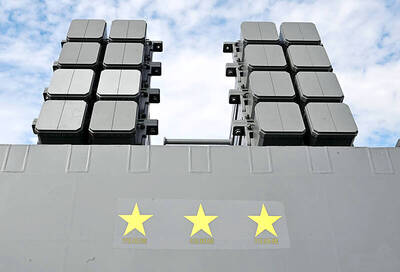
UPGRADE: The Kang Ding-class frigate is replacing its Chaparall missiles with Tien Chien II and Hua Yang VLS, which would provide it with long-range, 360° air defense Taiwan plans to produce 1,200 to 1,376 Hai Chien II missiles (海劍二, Sea Sword II) — also known as TC-2N — to serve as the standard air defense system of the navy’s surface combatant fleet, a source said yesterday. Last week, the Hai Chien II, the naval version of the Tien Kung II missile (天劍二, Sky Sword II), completed a live-fire test in waters off the National Chungshan Institute of Science and Technology’s Jiupeng facility (九鵬) in Pingtung County’s Manjhou Township (滿州). The MIM72 Chaparral and other dated air defense missiles that currently arm Taiwanese ships have inadequate range to combat Chinese

REASONS FOR TRAVEL: An assistant professor said that proposed amendments to penalize drivers if they used drugs overseas would not deter people from traveling People who operate a motor vehicle under the influence of marijuana would have their driver’s license revoked, even if they used the substance while overseas, the Ministry of Transportation and Communications said yesterday, citing proposed amendments to the Road Traffic Management and Penalty Act (道路交通管理處罰條例). The amendments would also authorize the government to revoke the licenses of people determined to have used Category 1 or Category 2 narcotics, even if they were not operating a vehicle while under the influence of drugs, as well as ban them from taking the license test for three years, the ministry said. People aged 18 or

HEAVY WEATHER: Typhoon Jangmi is due to crash straight into the Ryukyus as airlines look to shift flights to larger aircraft or cancel flights to Okinawa entirely Taiwan’s international air carriers announced flight adjustments over the weekend as Typhoon Jangmi is forecast to hit the Ryukyu Islands today and tomorrow. The Central Weather Administration (CWA) upgraded Jangmi from a tropical storm to a typhoon at 8am yesterday, with the eye located 580km south of Naha city. It was moving north at 19kph. Today, China Airlines’ CI-120, CI-121, CI-122 and CI-123 flights between Taoyuan and Naha, Okinawa, have been canceled as well as CI-132 and CI-133 between Kaohsiung and Naha. EVA Air’s BR-112, BR-113, BR-186 and BR-185 flights between Taoyuan and Naha are also canceled. Low-cost carrier Tigerair Taiwan canceled IT-230,
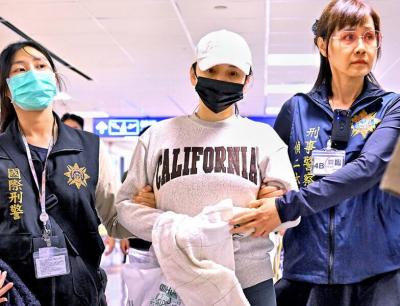
Johanne Liou (劉喬安), a Taiwanese woman who shot to unwanted fame during the Sunflower movement protests in 2014, returned to Taiwan last night after being deported from the US. She is to stand trial in Taiwan for charges involving embezzlement, fraud and drug crimes. The Criminal Investigation Bureau (CIB) said it took her into custody at Taiwan Taoyuan International Airport and would first question her before transferring her to the New Taipei District Prosecutors’ Office. She was arrested upon disembarking a flight from San Francisco that landed shortly before 7pm. Liou absconded to the US in 2019 after jumping bail


 RSS
RSS