


Democratic Progressive Party (DPP) presidential hopeful Tsai Ing-wen (蔡英文) unveiled her first campaign ad yesterday in an effort to increase her profile before the party’s presidential primaries next month.
The TV ad, titled “Reason … Giving Democracy More Power,” makes no mention of her opponents, but depicts her leadership of the DPP in the past three years, highlighting the message “winning back the people’s confidence.”
“True reflection is bravely facing up to the people. One step at a time, we have rediscovered Taiwan’s most basic values,” Tsai says in the one minute spot, making reference to the DPP’s resurgence since its poor showing in the legislative and presidential elections in 2008.
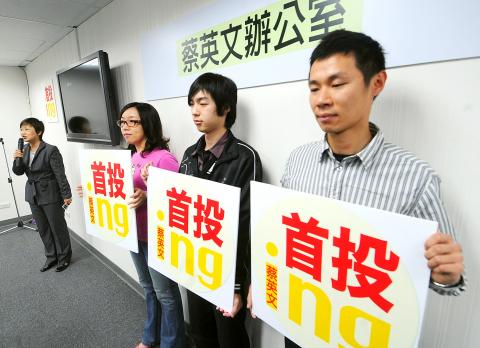
Photo: Wang Min-wei, Taipei Times
“A strong Taiwan will be able to stand on stable roots and welcome the world. Taiwan’s future deserves a better hope,” she says before a voiceover describes her as “reasonable” and “tough.”
The first TV ad to be released for the presidential campaign, the spot shows that Tsai’s campaign is already in full swing as she prepares for a potential showdown with former premier Su Tseng-chang (蘇貞昌).
Hsu Chia-chin (徐佳青), a spokesman for Tsai, refused to disclose the cost of the advertisement, which ran across cable news channels yesterday, but said more TV spots would likely follow until the a presidential nominee is chosen by the DPP.
Underscoring one of Tsai’s key messages as part of her campaign — “generational change” — Hsu said Tsai’s campaign was preparing for at least a dozen university students to join the Tsai, who temporarily stepped down as party chairperson to focus on her campaign, as she officially registers for the primaries tomorrow.
Lee Hou-ching (李厚慶), a spokesperson for Su, said that while his campaign did not have a timetable for the release of TV ads, it would likely be “soon,” as the former premier also aims to give himself a leg-up when the telephone primary polls are held.
Su is also expected to officially register and pay the NT$5 million (US$169,000) registration fee tomorrow at 10am, an hour before Tsai is expected to do so. Another spokesperson, Andrew Wang (王閔生), picked up the registration forms yesterday morning.
The former premier is expected to make a formal announcement this evening at Taipei City’s Civil Service Development Institute.
The two candidates and former vice president Annette Lu (呂秀蓮), the other presidential hopeful, have been canvassing the country during the past month as the DPP moves to use telephone polls to decide on its nomination next month.

FUKUOKA SITUATION: Japanese media reported that the pathogen is expected to be identified by the summer, while the CDC downplayed the idea that it was hMPV A “mysterious cold-like illness” reported in Japan’s Fukuoka Prefecture does not seem to be a new disease, but Japanese authorities have been asked about the situation, the Centers for Disease Control (CDC) said yesterday. The Fukuoka Prefectural Medical Association on Wednesday told a news conference that a “mystery cold” that has become a hot topic on social media is “highly likely to be caused by some kind of viral infection,” Japan’s KBC News reported. “Many people are experiencing symptoms starting with a sore throat, followed by a runny nose, phlegm and a severe cough,” KBC News reported, citing association officials. Health authorities are

Nvidia Corp CEO Jensen Huang (黃仁勳) arrived in Taiwan yesterday ahead of upcoming AI and technology events, saying he plans to meet with clients and Taiwan Semiconductor Manufacturing Co Chairman C.C. Wei (魏哲家) during his visit. After landing at Taipei Songshan Airport, Huang posed for photos with fans and handed out Yakult drinks to reporters and supporters waiting at the scene, saying he has “a lot to do” during the trip. Asked about reports that Nvidia’s planned headquarters site in Taipei’s Beitou Shilin Technology Park could break ground on May 27, Huang said that if the company holds an event, he would

Carrefour Taiwan is to begin using a new name from the start of July, but it cannot divulge the name until then, the chairman of the supermarket chain's parent company said today. President Chain Store Co chairman Lo Chih-hsien (羅智先) was asked by reporters after a shareholders' meeting to confirm whether the company has settled on a new name for the supermarket brand. In March, the government-registered name of two Carrefour Taiwan branches was quietly changed to "Le Chia Kang" (樂家康) in Chinese, raising speculation that has been selected as the name. Lo said that because of local regulations and contractual obligations, the
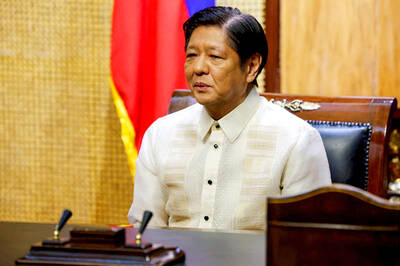
The Philippines would likely be involved in any conflict over Taiwan due to its proximity to the democracy claimed by China, President Ferdinand Marcos Jr said, reiterating a stance that risks angering Beijing. “In the Philippines, we do not have a choice because Taiwan is so close to the Philippines and we have almost 200,000 Filipino nationals living and working in Taiwan,” Marcos said in an interview with Japanese media in Manila on Monday. The Philippine leader’s comments come ahead of a state visit to Japan next week, where he is to meet with Japanese Prime Minister Sanae Takaichi to discuss security


 RSS
RSS