


Earlier this month, the Ministry of National Defense announced plans to cut troop levels by 9,200 in light of “warmer” ties with China, saying the measure would not jeopardize national defense because Taiwan was seeking “more advanced” and “high-tech” weapons.
However, with five consecutive years of shrinking defense budgets, more than US$13 billion in arms purchases still in the pipeline, a modernizing Chinese military and a US administration that appears increasingly reluctant to provide Taiwan with the weapons it needs, is the ministry’s optimism realistic or merely a smokescreen?
When asked to comment on the state of Taiwan’s defenses and how the nation could do more with a limited budget, in several instances, several defense experts made the case against high-profile expensive platforms in favor of smaller, relatively inexpensive and in many cases domestically produced asymmetrical options.
“Taiwan is on a peacetime footing budget-wise, even as its strategic plight worsens,” said James Holmes, associate professor of strategy at the US Naval War College and co-author of Red Star Over the Pacific.
“Three percent of GDP is not a serious budget for a nation facing mortal peril,” Holmes said of the goal set by President Ma Ying-jeou (馬英九), which has not been reached as the level of spending has dropped since Ma came into office in 2008, settling at about 2.2 percent of GDP for the current financial year.
In Holmes’ view, the Ma administration is allowing numbers to drive strategy and determined structure.
“The notion of substituting technology for large numbers of bodies is a seductive one, but is Taipei just trying to justify predetermined budget cuts or has it developed a strategy of island defense that can be executed with far fewer troops?” he asked.
“It sounds like the former,” Holmes said.
Normandy, France, or Okinawa, Japan, should be the frame of reference for Taiwan’s defense strategy, he said, with a future war -representing nothing less than a battle for national survival.
“Even assuming the US authorizes sales of the items Taipei wants, the present, meager defense budget would rule out purchases of high-tech arms in adequate numbers,” he said.
For Wendell Minnick, Asia bureau chief at Defense News, the ministry’s rhetoric was yet another attempt to demonstrate calm to the Taiwanse public that is increasingly concerned about continued threats from China.
“Its solution to a reduction in manpower is magic swords to slay the dragon, [but] every US military commander knows that training, maintenance and logistics win wars,” he said.
“It helps to have a magic bullet or two, but it also helps to keep the gun that fires it clean and operational,” he said.
“Taiwan’s military budget is being squeezed as defense budgets decline and costs rise with the recent acquisition of about US$13 billion worth of new arms in the pipeline. The streamlining and reorganization plan is now delayed for the next three years due to this issue,” Minnick said. “Training will be reduced as will the move from conscription to an all-volunteer force.”
Ma promised during his electoral campaign in 2008 that he would seek to create an all--volunteer military by 2014, a very expensive endeavor by any measure.
Patriot PAC-3 missile systems, P-3C Orion aircraft, early-warning radar, F-16C/Ds and submarines are among the items that are believed to be part of the ministry’s high-tech shopping list. Several of those platforms were first offered by former US president George W. Bush’s administration nearly a decade ago and may no longer reflect the scope of the military threat that China represents today, as the US-Taiwan Business Council noted in a report recently.
“To make matters worse, Taiwan’s military has a throw-away attitude with arms. It has delayed refits or upgrades for the F-16A/Bs, LaFayette frigates and Dutch-built submarines for many years,” Minnick said. “It’s hard to justify new arms deals when you ignore maintenance.”
“But then again, it’s all about the symbology of new arms from the US,” rather than actual needs, he said.
Aside from F-16C/Ds, for which the Ma administration has made repeated requests, PAC-3 and submarines, other high-tech weapons Taiwan could seek to acquire include a land or sea-based system equivalent of the Aegis combat system and SLAMRAAM, a surface-launched version of the Advanced Medium-Range Air-to-Air Missile fire-and-forget air-to-air missile the US has already sold to Taiwan.
Most analysts seemed to agree that rather than aim for highly symbolic platforms, such as F-16C/Ds, Taiwan ought to focus more on less expensive, though by no means less effective, weapons to counter an attack.
Roger Cliff, an independent defense researcher, said expensive platforms such as F-16C/Ds and US$1 billion submarines were probably not good choices.
“Taiwan should take advantage of the fact that it is an island and only needs the ability to defend itself from attack, not the ability to invade and conquer an adversary, in making decisions about what types of military capabilities to develop,” he said.
Many such systems, Cliff said, would be relatively inexpensive.
“I won’t criticize the decision to acquire the PAC-3 system, since the decision has already been made and it is probably useful to introduce some uncertainty into Chinese ballistic missile target planning,” Cliff said of the expensive air defense system. “However, I would not commit additional money to active missile defenses [and] instead would direct any additional missile defense funds toward passive defenses — fortification, hardening and dispersal.”
For defense against an -amphibious attack, Cliff said, Taiwan should invest in rapidly deployable sea mines, small unmanned aerial vehicles (UAV) for finding and targeting an invading fleet and truck-mobile and helicopter-borne radar to perform similar functions. Precision anti-armor howitzer rounds like the US Copperhead would be desirable, as would large numbers of man-portable mounted anti-armor weapons, such as the US-made Javelin. Furthermore, given Taiwan’s difficult topography, such systems would negate slower Chinese armor and would be more cost-effective than investing in expensive main battle tanks,” Cliff said.
“These systems, all of which could be acquired in large numbers at relatively low cost, would make an attack on or invasion of Taiwan an extremely daunting prospect for China,” he said.
Facing tight budgetary constraints and procurement options that for the foreseeable future would continue to be largely limited to the US, the experts were also of the opinion that Taiwan should dedicate more resources to asymmetrical and indigenous programs.
For many, ballistic and cruise missiles are key, as would be surveillance platforms and other asymmetric capabilities.
“There is a plausible way for the Ma administration to square the contradiction of declining defense budgets and personnel with the purchase of ostensibly more expensive high-tech weapons: buying [or developing] more ballistic and cruise missiles,” said Rick Fisher, a senior fellow at the International Assessment and Strategy Center in Washington.
Two Taiwanese-designed missiles that could achieve that goal, Fisher said, are the Hsiung Feng IIE cruise missile and Hsiung Feng III (HF-3) ramjet-powered anti-ship missile. Echoing Fisher, Cliff also recommended that those missiles be mounted on trucks and fast attack boats.
Although in its second term the Bush administration denied Taiwan access to certain parts required in the development of those missiles, Fisher said he did not see such constraints as posing too formidable a challenge to Taiwan. In fact, Deputy Minister of National Defense Chao Shih-chang (趙世璋) told the legislature in December last year that Taiwan was now mass-producing cruise missiles and that problems with key parts and components that had previously stalled manufacturing had been tackled.
“The HF-3 is especially useful as it can threaten China’s invasion-centric strategy,” Fisher said. “If the People’s Liberation Army [PLA] cannot guarantee a successful invasion, then [it] is much less likely to opt for an attack.”
To counter possible Chinese countermeasures, such as field laser and rail-gun weapons, Fisher said Taiwan should increase the number of missile warheads aimed at invading forces. One option would be a multiple-version of the Army Tactical Missile System (ATACMS) short-range ballistic missile developed by Lockheed Martin. One version can carry up to nine independently targeted warheads, which, added to its high maneuverability, makes it ideal for damaging large amphibious ships or destroying smaller ones, he said.
“For the price of 66 F-16C/D fighters, Taiwan could opt to purchase nearly 1,000 ATACMS,” Fisher said.
For the moment, this option would likely be off the table, as the US Department of State refuses to sell Taiwan “offensive” weapons, including ballistic missiles and certain components. Without presidential direction, Fisher said he saw no prospect of this policy changing anytime soon.
“This is the most inexpensive and least personnel intensive way to keep the PLA at bay,” he said.
For retired US commander William Murray, associate research professor at the US Naval War College and the proponent of the controversial “porcupine defense” strategy, Taiwan’s countermeasures need not necessarily be high-tech.
Decoys that could “seduce” -China’s limited numbers of -precision-guided munitions could play a substantial role in helping Taiwan survive an initial bombardment, he said. Taiwan would also benefit from a large inventory of mobile, land or fast sea-based anti-ship cruise missiles receiving targeting information from surveillance platforms, such as helicopters and UAVs, a concept supported by Cliff.
Slightly more high-tech would be laser-guided rockets or artillery rounds, which could be effective in keeping an invading force at a distance, Murray said, though he admitted that their employment would probably require an airborne-designator, which would have to operate in an environment saturated with Chinese countermeasures, such as surface-to-air missiles and anti-aircraft artillery.
Murray also pointed to the need for a survivable integrated air defense system, which should emphasize mobility and enough lethality to prevent the PLA fixed-wing tactical aircraft from delivering precision-guided munitions against critical targets in Taiwan. As such, any future acquisition of surface-to-air missiles should be truck-mounted and accompanied by a number of high-fidelity decoys, he said.
“[Those systems] are purely defensive in nature. They are relatively affordable in large numbers [and] they are more useful during a military conflict than are a handful of big-ticket items like F-16s and submarines or large surface warships,” Murray said.
“They are lethal and survivable,” he said, attributes that “would help reinforce the deterrence that kept the Taiwan Strait relatively peaceful.”
Presenting a credible, affordable and realistic deterrent would not necessarily involve headline-making weapons systems. What is more certain is that credible deterrence could be key to peace with China, not detrimental to it.
“Let’s recall the words of the strategist Al Capone: You get better results with a kind word and a gun than with a kind word alone,” Holmes said.
Note: The views expressed by the experts interviewed for this article are theirs alone and do not necessarily reflect the views of the US government.
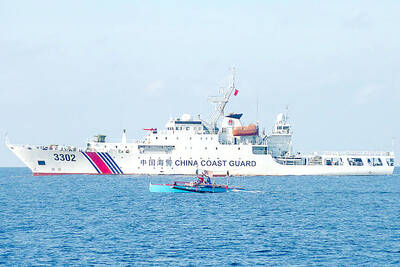
EXPANSIONIST: China deploys an average of 40 to 50 warships and coast guard vessels daily in the South China Sea, despite pledges not to militarize the region, an official said China is attempting to expand its influence across the First Island Chain and increase pressure on Japan by sending coast guard vessels into waters off of Taiwan under the pretext of maritime negotiations with Japan and the Philippines, a national security official said yesterday. China’s recent actions in the waters east of Taiwan and Japan and the Philippines’ exclusive economic zones (EEZ) are attempts to establish dominance in First Island Chain waters, said the official who declined to be named, adding that this is “expansion disguised as law enforcement.” Framing China’s actions solely as a cross-strait issue is a serious misjudgment that
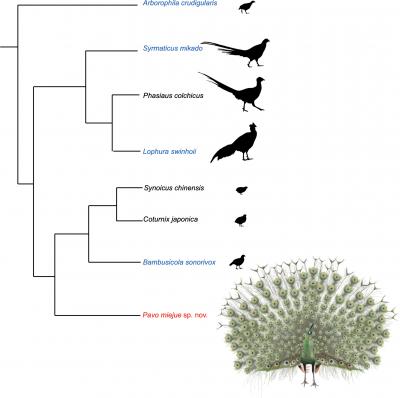
Through analyzing fossil evidence, a research team at National Taiwan University (NTU) discovered the largest endemic bird to have lived in Taiwan, naming it Pavo miejue, or extinct peafowl (滅絕孔雀). The Mikado pheasant, which is printed on the back of the NT$1,000 bank note, was previously believed to be the biggest endemic bird to Taiwan. The research team’s findings suggest that Pavo miejue lived during the Pleistocene epoch tens of thousands of years ago. It is the first endemic extinct bird species discovered and formally named in Taiwan. The study was coauthored by NTU Institute of Ecology and Evolutionary Biology professor Tsai Cheng-hsiu (蔡政修),
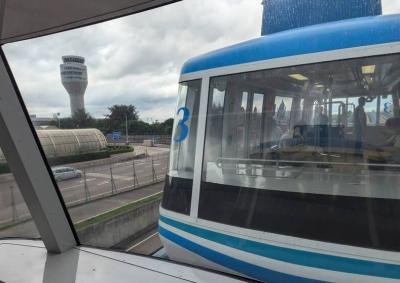
Taiwan Taoyuan International Airport is to suspend its automated Skytrain service connecting Terminal 1 and Terminal 2 starting on July 1 to facilitate connection works for the upcoming Terminal 3, the airport operator said today. Passengers and staff who need to travel between the two terminals after the suspension can instead use the Taoyuan MRT or the airport's 24-hour shuttle bus service, Taoyuan International Airport Corp said. The Taoyuan MRT Airport Line directly links the two terminals, while the shuttle buses are to operate around the clock, the company added. The Skytrain provides free transportation between the airport’s two terminals for travelers and
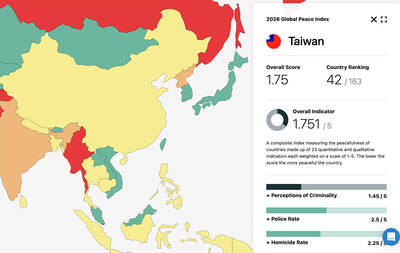
Taiwan ranked 42nd in terms of peacefulness among 163 countries, down five places from last year, according to this year’s Global Peace Index. With an overall score of 1.751, Taiwan dropped from 37th last year, the report published by the global Institute for Economics and Peace showed. The overall score measures a country’s level of peacefulness using 23 quantitative and qualitative indicators across three domains — ongoing domestic and international conflict, societal safety and security, and militarization. While Taiwan ranked 42nd worldwide, it was listed in ninth place among the 19 Asian-Pacific countries in the report, after New Zealand, Singapore, Japan, Malaysia,


 RSS
RSS