

The environmental impact assessment review process for the Taipei Dome construction project was delayed until next month following a four-hour meeting, as several dozen environmental activists and local residents voiced concerns about the proposed complex’s impact on local traffic and the overall environment.
Taipei City’s Environmental Impact Assessment Review Committee has turned down the environmental impact assessment report three times since 2007. The fourth committee meeting held yesterday at the Taipei City Hall failed to finish the review process of the revised project plan after more than half of the 20 committee members left the meeting that was marked by disapproval from environmental activists and local residents.
“The size of the Taipei Dome in the revised plan only shrank 3 percent when compared with the original plan, which makes little difference to the negative impact on traffic and the environment. We want the city government to revoke the contract and stop the development project,” said Yu Yi (游藝), head of a civic group that is calling for the preservation of the factory site, during the committee meeting.
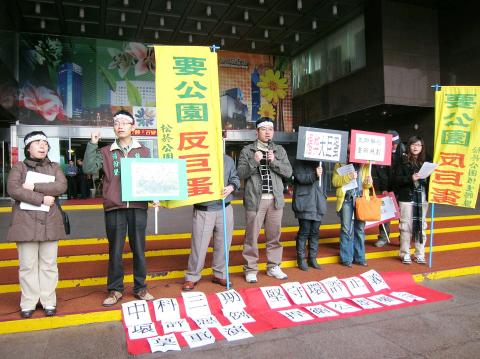
Photo: Lin Hsiang-mei, Taipei Times
Pan Pei-chun (潘佩君), the parent of a student at Taipei Municipal Guangfu Elementary School, which is next to the proposed site on the corner of Zhongxiao E Road and Guangfu S Road, said many parents at the school were concerned about the noise and pollution that would be caused by the construction.
Trucks going in and out of the construction site could also pose a danger to children, she added.
Farglory chairman Chao Teng-hsiung (趙藤雄), who attended the committee meeting, rejected the protesters’ claim that the building would have a negative impact on the environment and insisted that its revised Taipei Dome project, which lowered the building coverage ratio from 60 percent to 55 percent and offered more pedestrian space, would be an eco-friendly complex that would strike a balance between urban development and environmental protection.
“Building domes in downtown areas is a global trend and stopping the Taipei Dome development project should not be an option. The stalling of the project has become a joke and it’d be unbelievable if the project was denied,” he said while leaving the meeting.
Taipei City’s Department of Environmental Protection commissioner Wu Sheng-chong (吳聖忠) said the department would gather committee members together some time next month to complete the review process.
The proposed complex would include a 40,000-seat indoor stadium with surrounding shopping and residential districts. Construction is scheduled to begin in July if it passes the environmental impact assessment.
The group signed the contract with the city government in 2006 and plans to invest more than NT$23 billion (US$700 million) in the complex. Since then, ongoing protests from environmentalists and local residents have stalled the review process.
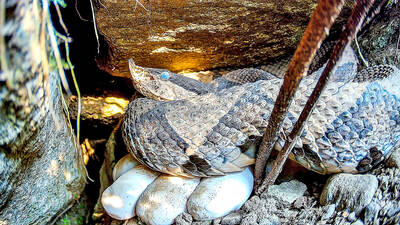
NATURE TAKES ITS COURSE: The agency’s head said he felt a sense of loss watching red-banded snakes eat the babies, as they had decided on non-intervention The Forestry and Nature Conservation Agency yesterday released a documentary on a hundred-pace viper that had incubated 16 eggs, all of which hatched, but only a baby viper escaped after they were attacked by red-banded snakes. The agency’s Taichung branch last year launched the viper reproduction monitoring project soon after forest rangers Lin Chun-yu (林俊佑) and Chou Chia-cheng (周家成) spotted a pregnant hundred-pace viper in a grass-covered burrow near a parking lot in Tbulan Village (松鶴部落). The Atayal village, in Taichung’s Heping District (和平), is headed by Ecyang Yapu, who was positive about the project and assisted in access control and power
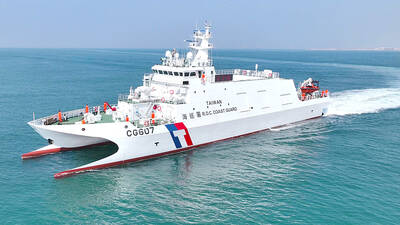
The Coast Guard Administration (CGA) yesterday said that it had deployed vessels to “monitor” Chinese ships operating in waters off the east coast. The CGA said it dispatched vessels in response to a China Coast Guard announcement that it had carried out another “routine law-enforcement patrol” in waters off the east coast. “The CGA firmly rejects China’s cognitive warfare campaign of ‘law enforcement in name, jurisdictional expansion in practice,’” it said on X. As of 11am yesterday, two China Coast Guard ships were “loitering and drifting” about 105 nautical miles (195km) and 74 nautical miles east of Green Island (綠島) respectively, it said. It
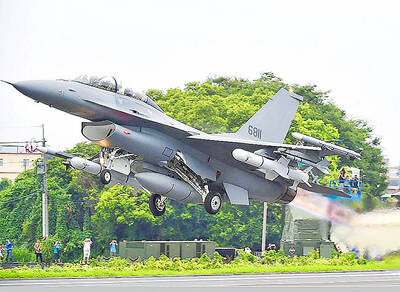
A sharp rise in compensation to be paid by air force officers who leave before completing their required service could indicate an increase in pilots leaving the military early, an analyst said on Friday, warning that the trend could worsen a shortage of experienced personnel. Chieh Chung (揭仲), a researcher at the Association for Strategic Foresight, issued the warning even though the number of volunteer military personnel is expected to increase next year. The planned headcount for volunteer military personnel, covering officers, noncommissioned officers (NCO) and enlisted soldiers, is 158,223 for next year, up 4,258 from 153,965 this year, Chieh said. The increase
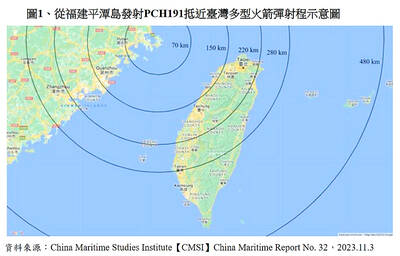
Potential improvements to munitions used by China’s long-range rocket-artillery units could extend their range to cover the entire Miyako Strait, which might give the Chinese People’s Liberation Army (PLA) the ability to secure the strategic waterway, the Mainland Affairs Council (MAC) said in a report. The PLA’s long-range rocket-artillery units deployed along the Taiwan Strait are concentrated along the coast of Fujian Province, including Changle, Pingtan and Shishi, the quarterly report on China said. The artillery brigades of the PLA’s 71st, 72nd and 73rd group armies have been deployed, with preparations for potential battlefield operations under way since August 2022, the report


 RSS
RSS