


Greater Kaohsiung prosecutors yesterday said they had no position on whether former first lady Wu Shu-jen (吳淑珍) should serve a lengthy jail sentence until she reports to Taichung Prison’s Pei Teh Hospital on Friday to undergo an evaluation, which will determine if she is fit enough to serve her term.
Wu’s son, Chen Chih-chung (陳致中), said he hoped doctors at the hospital would visit Wu in Greater Kaohsiung to assess her health rather than force her to travel to Greater Taichung.
Chen said his family was deeply worried because his mother, who is paralyzed from the waist down, cannot care for herself.
Following legal procedures, Wu, who lives in Greater Kao-hsiung, will be driven by ambulance to the Kaohsiung District Prosecutors’ Office, from where prosecutors will accompany her to Pei Teh Hospital.
If it is determined that the former first lady is well enough to serve time, she would begin serving her sentence immediately after the evaluation. Otherwise, she would be sent back home until it is determined when she should start serving her sentence.
Prosecutor General Huang Shih-ming (黃世銘) said the exam at Pei Teh Hospital was the only way to determine whether she had to begin her prison term immediately, adding that according to the law, those convicted of crime are not allowed to serve their jail term at home.
The Supreme Court in November ruled that Wu and her husband, former president Chen Shui-bian (陳水扁), should serve a total of 19 years in jail for taking bribes during his term as president.
Chen Shui-bian, who had been held at a detention center since late 2008, was moved to Taipei Prison in Taoyuan County on Dec. 2 to begin serving his sentence.
Meanwhile, Democratic Progressive Party (DPP) lawmakers said they opposed Wu’s prison sentence, adding that they were not asking for “special treatment,” but saying that the law had special provisions for individuals with health problems like Wu.
During a press conference, DPP lawmakers — including several with close ties to the former first family — cited statistics showing that over the past year, prison officials had refused to take four prisoners into custody for health reasons.
One of them, Gao Jyh-peng (高志鵬) said, had a condition similar to Wu, including cervical spine injuries and was unable to take care of himself without assistance.
Wu was paralyzed and became wheelchair-bound after being repeatedly run over during a political event for her husband in 1985.
“The government should not make a special case for Wu just because she is a member of the Chen family,” Gao said, adding however: “Her condition is just not suited for prison.”

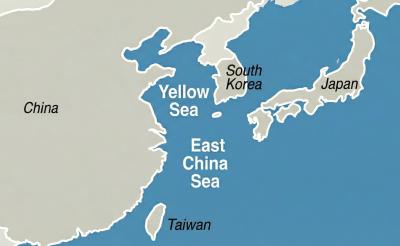
China has reserved offshore airspace in the Yellow Sea and East China Sea from March 27 to May 6, issuing alerts usually used to warn of military exercises, although no such exercises have been announced, the Wall Street Journal (WSJ) reported yesterday. Reserving such a large area for 40 days without explanation is an “unusual step,” as military exercises normally only last a few days, the paper said. These alerts, known as Notice to Air Missions (Notams), “are intended to inform pilots and aviation authorities of temporary airspace hazards or restrictions,” the article said. The airspace reserved in the alert is

NAMING SPAT: The foreign ministry called on Denmark to propose an acceptable solution to the erroneous nationality used for Taiwanese on residence permits Taiwan has revoked some privileges for Danish diplomatic staff over a Danish permit that lists “Taiwan” as “China,” Eric Huang (黃鈞耀), head of the Ministry of Foreign Affairs’ Department of European Affairs, told a news conference in Taipei yesterday. Reporters asked Huang whether the Danish government had responded to the ministry’s request that it correct the nationality on Danish residence permits of Taiwanese, which has been listed as “China” since 2024. Taiwan’s representative office in Denmark continues to communicate with the Danish government, and the ministry has revoked some privileges previously granted to Danish representatives in Taiwan and would continue to review

More than 6,000 Taiwanese students have participated in exchange programs in China over the past two years, despite the Mainland Affairs Council’s (MAC) “orange light” travel advisory, government records showed. The MAC’s publicly available registry showed that Taiwanese college and university students who went on exchange programs across the Strait numbered 3,592 and 2,966 people respectively. The National Immigration Agency data revealed that 2,296 and 2,551 Chinese students visited Taiwan for study in the same two years. A review of the Web sites of publicly-run universities and colleges showed that Taiwanese higher education institutions continued to recruit students for Chinese educational programs without
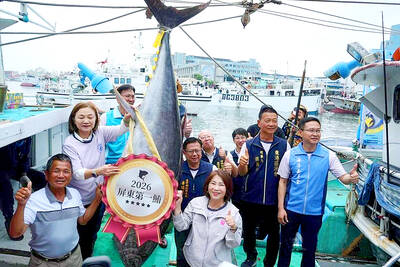
The first bluefin tuna of the season, brought to shore in Pingtung County and weighing 190kg, was yesterday auctioned for NT$10,600 (US$333.5) per kilogram, setting a record high for the local market. The auction was held at the fish market in Donggang Fishing Harbor, where the Siaoliouciou Island-registered fishing vessel Fu Yu Ching No. 2 delivered the “Pingtung First Tuna” it had caught for bidding. Bidding was intense, and the tuna was ultimately jointly purchased by a local restaurant and a local company for NT$10,600 per kilogram — NT$300 ,more than last year — for a total of NT$2.014 million. The 67-year-old skipper


 RSS
RSS