


The northwestern seashore, from Taoyuan County to Hsinchu County, is retreating as a result of human activity, the Ministry of Economic Affairs’ Central Geological Survey (CGS) said.
The latest survey report, released last year, showed that the coastline south of Datan Village (大潭) in Guanyin Township (觀音), Taoyuan County, and the section of coastline from Hukou Township (湖口), Hsinchu County, to Siangshan District (香山) in Hsinchu City was retreating.
CGS Director Lin Chao-tsung (林朝宗) said such erosion could have been caused by manmade structures along the coast, such as the Datan Power Station and the Hsinchu Fishing Harbor.
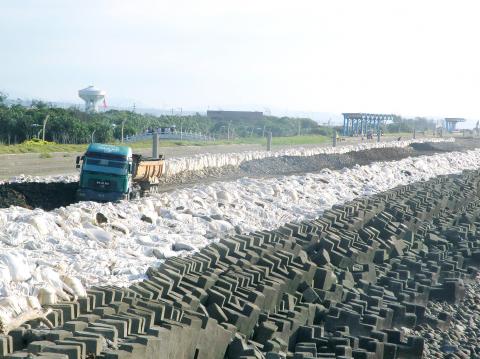
Photo: Hung Mei-hsiu, Taipei Times
While some sections of Taiwan’s coastline are retreating, the report shows there are also sections of shoreline pushing outward into the sea.
As manmade structures change the course of rivers, the sand and soil carried downstream settles only on the banks of a river mouth without manmade structures, making coastlines shrink on one side, but grow on the other, he said.
Under normal circumstances, the coastline should be growing evenly, Lin said.
The CGS said the government should take a series of measures to prevent extensive shrinking of coastlines.
Although concrete blocks are now piled along coastlines to prevent erosion, Lin said that concrete blocks would only work for a limited period of time and erosion would still occur sooner or later.
He said the best way to prevent erosion would be to make better plans before building anything along the coast.
The latest report released by the Ministry of the Interior’s Construction and Planning Agency showed that as of last year, Taiwan had 1,321.9km of coastline, or 3km more than in 2008. However, this was the result of manmade structures, as cemented coastline — including embankment, harbor and reclaimed lands — had grown 3km since 2008.
At the moment, 55.5 percent of Taiwan’s coastline has been cemented, about 0.1 percent more than in 2008.
As climate change progresses, sea levels continue to rise, Lin said, and the concept of reclaiming land from the sea should be changed, since experts are becoming more uncertain about how long manmade structures will last.

In a historic first, Taiwanese officials participated in this year’s Riga Strategic Communications Dialogue in Latvia from Wednesday to Friday last week, which debuted a breakout session focused on Taiwan The event organizer, the NATO Strategic Communications Center of Excellence, displayed Taiwan’s national flag and the officials’ formal titles on their Web site. Taiwanese attendees included National Security Council (NSC) Deputy Secretary-General Lin Fei-fan (林飛帆) and deputy head of the Taipei Representative Office in the UK, Chiang Ya-chi (江雅綺). In addition to the session discussing Taiwan titled “Taiwan: Navigating Strategic Communication in a Tense Environment,” the dialogue also included sessions
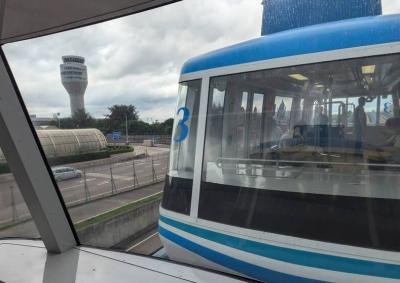
Taiwan Taoyuan International Airport is to suspend its automated Skytrain service connecting Terminal 1 and Terminal 2 starting on July 1 to facilitate connection works for the upcoming Terminal 3, the airport operator said today. Passengers and staff who need to travel between the two terminals after the suspension can instead use the Taoyuan MRT or the airport's 24-hour shuttle bus service, Taoyuan International Airport Corp said. The Taoyuan MRT Airport Line directly links the two terminals, while the shuttle buses are to operate around the clock, the company added. The Skytrain provides free transportation between the airport’s two terminals for travelers and
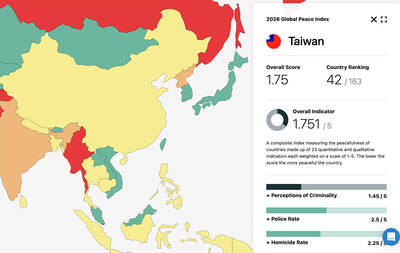
Taiwan ranked 42nd in terms of peacefulness among 163 countries, down five places from last year, according to this year’s Global Peace Index. With an overall score of 1.751, Taiwan dropped from 37th last year, the report published by the global Institute for Economics and Peace showed. The overall score measures a country’s level of peacefulness using 23 quantitative and qualitative indicators across three domains — ongoing domestic and international conflict, societal safety and security, and militarization. While Taiwan ranked 42nd worldwide, it was listed in ninth place among the 19 Asian-Pacific countries in the report, after New Zealand, Singapore, Japan, Malaysia,

TOKYO-MANILA DELIMITATION TALKS: Beijing is attempting to use this opportunity to normalize patrols and law enforcement in the waters east of Taiwan, MOFA said China has no law enforcement authority over the waters east of Taiwan, the Ministry of Foreign Affairs (MOFA) said yesterday, accusing China of undermining regional peace and stability. The Chinese Ministry of Transport on Saturday evening announced that it had launched a “special maritime law enforcement operation” in the waters east of Taiwan, dispatching coast guard vessels to engage in illegal enforcement activities, the ministry said. State-run Xinhua news agency said the operation was “a necessary action taken in response to Japan and the Philippines unilaterally announcing the initiation of maritime boundary delimitation negotiations in the waters east of China’s Taiwan island,


 RSS
RSS