


The Ministry of Education (MOE) yesterday approved a draft amendment to the regulations for Studying and Counseling Assistance for Overseas Compatriot Students in Taiwan (僑生回國就學及輔導辦法) to extend the amount of time these students can visit Taiwan.
The amendment proposes to extend the maximum length of stay every year from 90 to 120 days to meet the students’ needs regarding family visits and vacations.
The amendment also seeks to relax the requirement on overseas compatriot students entering graduate schools for working professionals, allowing only those who have obtained legal residency, not as a student, to file an application for such schools.
Currently, the students are barred from applying for graduate programs for working professionals for fear they could try to obtain residency in Taiwan through enrolment in such programs.
If approved by the legislature, the amendment would allow universities and colleges that have received permission to begin to recruit overseas Taiwanese compatriots and allow such students to apply for programs directly with the schools.
At present, the students can only file applications to return to Taiwan for study and provide a priority list of the schools they are interested in to embassies, consulates, representative offices or organizations authorized by the Ministry of Foreign Affairs.
The proposal also seeks to modify the requirement that overseas compatriot students provide formal consent from guardians living in Taiwan. The proposed amendment would exempt students older than 20 from such a requirement.
The draft also proposes to allow universities and colleges to fill their local student vacancies by recruiting overseas compatriots.
To prevent compatriots from working illegally while in Taiwan, the amendment would require obliging schools and the Council of Labor Affairs to immediately deal with students found to have worked illegally. Schools that fail to comply would see their number of vacancies for overseas compatriots cut.
The draft would also allow talented compatriots to stay in Taiwan for internships after graduation rather than requiring that they leave the country after graduation, suspension of studies or expulsion.
Meanwhile, a ministry official said that the government had decided it would allow public universities to merge as student numbers continue to shrink because of the nation’s low birthrate.
Two planned mergers, one of them involving National Taiwan University, are likely to go ahead after the legislature passed a bill on Monday allowing colleges to team up to better utilize resources, the official said.
The bill came after a recent forecast predicted that about 60 colleges out of the current 164 could close by 2021 because of a shortage of students.
About 300,000 high-school graduates are eligible to apply for college each year, but the number is expected to drop to 195,000 in 2021, demographic forecasts show.
ADDITIONAL REPORTING BY AFP

Yangmingshan National Park authorities yesterday urged visitors to respect public spaces and obey the law after a couple was caught on a camera livestream having sex at the park’s Qingtiangang (擎天崗) earlier in the day. The Shilin Police Precinct in Taipei said it has identified a suspect and his vehicle registration number, and would summon him for questioning. The case would be handled in accordance with public indecency charges, it added. The couple entered the park at about 11pm on Thursday and began fooling around by 1am yesterday, the police said, adding that the two were unaware of the park’s all-day live

Fast food chain McDonald's is to raise prices by up to NT$5 on some products at its restaurants across Taiwan, starting on Wednesday next week, the company announced today. The prices of all extra value meals and sharing boxes are to increase by NT$5, while breakfast combos and creamy corn soup would go up by NT$3, the company said in a statement. The price of the main items of those meals, if ordered individually, would remain the same. Meanwhile, the price of a medium-sized lemon iced tea and hot cappuccino would rise by NT$3, extra dipping sauces for chicken nuggets would go up
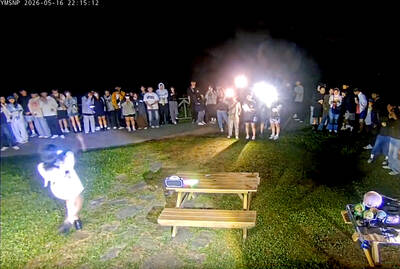
Yangmingshan National Park’s Qingtiangang (擎天崗) nature area has gone viral after a park livestream camera observed a couple in the throes of intimate congress, which was broadcast live on YouTube, drawing large late-night crowds and sparking a backlash over noise, bright lights and disruption to wildlife habitat. The area’s livestream footage appeared to show a couple engaging in sexual activity on a picnic table in the park on Friday last week, with the uncensored footage streamed publicly online. The footage quickly spread across social media, prompting a tide of visitors to travel to the site to “check in” and recreate the

Minister of Digital Affairs Lin Yi-ching (林宜敬) yesterday cited regulatory issues and national security concerns as an expert said that Taiwan is among the few Asian regions without Starlink. Lin made the remarks on Facebook after funP Innovation Group chief executive officer Nathan Chiu (邱繼弘) on Friday said Taiwan and four other countries in Asia — China, North Korea, Afghanistan and Syria — have no access to Starlink. Starlink has become available in 166 countries worldwide, including Ukraine, Malaysia, the Philippines and Vietnam, in the six years since it became commercial, he said. While China and North Korea block Starlink, Syria is not


 RSS
RSS