


Construction of the new Fengyuan Railway Station in Greater Taichung is scheduled to be completed by 2016, which could stimulate development in the area, the Railway Reconstruction Bureau said yesterday.
Bureau Deputy Director Zhou Yong-huei (周永暉) said the new station was part of the bureau’s Taichung Metropolitan Area Overpass Railway Project.
The overpass will be about 21km long, Zhou said. As some sections will be built above existing railway tracks, the bureau will need to switch to a temporary route for the railways to facilitate construction, he said.
The bureau mobilized 1,550 workers for the track switch project, Zhou said, which was completed on Dec. 28. Two electricity relay rooms and about 20 railway signals have also been relocated to sites near the temporary route.
Fengyuan station handles about 17,000 railway passengers each day, or half that of the Banciao Railway Station in New Taipei City (新北市). The temporary route in Fengyuan is 1.72km long, he said.
After the switch, the second platform would be torn down to build the overpass railway tracks Zhou said. Fengyuan Station will be constructed on the overpass.
An architect has been hired to do a preliminary design of the new station, Zhou said.
As Fengyuan was historically renowned for its timber, the architect designed the station using log imagery, he said.
Meanwhile, Zhou said the overpass would help eliminate 17 railway crossings along the current railway route.
Following the merger of Taichung City and Taichung County into Greater Taichung, Fengyuan Station will function as the northern branch of Taichung Railway Station, he said.
“In the past, the front and rear of Fengyuan Station were not equally developed,” Zhou said. “After the station is elevated onto the overpass, the open space under the overpass will help increase and improve traffic flow between the two areas.”

AGING: While Japan has 22 submarines, Taiwan only operates four, two of which were commissioned by the US in 1945 and 1946, and transferred to Taiwan in 1973 Taiwan would need at least 12 submarines to reach modern fleet capabilities, CSBC Corp, Taiwan chairman Chen Cheng-hung (陳政宏) said in an interview broadcast on Friday, citing a US assessment. CSBC is testing the nation’s first indigenous defense submarine, the Hai Kun (海鯤, Narwhal), which is scheduled to be delivered to the navy next month or in July. The Hai Kun has completed torpedo-firing tests and is scheduled to undergo overnight sea trials, Chen said on an SET TV military affairs program. Taiwan would require at least 12 submarines to establish a modern submarine force after assessing the nation’s operational environment and defense

A white king snake that frightened passengers and caused a stir on a Taipei MRT train on Friday evening has been claimed by its owner, who would be fined, Taipei Rapid Transit Corp (TRTC) said yesterday. A person on Threads posted that he thought he was lucky to find an empty row of seats on Friday after boarding a train on the Bannan (Blue) Line, only to spot a white snake with black stripes after sitting down. Startled, he jumped up, he wrote, describing the encounter as “terrifying.” “Taipei’s rat control plan: Release snakes on the metro,” one person wrote in reply, referring

The coast guard today said that it had disrupted "illegal" operations by a Chinese research ship in waters close to the nation and driven it away, part of what Taipei sees a provocative pattern of China's stepped up maritime activities. The coast guard said that it on Thursday last week detected the Chinese ship Tongji (同濟號), which was commissioned only last year, 29 nautical miles (54km) southeast of the southern tip of Taiwan, although just outside restricted waters. The ship was observed lowering ropes into the water, suspected to be the deployment of scientific instruments for "illegal" survey operations, and the coast
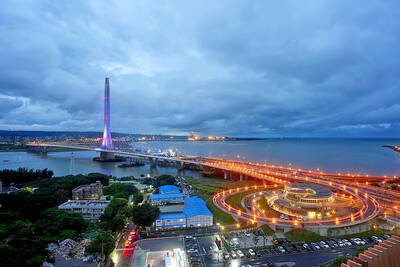
An inauguration ceremony was held yesterday for the Danjiang Bridge, the world’s longest single-mast asymmetric cable-stayed bridge, ahead of its official opening to traffic on Tuesday, marking a major milestone after nearly three decades of planning and construction. At the ceremony in New Taipei City attended by President William Lai (賴清德), Premier Cho Jung-tai (卓榮泰), Minister of Transportation and Communications Chen Shih-kai (陳世凱) and New Taipei City Mayor Hou Yu-ih (侯友宜), the bridge was hailed as both an engineering landmark and a long-awaited regional transport link connecting Tamsui (淡水) and Bali (八里)


 RSS
RSS