


The Kaohsiung City Government yesterday reminded residents seeking a temporary residence for their pets when they leave town to make sure they choose pet hotels that hold legal operating permits to avoid running foul of the law.
Economic Development Bureau Director-General Liu Hsin-cheng (劉馨正) told reporters the bureau had recently issued its first fine — NT$50,000 — against a well-known pet hotel that was operating without a permit.
Liu said owners who needed to leave their pets at a pet hotel often failed to ascertain whether the hotel has a legitimate operating permit.
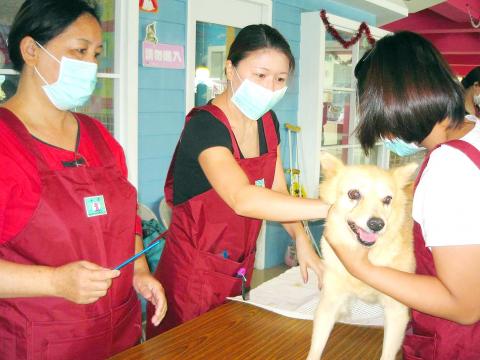
PHOTO: KE YU-HAO, TAIPEI TIMES
“Article 22 of the Animal Protection Act (動物保護法) requires that dog breeders or vendors or those who operate pet hotels obtain a legal permit,” Liu said.
Most of the public and businesspeople are aware that it is illegal to breed or sell dogs without a permit, but they have no idea that operating permits are also mandatory for pet hotels, Liu said.
“Therefore, it is illegal to run a private breeding dog house or provide family-style boarding services for dogs [without a permit],” Liu said.
Chu Chia-te (朱家德), director of the Kaohsiung Municipal Institute for Animal Health, said owners of pet hotels should also publicize the serial number of their operating permits when running advertisements.
Businesses that fail to follow regulations can be fined between NT$5,000 and NT$75,000, Chu said.
Sites advertising pet boarding services are becoming increasingly common on the Internet.
The National Taiwan University-run Professional Technology Temple, the nation’s largest university bulletin board system, even has a discussion board for people looking for such services.
Some service providers also run advertisements on online bidding Web sites such as Yahoo, providing family-style, cage-free boarding services at the cost of NT$100 per day.

LOUD AND PROUD Taiwan might have taken a drubbing against Australia and Japan, but you might not know it from the enthusiasm and numbers of the fans Taiwan might not be expected to win the World Baseball Classic (WBC) but their fans are making their presence felt in Tokyo, with tens of thousands decked out in the team’s blue, blowing horns and singing songs. Taiwanese fans have packed out the Tokyo Dome for all three of their games so far and even threatened to drown out home team supporters when their team played Japan on Friday. They blew trumpets, chanted for their favorite players and had their own cheerleading squad who dance on a stage during the game. The team struggled to match that exuberance on the field, with
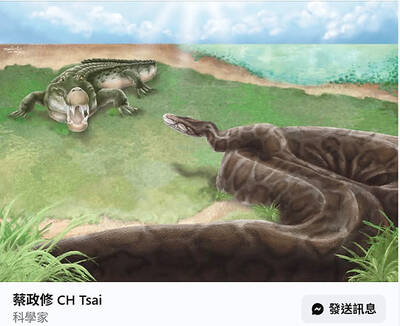
Taiwanese paleontologists have discovered fossil evidence that pythons up to 4m long inhabited Taiwan during the Pleistocene epoch, reporting their findings in the international scientific journal Historical Biology. National Taiwan University (NTU) Institute of Ecology and Evolutionary Biology associate professor Tsai Cheng-hsiu (蔡政修) led the team that discovered the largest snake fossil ever found in Taiwan. The single trunk vertebra was discovered in Tainan at the Chiting Formation, dated to between 400,000 and 800,000 years ago in the Middle Pleistocene, the paper said. The area also produced Taiwan’s first avian fossil, as well as crocodile, mammoth, saber-toothed cat and rhinoceros fossils, it said. Discoveries

Taiwanese paleontologists have discovered fossil evidence that pythons up to 4m long inhabited Taiwan during the Pleistocene epoch, reporting their findings in the international scientific journal Historical Biology. National Taiwan University (NTU) Institute of Ecology and Evolutionary Biology associate professor Tsai Cheng-hsiu (蔡政修) led the team that discovered the largest snake fossil ever found in Taiwan. A single trunk vertebra was discovered in Tainan at the Chiting Formation, dated to between 800,000 to 400,000 years ago in the Middle Pleistocene, the paper said. The area also produced Taiwan’s first avian fossil, as well as crocodile, mammoth, sabre-toothed cat and rhinoceros fossils, it said. Discoveries

Whether Japan would help defend Taiwan in case of a cross-strait conflict would depend on the US and the extent to which Japan would be allowed to act under the US-Japan Security Treaty, former Japanese minister of defense Satoshi Morimoto said. As China has not given up on the idea of invading Taiwan by force, to what extent Japan could support US military action would hinge on Washington’s intention and its negotiation with Tokyo, Morimoto said in an interview with the Liberty Times (sister paper of the Taipei Times) yesterday. There has to be sufficient mutual recognition of how Japan could provide


 RSS
RSS