


Striving to serve the local Taiwanese community and preserve the traditional culture of Taiwan, the Yokohama Overseas Chinese School asked visiting Lien Fang Yu (連方瑀), the wife of APEC envoy and former vice president Lien Chan (連戰) for help with the school’s development.
Arriving to a warm welcome as students of the school performed the traditional lion dance and waved the Republic of China flag, Lien Fang visited the Yokohama Overseas Chinese School — founded by Sun Yat-sen (孫逸仙) in 1897 — as part of her visit to Yokohama’s Chinatown.
Lien Fang arrived in Yokohama on Thursday, accompanying her husband, who is to take part today and tomorrow in APEC summit meetings on behalf of President Ma Ying-jeou (馬英九).
After the welcome ceremony, Lien Fang was briefed about the school by school president Shih Huei-chen (施惠珍), before she visited a fourth-grade classroom.
It was during the briefing that the school president told Lien Fang that the school was in constant financial hardship and asked her to deliver a message to the government in Taipei that the school needs more help.
“We’re always having financial difficulties,” Academic Affairs Office director Yang -Ching-huei (楊靜蕙), told the Taipei Times.
“Although we do receive some funds from the Overseas -Compatriots Commission, we depend mostly on tuition fees as a source of income,” she said. “Since our main goal is to serve the Taiwanese community here, we’re charging far less than most other Japanese schools.”
She said the Yokohama Overseas Chinese School charges ¥22,000 (US$268) per student per month at elementary and junior high school levels, and ¥25,000 per student per month at the high school level, while other private schools in Japan charge about ¥50,000 per student per month on average.
“Other than regular expenses, the buildings on campus need some serious renovation work. As you can see, these buildings are very old,” Yang said.
Yang is a retired teacher from Taiwan, who has devoted her time to serving overseas communities since her retirement, which led her to teach in Thailand before moving to Japan.
Although there are also Japanese students and ethnic Chinese students from other countries, 71 percent of the students are either from Taiwan or children of local Taiwanese families, which is the result of the schooling staying “focused,” said Chiang Pin-huei (江品輝), a teacher at the school who moved from Taiwan to Japan about a year ago.
Chiang said that since about half of the teachers are Japanese, both Japanese and Mandarin are used as the instructional languages of the school.
Another teacher at the school, Chang Ma-yun (張瑪雲), said that because of the lack of funds, teachers get paid very little and have to take on more than one person’s work.
“You asked which subject I teach, well, I teach everything because we don’t have enough money to hire more teachers,” Chang said.

The Ministry of Finance this afternoon announced the winning numbers for the March-April uniform invoice lottery. The winning number for the NT$10 million (US$318,060) special prize is 19531471, and the winning number for the NT$2 million grand prize is 85941329. Three numbers were drawn for the NT$200,000 first prize: 07225810, 20231230 and 83518781. Those with receipts matching the last seven digits of any of the first-prize numbers will win the NT$40,000 second prize, while those matching the last six digits will win the NT$10,000 third prize. Those whose receipts match the last five digits of the first-prize numbers can claim the NT$4,000 fourth prize,
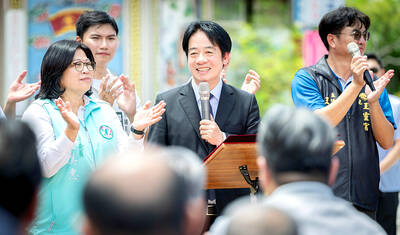
SIX SUBSIDIES: The monthly allowance for older farmers is to increase to NT$10,000, and NT$5,000 is to be given to homemakers under the national pension system, Lai said The government is to implement major welfare policies for disadvantaged groups, including raising the monthly allowance for older farmers to NT$10,000 and providing homemakers with NT$5,000 per month, President William Lai (賴清德) said yesterday. Lai made the remarks during a visit to Wangling Temple in Chiayi County, saying that the planned increases were being introduced amid economic growth and an increase in tax revenue. Touting a policy, in which the government plans to provide a monthly allowance of NT$5,000 for every child under the age of 18 in a bid to address Taiwan’s low birthrate, Lai said that if received for the
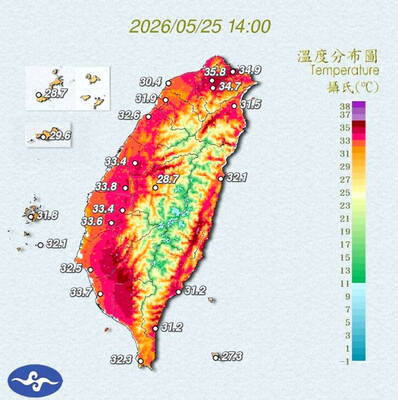
STAY COOL: The HPA recommended that people stay hydrated, use air-conditioning or fans while indoors, wear loose-fitting clothes and walk in the shade while outdoors Employers must implement measures such as installing cooling equipment, and providing drinking water and rest breaks for outdoor workers starting from Monday next week, the Taipei Department of Labor said on Sunday. Employers who fail to comply could face fines of NT$30,000 to NT$300,000 under the Occupational Safety and Health Act (職業安全衛生法), the department said. Businesses in Taipei employing fewer than 100 workers, as well as registered self-employed workers with labor insurance coverage, could receive on-site assessments and guidance from occupational safety consultants to help them apply for central government subsidies to implement or improve heat-protection measures, it said. Under the Ministry of
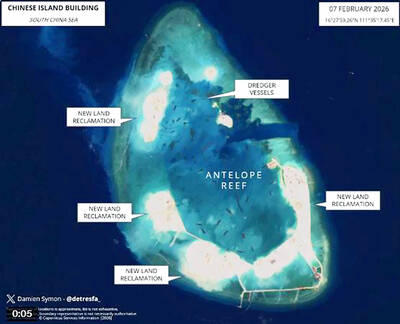
ISOLATION: The outposts would serve as support and backup bases, forcing US forces to either face China head-on or reroute, increasing travel time and operational costs China’s outposts in the South China Sea could be used to delay and constrain foreign forces during a conflict in the Taiwan Strait, giving Beijing a critical window to carry out amphibious landing and blockade operations, a report said. The Chinese Communist Party’s (CCP) forward operating bases on islands and reclaimed features in the South China Sea could delay foreign forces long enough for the Chinese People’s Liberation Army (PLA) to secure a key 48-to-72-hour window in the Taiwan Strait, a report commissioned by the Mainland Affairs Council found. The report, conducted by the Institute for National Defense and Security Research, examined


 RSS
RSS