


Although the Chinese Nationalist Party (KMT) government’s cross-strait policy has been a central pillar in President Ma Ying-jeou’s (馬英九) agenda, it has also generated mixed responses from political observers.
Some people have accused Ma of being too friendly to an enemy that harbors political and military ambitions to annex Taiwan — and losing sight of relations with the country’s most important strategic allies — the US and Japan.
Others believe that cross-strait detente is the only way forward and are happy that the two sides are working constructively to ease tensions.
This side also praises Ma’s cross-strait policy for what they claim helped improve relations with Washington and Tokyo.
Tang Shao-cheng (湯紹成), a research fellow at National Chengchi University’s Institute of International Relations, for one, praised the Ma administration’s cross-strait policy, saying it kept Taiwan’s relations with Beijing, Washington and Tokyo on an even keel.
Tang noted that during the presidency of former president Chen Shui-bian’s (陳水扁), cross-strait tensions not only “upset” Beijing, but Washington as well.
Ma has now changed the dynamics of the situation, replacing conflict with negotiations and confrontation with dialogue, he said.
“It conforms to the global trend,” he said. “In an age of globalization, countries compete with each other, but they also need to cooperate with each other. That is the way to go.”
Tang said he looks at Ma’s cross-strait policy from three perspectives.
“First, what does Taiwan want? Peace and prosperity and that it is pretty similar to what China wants,” he said.
“Second, what do Taiwan and China want? Both sides, again, want stability and peaceful development,” he said.
“Finally, what does the international community want?” he asked.
Taking the US as an example, Tang said Washington does not want war in the Taiwan Strait, but neither does it want to see Taiwan and China develop too close a relationship.
Washington might worry that closer cross-strait ties could leave it out in the cold or that once the two sides establish military confidence-building mechanisms, military technology might be transferred to China, he said.
Joseph Wu (吳釗燮), a former representative to the US and Mainland Affairs Council chairman under the Democratic Progressive Party (DPP) government, is one of those who worry about close relations with Beijing.
“Ma seems to have only China on his mind and pays very little attention to Japan and the US,” Wu said.
Over the past two years, Ma has made many people feel that he is not only incompetent, but also foolhardy, he said.
“If he continues to act this way, an increasing nimber of people will feel scared and his popularity will continue to fall,” Wu said.
The latest poll conducted by the Chinese-language Global Views Monthly magazine showed that trust in Ma fell to 37.1 percent, against a mistrust index of 44.7 percent.
Lo Chih-cheng (羅致政), a professor of political science at Soochow University, said Ma’s biggest mistake has been his inability to distinguish between friend and foe.
While the rest of the world does not want to see China as a threat, they do not forget that it is one. Ma, on the other hand, sees China as friendly sidekick, Lo said.
Former representative to Japan Koh Se-kai (許世楷) said the Taiwan Relations Act and the US-Japan strategic alliance serve as effective deterrents against China’s military ambitions.
However, when Ma told CNN that Taiwan would not ask the US to fight in a war on Taiwan’s behalf, Ma undermined the deterrent effect of that alliance.
“It can only serve Taiwan’s best interest for us to stand together with the US and Japan to counter China, not the other way around,” Koh said.
He said that once Taiwan’s economy becomes over-reliant on China, the country’s sovereignty could bery well be doomed.
Kenneth Lin (林向愷), a professor of economics at National Taiwan University, disagreed strongly with the administration’s prescription of an economic cooperation framework agreement (ECFA) as the only remedy for Taiwan’s economic woes.
Lin described the pact as an agreement paving the way for a “one China” market.
Once the deal is sealed, there would be a free flow of manpower, capital and professional skills across the Taiwan Strait, he said.
The Ma administration risks pushing Taiwan into a very dangerous situation if it becomes too reliant on China economically, he said.
Even Taiwan’s major competitor, South Korea, is ambivalent about signing a free-trade deal with China, preferring instead to sign such agreements with more developed countries, Lin said.
Tang, however, said Taiwan risked being marginalized if it did not sign the proposed accord with Beijing.
It was perfect timing to push the trade pact, he said, because politics always gets in the way during election periods — referring to the five special municipalities in November, legislative elections next year and the presidential election in 2012.
Tang said that while China could make some political concessions, it was unlikely Beijing would back down if its economic interests were threatened.

AGING: While Japan has 22 submarines, Taiwan only operates four, two of which were commissioned by the US in 1945 and 1946, and transferred to Taiwan in 1973 Taiwan would need at least 12 submarines to reach modern fleet capabilities, CSBC Corp, Taiwan chairman Chen Cheng-hung (陳政宏) said in an interview broadcast on Friday, citing a US assessment. CSBC is testing the nation’s first indigenous defense submarine, the Hai Kun (海鯤, Narwhal), which is scheduled to be delivered to the navy next month or in July. The Hai Kun has completed torpedo-firing tests and is scheduled to undergo overnight sea trials, Chen said on an SET TV military affairs program. Taiwan would require at least 12 submarines to establish a modern submarine force after assessing the nation’s operational environment and defense
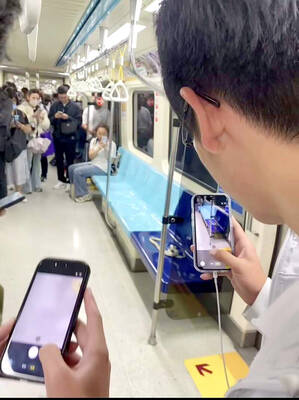
A white king snake that frightened passengers and caused a stir on a Taipei MRT train on Friday evening has been claimed by its owner, who would be fined, Taipei Rapid Transit Corp (TRTC) said yesterday. A person on Threads posted that he thought he was lucky to find an empty row of seats on Friday after boarding a train on the Bannan (Blue) Line, only to spot a white snake with black stripes after sitting down. Startled, he jumped up, he wrote, describing the encounter as “terrifying.” “Taipei’s rat control plan: Release snakes on the metro,” one person wrote in reply, referring

The coast guard today said that it had disrupted "illegal" operations by a Chinese research ship in waters close to the nation and driven it away, part of what Taipei sees a provocative pattern of China's stepped up maritime activities. The coast guard said that it on Thursday last week detected the Chinese ship Tongji (同濟號), which was commissioned only last year, 29 nautical miles (54km) southeast of the southern tip of Taiwan, although just outside restricted waters. The ship was observed lowering ropes into the water, suspected to be the deployment of scientific instruments for "illegal" survey operations, and the coast
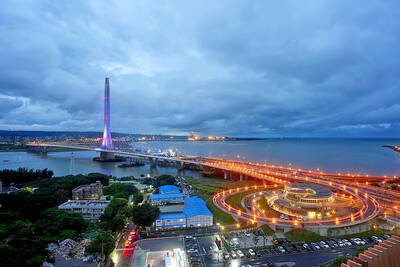
An inauguration ceremony was held yesterday for the Danjiang Bridge, the world’s longest single-mast asymmetric cable-stayed bridge, ahead of its official opening to traffic on Tuesday, marking a major milestone after nearly three decades of planning and construction. At the ceremony in New Taipei City attended by President William Lai (賴清德), Premier Cho Jung-tai (卓榮泰), Minister of Transportation and Communications Chen Shih-kai (陳世凱) and New Taipei City Mayor Hou Yu-ih (侯友宜), the bridge was hailed as both an engineering landmark and a long-awaited regional transport link connecting Tamsui (淡水) and Bali (八里)


 RSS
RSS