


■POLITICS
Cabinet reshuffle finalized
The government completed its reshuffle yesterday, with Premier Wu Den-yih (吳敦義) saying that Minister of Finance Lee Sush-der (李述德) would remain in his post, as would Financial Supervisory Commission (FSC) Vice Chairperson Lee Jih-chu (李紀珠), whom Wu said last week would leave the Cabinet. Asked why he changed his mind and kept Lee Jih-chu, Wu declined to comment on whether it was because she had told reporters on Thursday that President Ma Ying-jeou (馬英九) and Wu had offered her four different positions to step down as FSC vice chairperson. The reshuffle saw former FSC chairman Sean Chen (陳冲) succeed Eric Chu (朱立倫) as vice premier, while the former chairman of First Financial Holding Co, Chen Yuh-chang (陳裕璋), succeeded Sean Chen at the commission. Meanwhile, Christina Liu (劉憶如), former Chinatrust Financial Holding Co’s chief economic adviser, replaced Tsai Hsun-hsiung (蔡勳雄) as chair of the Council for Economic Planning and Development. Tsai refused the post of president of state-owned CPC Corp, Taiwan, a position vacant since September when Shih Yen-shiang (施顏祥) was appointed to lead the Ministry of Economic Affairs. Late last night, the Executive Yuan appointed Tsai as chief of Sinotech Engineering Inc, a government-funded non-profit organization dedicated to providing engineering consulting services.
■DIPLOMACY
MOFA prepares Thai plan
The Ministry of Foreign Affairs (MOFA) has prepared a contingency plan in response to the escalating conflict between protesters and the Thai government in Bangkok, with evacuation of Taiwanese expatriates the last resort, the ministry said yesterday. Spokesman Henry Chen (陳銘政) said the nation’s representative office in Thailand had prepared responses to different scenarios and evacuating Taiwanese expatriates in Thailand was merely one of the scenarios. Chen said the office had not activated the measure, but advised Taiwanese businesspeople and other expatriates in Bangkok to stay in touch with each other. When asked under what circumstances the ministry would begin an evacuation, Chen said the measure would be implemented when expatriates’ lives are in danger. The ministry raised the level of its travel alert for Bangkok to “red” on Friday, advising people to avoid traveling to Bangkok after the US and the UK closed their embassies amid an upsurge in violence between security forces and protesters.
■TRANSPORTATION
KRTC expects to trim losses
Kaohsiung Rapid Transit Corp (KRTC), which has been in the red since the Kaohsiung MRT opened in 2008, expects its losses to fall by about NT$100 million (US$3.14 million) this year because of increasing passenger volume. According to KRTC figures, the metro system carried 15.3 million passengers in the first four months of the year, up 5.8 percent from a year earlier. “The daily average passenger volume rose by about 7,000 passengers [to 127,000] during the four-month period,” a KRTC official said. “If the growth is sustained for the rest of the year, we expect the loss for 2010 to be nearly NT$100 million less than last year,” he said. Passenger numbers were still far short of the 300,000 per day that the company has said it would need to break even. Last year, the Kaohsiung metro system incurred a loss of NT$1.54 billion after receiving a subsidy from the Kaohsiung City Government.

FUKUOKA SITUATION: Japanese media reported that the pathogen is expected to be identified by the summer, while the CDC downplayed the idea that it was hMPV A “mysterious cold-like illness” reported in Japan’s Fukuoka Prefecture does not seem to be a new disease, but Japanese authorities have been asked about the situation, the Centers for Disease Control (CDC) said yesterday. The Fukuoka Prefectural Medical Association on Wednesday told a news conference that a “mystery cold” that has become a hot topic on social media is “highly likely to be caused by some kind of viral infection,” Japan’s KBC News reported. “Many people are experiencing symptoms starting with a sore throat, followed by a runny nose, phlegm and a severe cough,” KBC News reported, citing association officials. Health authorities are

Nvidia Corp CEO Jensen Huang (黃仁勳) arrived in Taiwan yesterday ahead of upcoming AI and technology events, saying he plans to meet with clients and Taiwan Semiconductor Manufacturing Co Chairman C.C. Wei (魏哲家) during his visit. After landing at Taipei Songshan Airport, Huang posed for photos with fans and handed out Yakult drinks to reporters and supporters waiting at the scene, saying he has “a lot to do” during the trip. Asked about reports that Nvidia’s planned headquarters site in Taipei’s Beitou Shilin Technology Park could break ground on May 27, Huang said that if the company holds an event, he would

The Ministry of Finance this afternoon announced the winning numbers for the March-April uniform invoice lottery. The winning number for the NT$10 million (US$318,060) special prize is 19531471, and the winning number for the NT$2 million grand prize is 85941329. Three numbers were drawn for the NT$200,000 first prize: 07225810, 20231230 and 83518781. Those with receipts matching the last seven digits of any of the first-prize numbers will win the NT$40,000 second prize, while those matching the last six digits will win the NT$10,000 third prize. Those whose receipts match the last five digits of the first-prize numbers can claim the NT$4,000 fourth prize,
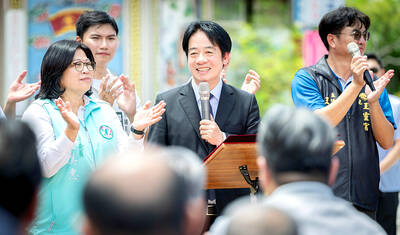
SIX SUBSIDIES: The monthly allowance for older farmers is to increase to NT$10,000, and NT$5,000 is to be given to homemakers under the national pension system, Lai said The government is to implement major welfare policies for disadvantaged groups, including raising the monthly allowance for older farmers to NT$10,000 and providing homemakers with NT$5,000 per month, President William Lai (賴清德) said yesterday. Lai made the remarks during a visit to Wangling Temple in Chiayi County, saying that the planned increases were being introduced amid economic growth and an increase in tax revenue. Touting a policy, in which the government plans to provide a monthly allowance of NT$5,000 for every child under the age of 18 in a bid to address Taiwan’s low birthrate, Lai said that if received for the


 RSS
RSS