


The Democratic Progressive Party (DPP) would seek a trade deal with Beijing under international rules if it returns to power, seeking safeguards for Taiwan that it says are missing in the pact the Chinese Nationalist Party (KMT) government plans to sign next month.
China and Taiwan, which conduct US$109 billion in annual two-way trade, need a deal under the WTO that would give Taiwan tariff reduction benefits but not be too hasty, DPP Chairperson Tsai Ing-wen (蔡英文) said yesterday.
“We are trading with a country that has this very aggressive political intention,” Tsai said in an interview. “We’d be telling Beijing that the immediate task in the trade area between the two of us is to be good citizens of the WTO community.”
“We are guaranteed we would not be discriminated against. We would be competing with others everywhere on equal terms,” she added.
President Ma Ying-jeou’s (馬英九) administration is pushing an economic cooperation framework agreement (ECFA) with China, which it says is essential to ensure the competitiveness of Taiwan’s economy. However, opponents fear the deal would allow China to pursue its claim of sovereignty over Taiwan and would also lead to massive unemployment as Taiwan is swamped by cheap Chinese goods.
A DPP-led government, if re-elected in elections due in 2012, would propose a referendum on the deal and scrap the pact if most voters expressed opposition, Tsai said.
While financial markets have largely backed an ECFA deal, eyeing the potential benefits to Taiwan’s top exporters, Tsai however sees “rushing into ECFA” as dangerous as it would not allow Taiwan’s economy time enough to restructure to deal with the new environment.
“We have no hurry for that ECFA thing,” said Tsai, 53, a forthright former law scholar and professor with degrees from Cornell and London Universities who was Taiwan’s vice premier in 2006.
“The issue is how urgent we need this sort of agreement with China,” she said in the interview conducted in English. “Our argument is there is no urgency for that kind of agreement with China. Our companies are doing OK.”
Previous efforts to build trade ties when the DPP ruled from 2000 to 2008 struggled as the party’s anti-China rhetoric outraged Beijing.
Tsai said the opposition would pursue a separate dialogue mechanism with Beijing, possibly under the umbrella of an outside organization, to seek peace and “teach Beijing about the island’s democracy.”
The party has already organized a group of scholars and non-governmental organizations to open talks, she said.
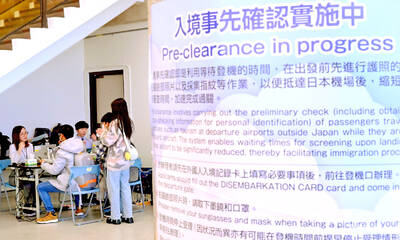
A preclearance service to facilitate entry for people traveling to select airports in Japan would be available from Thursday next week to Feb. 25 at Taiwan Taoyuan International Airport, Taoyuan International Airport Corp (TIAC) said on Tuesday. The service was first made available to Taiwanese travelers throughout the winter vacation of 2024 and during the Lunar New Year holiday. In addition to flights to the Japanese cities of Hakodate, Asahikawa, Akita, Sendai, Niigata, Okayama, Takamatsu, Kumamoto and Kagoshima, the service would be available to travelers to Kobe and Oita. The service can be accessed by passengers of 15 flight routes operated by

GIVE AND TAKE: Blood demand continues to rise each year, while fewer young donors are available due to the nation’s falling birthrate, a doctor said Blood donors can redeem points earned from donations to obtain limited edition Formosan black bear travel mugs, the Kaohsiung Blood Center said yesterday, as it announced a goal of stocking 20,000 units of blood prior to the Lunar New Year. The last month of the lunar year is National Blood Donation Month, when local centers seek to stockpile blood for use during the Lunar New Year holiday. The blood demand in southern Taiwan — including Tainan and Kaohsiung, as well as Chiayi, Pingtung, Penghu and Taitung counties — is about 2,000 units per day, the center said. The donation campaign aims to boost
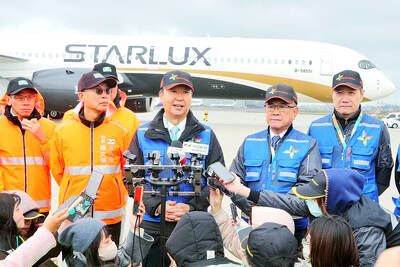
ENHANCING EFFICIENCY: The apron can accommodate 16 airplanes overnight at Taoyuan airport while work on the third runway continues, the transport minister said A new temporary overnight parking apron at Taiwan Taoyuan International Airport is to start operating on Friday next week to boost operational efficiency while the third runway is being constructed, the Ministry of Transportation and Communications said yesterday. The apron — one of the crucial projects in the construction of the third runway — can accommodate 16 aircraft overnight at the nation’s largest international airport, Minister of Transportation and Communications Chen Shih-kai (陳世凱) told reporters while inspecting the new facility yesterday morning. Aside from providing the airport operator with greater flexibility in aircraft parking during the third runway construction,

American climber Alex Honnold is to attempt a free climb of Taipei 101 today at 9am, with traffic closures around the skyscraper. To accommodate the climb attempt and filming, the Taipei Department of Transportation said traffic controls would be enforced around the Taipei 101 area. If weather conditions delay the climb, the restrictions would be pushed back to tomorrow. Traffic controls would be in place today from 7am to 11am around the Taipei 101 area, the department said. Songzhi Road would be fully closed in both directions between Songlian Road and Xinyi Road Sec 5, it said, adding that bidirectional traffic controls would


 RSS
RSS