


The Legislative Yuan’s Education and Culture Committee meeting on Wednesday looks set to face a firestorm of protest as it reviews two controversial bills that will allow Chinese students to study in Taiwan and give recognition to Chinese educational credentials.
Chinese Nationalist Party (KMT) Legislator and committee chairperson Chao Li-yun (趙麗雲) said the committee “must do something” during Wednesday’s meeting because of its failure to review the bills despite four earlier meetings.
Minister of Education Wu Ching-chi (吳清基) has also expressed concern about the need to push through the bills as soon as possible, she said.
The proposed amendment to the University Act (大學法) and another amendment to the Vocational School Act (專科學校法) were included in the committee’s agenda on Friday night.
Review of the bills has been stalled because of a boycott by Democratic Progressive Party (DPP) legislators.
SEPTEMBER
At present, Taiwan does not recognize Chinese diplomas or allow local schools to recruit students from China. The KMT administration would like to relax the restrictions by the next academic year, meaning next September.
The number of Chinese students allowed to come to Taiwan for study would be capped at 1 percent of student vacancies at local colleges and universities if the necessary bills are passed by the legislature.
Wu, Vice Minister Lin Tsung-ming (林聰明) and Mainland Affairs Council Vice Minister Chao Chien-ming (趙建民) last month visited Legislative Speaker Wang Jin-pyng (王金平) and lawmakers to solicit support for the proposed bills.
Chao said it was reasonable to include the bills on Wednesday’s agenda because the Ministry of Education has already held 21 public hearings on the issue across the nation at the request of the committee.
“We should not refrain from dealing with the bills just because some people have different opinions about them,” Chao said.
DPP MOBILIZATION
The DPP caucus has threatened to mobilize its legislators to stop the committee meeting from going ahead.
DPP Legislator Kuan Bi-ling (管碧玲) criticized the KMT-dominated committee for including the bills on the committee’s agenda at a time when most legislators were occupied by the review of the draft Industrial Innovation Act (產業創新條例) on Friday.

Taiwanese paleontologists have discovered fossil evidence that pythons up to 4m long inhabited Taiwan during the Pleistocene epoch, reporting their findings in the international scientific journal Historical Biology. National Taiwan University (NTU) Institute of Ecology and Evolutionary Biology associate professor Tsai Cheng-hsiu (蔡政修) led the team that discovered the largest snake fossil ever found in Taiwan. The single trunk vertebra was discovered in Tainan at the Chiting Formation, dated to between 400,000 and 800,000 years ago in the Middle Pleistocene, the paper said. The area also produced Taiwan’s first avian fossil, as well as crocodile, mammoth, saber-toothed cat and rhinoceros fossils, it said. Discoveries

Taiwanese paleontologists have discovered fossil evidence that pythons up to 4m long inhabited Taiwan during the Pleistocene epoch, reporting their findings in the international scientific journal Historical Biology. National Taiwan University (NTU) Institute of Ecology and Evolutionary Biology associate professor Tsai Cheng-hsiu (蔡政修) led the team that discovered the largest snake fossil ever found in Taiwan. A single trunk vertebra was discovered in Tainan at the Chiting Formation, dated to between 800,000 to 400,000 years ago in the Middle Pleistocene, the paper said. The area also produced Taiwan’s first avian fossil, as well as crocodile, mammoth, sabre-toothed cat and rhinoceros fossils, it said. Discoveries
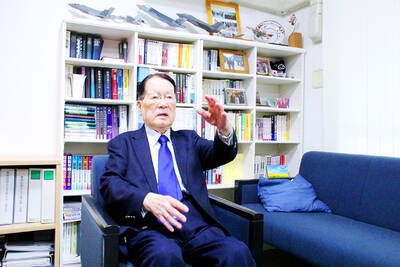
Whether Japan would help defend Taiwan in case of a cross-strait conflict would depend on the US and the extent to which Japan would be allowed to act under the US-Japan Security Treaty, former Japanese minister of defense Satoshi Morimoto said. As China has not given up on the idea of invading Taiwan by force, to what extent Japan could support US military action would hinge on Washington’s intention and its negotiation with Tokyo, Morimoto said in an interview with the Liberty Times (sister paper of the Taipei Times) yesterday. There has to be sufficient mutual recognition of how Japan could provide
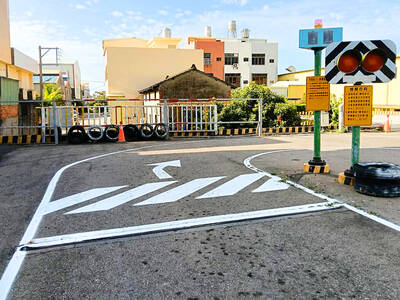
UPDATED TEST: The new rules aim to assess drivers’ awareness of risky behaviors and how they respond under certain circumstances, the Highway Bureau said Driver’s license applicants who fail to yield to pedestrians at intersections or to check blind spots, or omit pointing-and-calling procedures would fail the driving test, the Highway Bureau said yesterday. The change is set to be implemented at the end of the month, and is part of the bureau’s reform of the driving portion of the test, which has been criticized for failing to assess whether drivers can operate vehicles safely. Sedan drivers would be tested regarding yielding to pedestrians and turning their heads to check blind spots, while drivers of large vehicles would be tested on their familiarity with pointing-and-calling


 RSS
RSS