


President Ma Ying-jeou (馬英九) said Taiwan and China were at an “historic juncture” and that his engagement of Beijing through trade had put relations on their surest footing in more than half a century.
“This is a very meaningful job for Taiwan at an historic juncture,” Ma told AFP in an interview on Thursday.
“If we can contribute to peace and prosperity across the Taiwan Straits [sic], the accomplishments would be historic,” said Ma, describing the present as the “most peaceful era in history.”
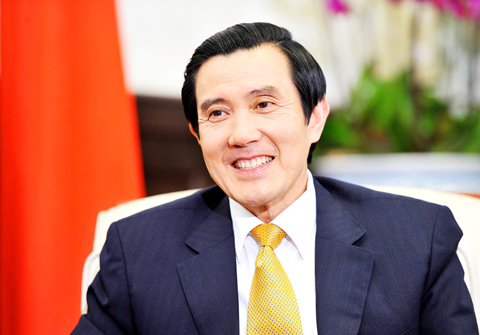
PHOTO: SAM YEH, AFP
Shrugging off poor opinion polls and criticism that his policy amounted to appeasement that would damage Taiwan’s economy and security, Ma said Taiwan’s future prosperity was inextricably linked with progress in China.
However, Ma said that the former enemies had a long way to go adding that his government would not consider formal peace talks until China removed or dismantled more than 1,000 missiles targeting Taiwan.
Despite often tense relations, the past 20 years have seen massive Taiwanese investment in China, with the country overtaking the US as Taiwan’s biggest export market.
Since taking office in May 2008, Ma’s administration has since signed 12 economic agreements with China paving the way for, among other things, increased flights and tourist arrivals, and calming one of Asia’s most volatile security situations.
“It’s very important that the tension has been greatly reduced. In this part of the world, as you can see, there are two flashpoints — the Korean Peninsula and the Taiwan Straits,” he said. “If we can take one out of the picture, I think everyone will be happy and this is exactly what we are doing now.”
Ma said Taiwan had risked being left behind in an era of rapidly expanding free-trade agreements across Asia.
“In the last 10 years FTAs, free-trade agreements, rose from three to 58, with the notable absence of Taiwan and North Korea,” he said.
To tie Taiwan into this regional network, Ma has been pushing for an economic cooperation framework agreement (ECFA) with China that he said would unlock unused potential by offering lower tariffs for a select list of industries.
Ma’s admininistration hopes to sign it with China in June, he said, arguing that in a time of interlinking economies and ever fiercer competition, there was no alternative.
“Diplomatic isolation can be handled, and we handle it well, but with economic isolation we have to be very careful. If we lose the market share in a given country, it will be very difficult to get it back,” he said.
Critics, however, oppose an ECFA amid fears that it would jeopardize Taiwan’s sovereignty and make it too economically dependent on China.
Ma, who has seen his approval ratings fall below 30 percent in some polls mainly because of criticism of his China and economic policies and a perception he is not decisive enough, said an ECFA would strengthen Taiwan’s current status quo.
“It will make the status quo more favorable to Taiwan because it will increase Taiwanese products’ competitiveness in the world and will make Taiwan’s status in East Asia even stronger than before,” he said.
Ma said there were no plans to start political dialogue with China and he said the time was not right for him to consider a visit to Beijing.
He said Taiwan was watching “with concern” the human rights situation in China following deadly unrest in Tibet in 2008 and Xinjiang last year, the ongoing crackdown on dissent and the conflict with Internet giant Google.

Considering that most countries issue more than five denominations of banknotes, the central bank has decided to redesign all five denominations, the bank said as it prepares for the first major overhaul of the banknotes in more than 24 years. Central bank Governor Yang Chin-lung (楊金龍) is expected to report to the Legislative Yuan today on the bank’s operations and the redesign’s progress. The bank in a report sent to the legislature ahead of today’s meeting said it had commissioned a survey on the public’s preferences. Survey results showed that NT$100 and NT$1,000 banknotes are the most commonly used, while NT$200 and NT$2,000

The Centers for Disease Control (CDC) yesterday reported the first case of a new COVID-19 subvariant — BA.3.2 — in a 10-year-old Singaporean girl who had a fever upon arrival in Taiwan and tested positive for the disease. The girl left Taiwan on March 20 and the case did not have a direct impact on the local community, it said. The WHO added the BA.3.2 strain to its list of Variants Under Monitoring in December last year, but this was the first imported case of the COVID-19 variant in Taiwan, CDC Deputy Director-General Lin Ming-cheng (林明誠) said. The girl arrived in Taiwan on

ANNUAL EVENT: Two massive Pokemon balloons are to be set up in Daan Park, with an event zone operating from 10am to 6pm This year’s Taipei Floral Picnic is to be held at Daan Park today and tomorrow, featuring an exclusive Pokemon Go event, a themed food market, a coffee rave picnic area and stage performances, the Taipei Department of Information and Tourism said yesterday. Two massive Pokemon balloons are to be set up in the park as attractions, with an exclusive event zone operating from 10am to 6pm, it said. Participants who complete designated tasks on-site would have a chance to receive limited-edition souvenirs, it added. People could also try the newly launched game Pokemon Pokopia in the trial area, the department said. Three PokeStops are

South Korea is planning to revise its controversial electronic arrival card, a step Taiwanese officials said prompted them to hold off on planned retaliatory measures, a South Korean media report said yesterday. A Yonhap News Agency report said that the South Korean Ministry of Foreign Affairs is planning to remove the “previous departure place” and “next destination” fields from its e-arrival card system. The plan, reached after interagency consultations, is under review and aims to simplify entry procedures and align the electronic form with the paper version, a South Korean ministry official said. The fields — which appeared only on the electronic form


 RSS
RSS