


Participants at a meeting of groups that oppose signing an economic cooperation framework agreement (ECFA) with China on Monday night agreed to follow an initiative to hold a rally against the proposed trade pact.
“For the time being, we will continue to support the Taiwan Solidarity Union’s [TSU] signature drive for an ECFA referendum,” Tsay Ting-kuei (蔡丁貴), convener of the Taiwan Referendum Alliance, told the Taipei Times yesterday.
“However, we think the first stage of the TSU to submit the petition signatures will come too late, as the date [for doing so] has been set for April 25,” he said.
Although Tsay said it would be nice to see the TSU petition for a referendum passed by the Central Election Committee and for the second stage of the petition process to begin, “we do not anticipate this will happen under the current atmosphere created by [President] Ma Ying-jeou’s (馬英九) administration.”
“We are prepared to convey a proposal to the Democratic Progressive Party, which is expected to hold a rally against an ECFA on May 20, the second anniversary of Ma’s inauguration,” Tsay said. “Our proposal is that the rally request the Legislative Yuan and/or Ma to respond to a resolution for an ECFA referendum in accordance with the Referendum Act [公民投票法], rather than just dismiss the rally at the end of the day.”
Tsay said his group was prepared to apply continuous pressure on the legislature and the Ma administration by holding rallies of between 5,000 and 10,000 protesters a day around the legislature.
“We believe it is our civil right to have a referendum on the ECFA. We are convinced that the Republic of China under Ma has clearly proved itself to be a Chinese government exiled in Taipei and that Ma has chosen to suppress the freedoms of Taiwanese by denying a referendum — even under current laws that make it extremely difficult to pass a referendum,” Tsay said.
On whether the DPP would approve the proposal, Tsay said that remained to be seen and that his organization understood that the DPP also had to keep electoral considerations in mind.
“They [the DPP] have tried very hard to please both the upper and lower classes of society,” Tsay said. “Signing an ECFA would amplify the economic gap between the rich and the poor. Some DPP spokesman insisted on TV that DPP Chairperson Tsai Ing-wen (蔡英文) has yet to say that she is against an ECFA, though she does say that the matter should be decided via a referendum.”
“This will do more damage to the DPP than they think,” he said. “If the DPP fails to block an ECFA for the welfare of Taiwanese, we all feel that forming another stronghold to give Taiwanese a strong voice would be both a pragmatic and necessary alternative.”

The Ministry of Finance this afternoon announced the winning numbers for the March-April uniform invoice lottery. The winning number for the NT$10 million (US$318,060) special prize is 19531471, and the winning number for the NT$2 million grand prize is 85941329. Three numbers were drawn for the NT$200,000 first prize: 07225810, 20231230 and 83518781. Those with receipts matching the last seven digits of any of the first-prize numbers will win the NT$40,000 second prize, while those matching the last six digits will win the NT$10,000 third prize. Those whose receipts match the last five digits of the first-prize numbers can claim the NT$4,000 fourth prize,
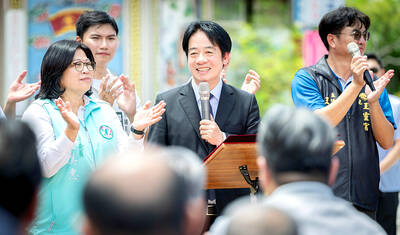
SIX SUBSIDIES: The monthly allowance for older farmers is to increase to NT$10,000, and NT$5,000 is to be given to homemakers under the national pension system, Lai said The government is to implement major welfare policies for disadvantaged groups, including raising the monthly allowance for older farmers to NT$10,000 and providing homemakers with NT$5,000 per month, President William Lai (賴清德) said yesterday. Lai made the remarks during a visit to Wangling Temple in Chiayi County, saying that the planned increases were being introduced amid economic growth and an increase in tax revenue. Touting a policy, in which the government plans to provide a monthly allowance of NT$5,000 for every child under the age of 18 in a bid to address Taiwan’s low birthrate, Lai said that if received for the
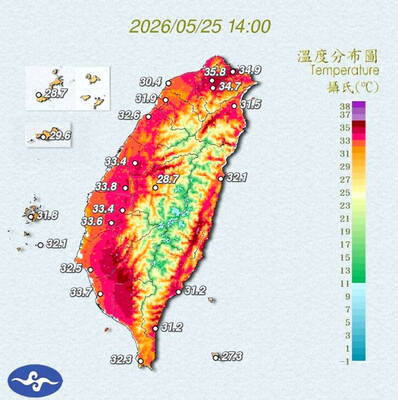
STAY COOL: The HPA recommended that people stay hydrated, use air-conditioning or fans while indoors, wear loose-fitting clothes and walk in the shade while outdoors Employers must implement measures such as installing cooling equipment, and providing drinking water and rest breaks for outdoor workers starting from Monday next week, the Taipei Department of Labor said on Sunday. Employers who fail to comply could face fines of NT$30,000 to NT$300,000 under the Occupational Safety and Health Act (職業安全衛生法), the department said. Businesses in Taipei employing fewer than 100 workers, as well as registered self-employed workers with labor insurance coverage, could receive on-site assessments and guidance from occupational safety consultants to help them apply for central government subsidies to implement or improve heat-protection measures, it said. Under the Ministry of
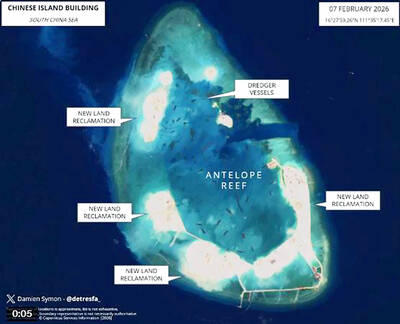
ISOLATION: The outposts would serve as support and backup bases, forcing US forces to either face China head-on or reroute, increasing travel time and operational costs China’s outposts in the South China Sea could be used to delay and constrain foreign forces during a conflict in the Taiwan Strait, giving Beijing a critical window to carry out amphibious landing and blockade operations, a report said. The Chinese Communist Party’s (CCP) forward operating bases on islands and reclaimed features in the South China Sea could delay foreign forces long enough for the Chinese People’s Liberation Army (PLA) to secure a key 48-to-72-hour window in the Taiwan Strait, a report commissioned by the Mainland Affairs Council found. The report, conducted by the Institute for National Defense and Security Research, examined


 RSS
RSS