


■LAW
Chiu Yi found innocent
Taipei District Court yesterday found Chinese Nationalist Party (KMT) Legislator Chiu Yi (邱毅) not guilty in a slander suit filed by former premier Frank Hsieh (謝長廷). Former president Chen Shui-bian (陳水扁) told a court hearing in February last year that former Bureau of Investigation director-general Yeh Sheng-mao (葉盛茂) told him that Hsieh wired NT$1billion (US$30 million) to Singapore through his family. Asked to comment on the remark, Chiu told reporters that Hsieh wired the fund overseas through his wife’s family, and that it must have been dirty money. The district court ruled that Chiu’s remark was related to corruption and money laundering, which were hot issues at the time and they could be discussed in public, so it found Chiu not guilty. Hsieh can appeal the ruling to the Taiwan High Court.
■POPULATION
Ministry wants more babies
The Ministry of the Interior is offering NT$1 million (US$31,000) for a catchy slogan to help boost the nation’s dwindling birth rate, one of the world’s lowest. “We are seeking a creative slogan that would appeal to the public and make everybody want to have children,” an interior ministry statement said. Authorities have offered various incentives in an unsuccessful bid to boost birth rates amid growing concern that a severe manpower shortage will trigger social and economic problems. The birth rate stood at 8.29 births per 1,000 people last year, the ministry said. That compares with a global average of more than 20 births per 1,000 people, according to UN statistics.
■AVIATION
Runways to be lengthened
The runways at Taiwan Taoyuan International Airport will be lengthened to allow for the landing of the Airbus A380 and other big aircraft, the Council for Economic Planning and Development (CEPD) said on Monday. The CEPD approved the project submitted by the Ministry of Transportation and Communications to remodel facilities at the airport in line with an ambitious “Taoyuan Aerotropolis” plan. The Taoyuan Aerotropolis plan — set to be completed in 2020 — involves the expansion of existing airport terminals, the establishment of an aerospace industrial park and special zones for cargo, passenger and logistics services. Under the project, scheduled to be completed by mid-2014 at a cost of NT$10.7 billion (US$310 million), the length of runways and taxiways will be extended to allow for the landing of big planes, including Airbus 380s, the CEPD said.
■MILITARY
More missiles in China
Andrei Pinkov, of the Toronto-based Kanwa Asian Defence Monthly, has said S300PMU2 long-range surface-to-air missiles have been deployed at Longtian military airport in China’s Fujian Province. Pinkov said satellite images show that eight launch vehicles for the Russian-model S300PMU2 missiles, which have a range of 200km, are now stationed at the Longtian base. The base also has S300PMU1 missiles that are launched from vehicles made in Belarus and have a range of 150km. The S300PMU2 rockets are guided by 30N6E2 radars that can simultaneously track 100 targets within a 350km range. Also available are 64N6E2 search radars that can seek out 300 airborne targets at the same time, within a range of 300km. The system can guide 72 missiles to attack 36 airborne targets, with a system reaction time of between seven and 11 seconds, the report said.

Yangmingshan National Park authorities yesterday urged visitors to respect public spaces and obey the law after a couple was caught on a camera livestream having sex at the park’s Qingtiangang (擎天崗) earlier in the day. The Shilin Police Precinct in Taipei said it has identified a suspect and his vehicle registration number, and would summon him for questioning. The case would be handled in accordance with public indecency charges, it added. The couple entered the park at about 11pm on Thursday and began fooling around by 1am yesterday, the police said, adding that the two were unaware of the park’s all-day live
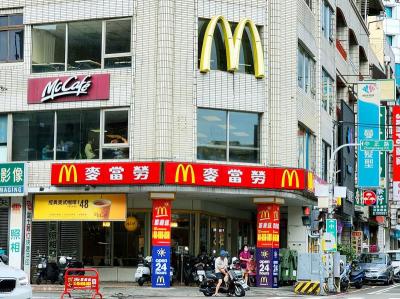
Fast food chain McDonald's is to raise prices by up to NT$5 on some products at its restaurants across Taiwan, starting on Wednesday next week, the company announced today. The prices of all extra value meals and sharing boxes are to increase by NT$5, while breakfast combos and creamy corn soup would go up by NT$3, the company said in a statement. The price of the main items of those meals, if ordered individually, would remain the same. Meanwhile, the price of a medium-sized lemon iced tea and hot cappuccino would rise by NT$3, extra dipping sauces for chicken nuggets would go up
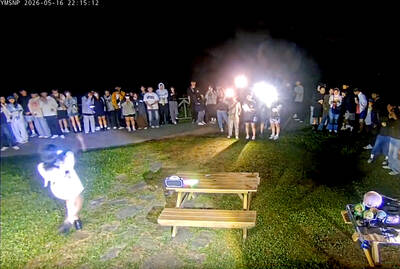
Yangmingshan National Park’s Qingtiangang (擎天崗) nature area has gone viral after a park livestream camera observed a couple in the throes of intimate congress, which was broadcast live on YouTube, drawing large late-night crowds and sparking a backlash over noise, bright lights and disruption to wildlife habitat. The area’s livestream footage appeared to show a couple engaging in sexual activity on a picnic table in the park on Friday last week, with the uncensored footage streamed publicly online. The footage quickly spread across social media, prompting a tide of visitors to travel to the site to “check in” and recreate the

Minister of Digital Affairs Lin Yi-ching (林宜敬) yesterday cited regulatory issues and national security concerns as an expert said that Taiwan is among the few Asian regions without Starlink. Lin made the remarks on Facebook after funP Innovation Group chief executive officer Nathan Chiu (邱繼弘) on Friday said Taiwan and four other countries in Asia — China, North Korea, Afghanistan and Syria — have no access to Starlink. Starlink has become available in 166 countries worldwide, including Ukraine, Malaysia, the Philippines and Vietnam, in the six years since it became commercial, he said. While China and North Korea block Starlink, Syria is not


 RSS
RSS