


More than 1,000 people — Taiwanese, Tibetans, Chinese, Americans, Europeans and Latin Americans — took to the streets of Taipei yesterday to commemorate the 51st anniversary of the 1959 Tibetan uprising.
Holding banners and signs with slogans like “self-determination for Tibet,” “stop cultural genocide in Tibet” and “Stop killing in Tibet,” the crowd departed from Zhongxiao Fuxing MRT station in Taipei and marched to Taipei 101.
“We’re here to remember March 10, 1959, on which more than 100,000 Tibetans took to the streets in Lhasa to protest Chinese occupation of their country and were violently suppressed,” said Chow Mei-li (周美里), chairwoman of Taiwan Friends of Tibet (TFOT), which organized the parade. “We want the Tibetans inside and outside Tibet who are still struggling for their freedom to know that they have the support of the Taiwanese people.”

PHOTO: CHANG CHIA-MING,TAIPEI TIMES
Chow said that yesterday’s date, March 14, also coincided with the latest uprising in Tibet and other Tibetan regions against Chinese rule that began two years ago, as well as the date on which Beijing adopted its “Anti-Ssuccession” Law threatening to invade Taiwan if it “breaks away from the motherland.”
She said the parade route was chosen because it passes through Taipei’s busiest shopping districts and it’s a way to let more Taiwanese know that, as they enjoy their Sunday afternoon shopping or doing whatever they like, there are other people out there without the freedom to do so.
“The parade ends in front of Taipei 101, which most Chinese tourists visit, and we also would like them to hear some different voices from what their government allows them to hear,” Chow said.
As the parade passed, many people stopped, watched and took pictures, while some even waved at the marchers.
Most Chinese tourists seemed quite interested, with many taking pictures or filming the parade, but most declined to comment.
However, one elderly female Chinese tourist called the demonstrators “nuts,” while another middle-aged Chinese man said the demonstrators were too young to know what really happened in Tibet.
Many marchers also voiced concern at the accelerating pace of cross-strait agreements, especially the economic cooperation framework agreement (ECFA).
“Tibetans believed the Chinese and believed in the 17-point agreement they signed with China in the 1950s, but the Chinese broke their promises and imposed harsh measures on freedom and religion in Tibet,” TFOT vice-chairman Yiong Cong-ziin (楊長鎮) said.
Some demonstrators brought placards that read “human rights before ECFA.”
Lobsang, a Tibetan living in Taiwan who was born in exile in Nepal, said he was touched that so many Taiwanese came out to support the Tibetan cause and that he appreciated the support.
Celine van der Cam, a 22-year-old Belgian in the parade, said she joined because she believed the Tibetans’ call to be just.
“The Chinese say they’re doing a lot to modernize Tibet. Well, if the Tibetans don’t want it, they should be left alone,” she said.

Taiwan has received more than US$70 million in royalties as of the end of last year from developing the F-16V jet as countries worldwide purchase or upgrade to this popular model, government and military officials said on Saturday. Taiwan funded the development of the F-16V jet and ended up the sole investor as other countries withdrew from the program. Now the F-16V is increasingly popular and countries must pay Taiwan a percentage in royalties when they purchase new F-16V aircraft or upgrade older F-16 models. The next five years are expected to be the peak for these royalties, with Taiwan potentially earning

STAY IN YOUR LANE: As the US and Israel attack Iran, the ministry has warned China not to overstep by including Taiwanese citizens in its evacuation orders The Ministry of Foreign Affairs (MOFA) yesterday rebuked a statement by China’s embassy in Israel that it would evacuate Taiwanese holders of Chinese travel documents from Israel amid the latter’s escalating conflict with Iran. Tensions have risen across the Middle East in the wake of US and Israeli airstrikes on Iran beginning Saturday. China subsequently issued an evacuation notice for its citizens. In a news release, the Chinese embassy in Israel said holders of “Taiwan compatriot permits (台胞證)” issued to Taiwanese nationals by Chinese authorities for travel to China — could register for evacuation to Egypt. In Taipei, the ministry yesterday said Taiwan

Taiwan is awaiting official notification from the US regarding the status of the Agreement on Reciprocal Trade (ART) after the US Supreme Court ruled US President Donald Trump's global tariffs unconstitutional. Speaking to reporters before a legislative hearing today, Premier Cho Jung-tai (卓榮泰) said that Taiwan's negotiation team remains focused on ensuring that the bilateral trade deal remains intact despite the legal challenge to Trump's tariff policy. "The US has pledged to notify its trade partners once the subsequent administrative and legal processes are finalized, and that certainly includes Taiwan," Cho said when asked about opposition parties’ doubts that the ART was
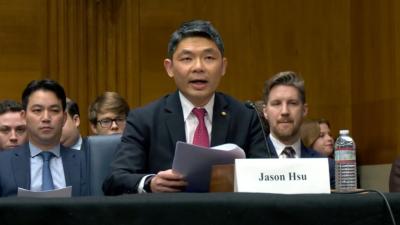
If China chose to invade Taiwan tomorrow, it would only have to sever three undersea fiber-optic cable clusters to cause a data blackout, Jason Hsu (許毓仁), a senior fellow at the Hudson Institute and former Chinese Nationalist Party (KMT) legislator, told a US security panel yesterday. In a Taiwan contingency, cable disruption would be one of the earliest preinvasion actions and the signal that escalation had begun, he said, adding that Taiwan’s current cable repair capabilities are insufficient. The US-China Economic and Security Review Commission (USCC) yesterday held a hearing on US-China Competition Under the Sea, with Hsu speaking on


 RSS
RSS