


Supporters of the democracy movement in Myanmar organized a campaign in Taipei yesterday to voice their support for five female political prisoners, each of whom have been sentenced to 65 years in prison.
The campaign took place at the heart of the busy shopping district outside Zhongxiao Fuxing (忠孝復興) Mass Rapid Transit station.
“The area around Zhongxiao Fuxing station is a shopping paradise for a lot of women. But have we thought that, while many women in Taiwan are happily shopping here, there are other women out there living is horrible conditions, or put in jail by totalitarian regimes on groundless charges?” Amnesty International Taiwan director Wang Hsing-chung (王興中) said as he explained why the location was chosen for the event.

PHOTO: CHANG CHIA-MING, TAIPEI TIMES
The campaign was staged one day before International Women’s Day today because many women in Myanmar live in dreadful conditions, are forced to part with their loved ones and are tortured in dark prison cells, like the five female political prisoners who were arrested after taking part in a protest against the Myanmar military junta over skyrocketing oil prices in 2007, he said.
Five women who were in leadership positions during the anti-government demonstration — Mar Mar Oo, Nilar Thein, Sandar Min, Thet Thet Aung and Thin Thin Aye — were arrested in 2007 and 2008, and each was sentenced to 65 years in prison.
Unlike other campaign gatherings that involve slogans or marching, yesterday’s campaign featured music performances and postcards with lip prints that were sent to the military regime. The audience and passers-by were asked to sign their names on a pre-written postcard asking for the release of the political prisoners, and to either leave their own lip prints or stamp the postcards with a lip print stamp.
“We usually associate lip prints with women, and the lip print on a postcard with a powerful message to the military junta symbolizes the women’s power,” Taiwan Free Burma Network spokesman Yang Tsung-li (楊宗澧) said. “We want the dictator to feel the power of women.”
A man surnamed Yang (楊), who was meeting his friend at the MRT station, agreed to sign a postcard after an activist explained to him what had happened to the five women.
“I don’t know who these five women are, but I know they’ve done something right and I’d always support people who represent justice,” he said.
Khim Ohmar, one of the student leaders in a massive anti-Myanmar-government demonstration in 1988 and now still working to promote democracy in Myanmar from exile in Mae Sot, Thailand, also appeared at yesterday’s event.
She said that seeing so many people in Taiwan working to raise public awareness on the situation in Myanmar gave her more energy and hope.
She also expressed her hope that the Taiwanese government could give the freedom movement in Myanmar a hand.
“Tell your [Taiwan’s] government to send the message to China: Stop supporting the military regime and stop sending firearms to the military government,” Khim Ohmar said.
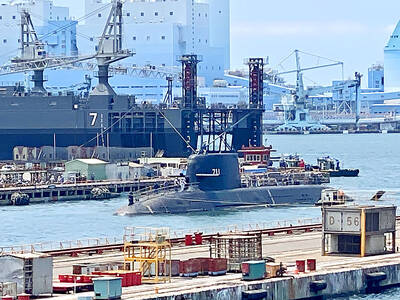
AGING: While Japan has 22 submarines, Taiwan only operates four, two of which were commissioned by the US in 1945 and 1946, and transferred to Taiwan in 1973 Taiwan would need at least 12 submarines to reach modern fleet capabilities, CSBC Corp, Taiwan chairman Chen Cheng-hung (陳政宏) said in an interview broadcast on Friday, citing a US assessment. CSBC is testing the nation’s first indigenous defense submarine, the Hai Kun (海鯤, Narwhal), which is scheduled to be delivered to the navy next month or in July. The Hai Kun has completed torpedo-firing tests and is scheduled to undergo overnight sea trials, Chen said on an SET TV military affairs program. Taiwan would require at least 12 submarines to establish a modern submarine force after assessing the nation’s operational environment and defense

A white king snake that frightened passengers and caused a stir on a Taipei MRT train on Friday evening has been claimed by its owner, who would be fined, Taipei Rapid Transit Corp (TRTC) said yesterday. A person on Threads posted that he thought he was lucky to find an empty row of seats on Friday after boarding a train on the Bannan (Blue) Line, only to spot a white snake with black stripes after sitting down. Startled, he jumped up, he wrote, describing the encounter as “terrifying.” “Taipei’s rat control plan: Release snakes on the metro,” one person wrote in reply, referring
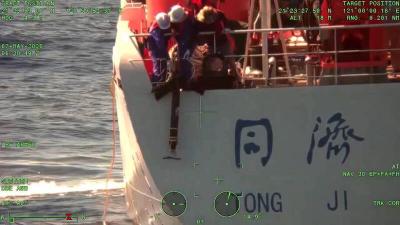
The coast guard today said that it had disrupted "illegal" operations by a Chinese research ship in waters close to the nation and driven it away, part of what Taipei sees a provocative pattern of China's stepped up maritime activities. The coast guard said that it on Thursday last week detected the Chinese ship Tongji (同濟號), which was commissioned only last year, 29 nautical miles (54km) southeast of the southern tip of Taiwan, although just outside restricted waters. The ship was observed lowering ropes into the water, suspected to be the deployment of scientific instruments for "illegal" survey operations, and the coast

Taiwan’s two cases of hantavirus so far this year are on par with previous years’ case numbers, and the government is coordinating rat extermination work, so there should not be any outbreaks, Centers for Disease Control (CDC) Director-General Philip Lo (羅一鈞) said today in an interview with the Liberty Times (the Taipei Times’ sister newspaper). An increase in rat sightings in Taipei and New Taipei City has raised concerns about the spread of hantavirus, as rats can carry the disease. In January, a man in his 70s who lived in Taipei’s Daan District (大安) tested positive posthumously for hantavirus, Taiwan’s


 RSS
RSS