


Democratic Progressive Party (DPP) Taipei City councilors and relatives of victims of the 228 Incident yesterday criticized the city government for putting up signs that describe 228 Peace Park as the “228 Peace Disaster Prevention Park.”
“Since when has the 228 Incident become a ‘peace disaster’?” DPP City Councilor Chien Yu-yen (簡余晏) asked at a press conference while holding pictures of the blue signs with white print that read “228 disaster prevention park” (二二八防災公園) in Chinese and “228 peace disaster prevention park” in English.
Fourteen of the signs were found on streets around the park.
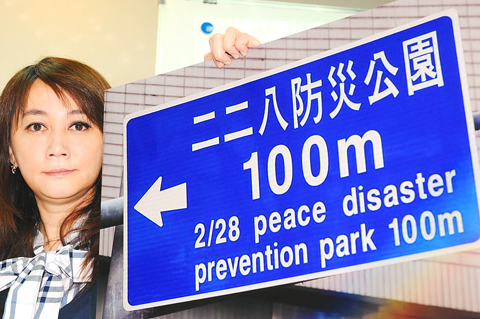
PHOTO: CNA
The 228 Incident refers to an uprising across the country against the Chinese Nationalist Party (KMT) regime in 1947 that was violently suppressed by the government.
Inside 228 Peace Park in Taipei stands the 228 Memorial Museum, which was used as a radio station during the initial days of the incident to spread news about the uprising that began in Taipei.
Some victims’ family members said the signs’ name change was politically motivated.
“I don’t want to think this way, but I sort of suspect the city government made the change to erase the historic memory,” former Memorial Foundation of the 228 Incident executive director Yang Chen-long (楊振隆) said.
Taipei City Fire Department official Chou Chung-chi (周鍾驥), who took part in the press conference, denied the change was politically motivated, but said the wording on the sign may not be appropriate.
He said the park was designated a “disaster prevention park” in Zhongzheng District (中正) as part of the city government’s aim to create one large open-air disaster asylum for each of the city’s 12 administrative districts.
“For the project, we’ve decided to insert the word ‘disaster prevention’ into each park’s name, so we have signs with names like ‘Da-an Disaster Prevention Park’ and ‘Shilin Disaster Prevention Park,’” Chou said. “‘The name ‘228 Peace Disaster Prevention Park’ does look quite strange, but we didn’t think that far when we made the signs.”
He said the blue “disaster prevention park” signs were put up so people would know which parks have been designated as open-air shelters.
“We will take down all the ‘228 Peace Disaster Prevention Park’ signs within a week, and will hold meetings to decide what should be on the new signs before putting up new signs,” Chou said.
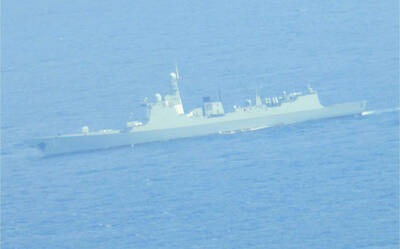
The military has spotted two Chinese warships operating in waters near Penghu County in the Taiwan Strait and sent its own naval and air forces to monitor the vessels, the Ministry of National Defense (MND) said. Beijing sends warships and warplanes into the waters and skies around Taiwan on an almost daily basis, drawing condemnation from Taipei. While the ministry offers daily updates on the locations of Chinese military aircraft, it only rarely gives details of where Chinese warships are operating, generally only when it detects aircraft carriers, as happened last week. A Chinese destroyer and a frigate entered waters to the southwest
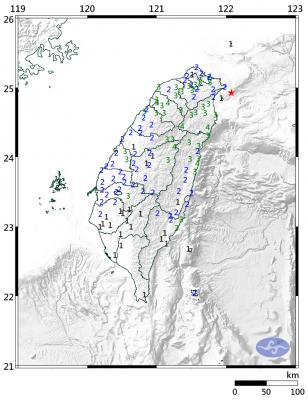
A magnitude 6.1 earthquake struck off the coast of Yilan County at 8:39pm tonight, the Central Weather Administration (CWA) said, with no immediate reports of damage or injuries. The epicenter was 38.7km east-northeast of Yilan County Hall at a focal depth of 98.3km, the CWA’s Seismological Center said. The quake’s maximum intensity, which gauges the actual physical effect of a seismic event, was a level 4 on Taiwan’s 7-tier intensity scale, the center said. That intensity level was recorded in Yilan County’s Nanao Township (南澳), Hsinchu County’s Guansi Township (關西), Nantou County’s Hehuanshan (合歡山) and Hualien County’s Yanliao (鹽寮). An intensity of 3 was

Japanese Prime Minister Sanae Takaichi’s comment last year on Tokyo’s potential reaction to a Taiwan-China conflict has forced Beijing to rewrite its invasion plans, a retired Japanese general said. Takaichi told the Diet on Nov. 7 last year that a Chinese naval blockade or military attack on Taiwan could constitute a “survival-threatening situation” for Japan, potentially allowing Tokyo to exercise its right to collective self-defense. Former Japan Ground Self-Defense Force general Kiyofumi Ogawa said in a recent speech that the remark has been interpreted as meaning Japan could intervene in the early stages of a Taiwan Strait conflict, undermining China’s previous assumptions
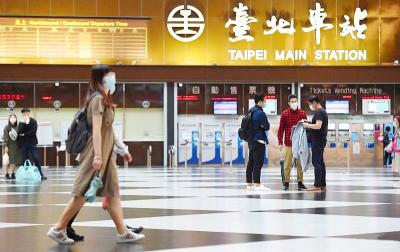
Taiwan Railways Corp (TRC) today announced that Shin Kong Mitsukoshi has been selected as the preferred bidder to operate the Taipei Railway Station shopping mall, replacing the current operator, Breeze Development Co Ltd. Among eight qualified firms that delivered presentations and were evaluated by a review committee, Shin Kong Mitsukoshi was ranked first, while Breeze was named the runner-up, the rail company said in a statement. Contract negotiations are to proceed in accordance with regulations, it said, adding that if negotiations with the top bidder fail, it could invite the second-ranked applicant to enter talks. Breeze in a statement today expressed doubts over


 RSS
RSS