


A former Yilan County official yesterday asked prosecutors to investigate three Control Yuan members who allegedly covered up for officials involved in the Yuanta I Pin Building (一品苑) case.
Lin Chin-kun (林錦坤), a former Yilan County Yuanshan Village (員山) representative, mailed a request to the Supreme Prosecutor’s Office Special Investigation Panel (SIP) requesting an investigation into whether Control Yuan members Ma Yi-kung (馬以工), Chen Yung-hsiang (陳永祥) and Lin Chu-liang (林鉅鋃) handled the case inappropriately.
The three Control Yuan members were in charge of the recently launched investigation into whether the I Pin apartment complex, located in Taipei City’s Boai Special District (博愛特區), might pose security problems because the 23-floor building provides a clear view of the nearby presidential residence.
The building is located at the intersection of Aiguo W Road and Boai Road, where the Presidential Office and the president’s residence are situated. It will have 23 floors above ground and five basement floors.
On Jan. 6, the Control Yuan censured the Taipei City Government for granting permission for the construction of a 23-story building near the president’s residence. Permission was given in 2006 during President Ma Ying-jeou’s (馬英九) term as Taipei mayor.
Lin said the decision to grant Yuanta the permission to construct the building involved more than merely administrative negligence, as the Control Yuan had criticized the Taipei City Government of doing, but also that officials had behaved inappropriately.
Lin said the Control Yuan members should have opened an impeachment case instead of only censuring the city government.
ADDITIONAL REPORTING BY LIN CHUN-HUNG

AGING: While Japan has 22 submarines, Taiwan only operates four, two of which were commissioned by the US in 1945 and 1946, and transferred to Taiwan in 1973 Taiwan would need at least 12 submarines to reach modern fleet capabilities, CSBC Corp, Taiwan chairman Chen Cheng-hung (陳政宏) said in an interview broadcast on Friday, citing a US assessment. CSBC is testing the nation’s first indigenous defense submarine, the Hai Kun (海鯤, Narwhal), which is scheduled to be delivered to the navy next month or in July. The Hai Kun has completed torpedo-firing tests and is scheduled to undergo overnight sea trials, Chen said on an SET TV military affairs program. Taiwan would require at least 12 submarines to establish a modern submarine force after assessing the nation’s operational environment and defense

A white king snake that frightened passengers and caused a stir on a Taipei MRT train on Friday evening has been claimed by its owner, who would be fined, Taipei Rapid Transit Corp (TRTC) said yesterday. A person on Threads posted that he thought he was lucky to find an empty row of seats on Friday after boarding a train on the Bannan (Blue) Line, only to spot a white snake with black stripes after sitting down. Startled, he jumped up, he wrote, describing the encounter as “terrifying.” “Taipei’s rat control plan: Release snakes on the metro,” one person wrote in reply, referring
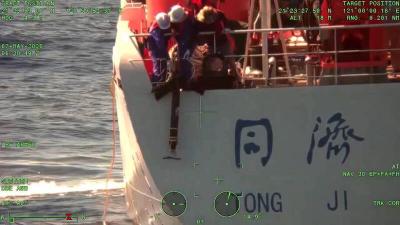
The coast guard today said that it had disrupted "illegal" operations by a Chinese research ship in waters close to the nation and driven it away, part of what Taipei sees a provocative pattern of China's stepped up maritime activities. The coast guard said that it on Thursday last week detected the Chinese ship Tongji (同濟號), which was commissioned only last year, 29 nautical miles (54km) southeast of the southern tip of Taiwan, although just outside restricted waters. The ship was observed lowering ropes into the water, suspected to be the deployment of scientific instruments for "illegal" survey operations, and the coast
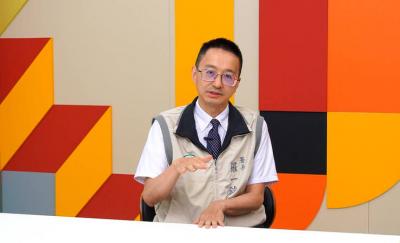
Taiwan’s two cases of hantavirus so far this year are on par with previous years’ case numbers, and the government is coordinating rat extermination work, so there should not be any outbreaks, Centers for Disease Control (CDC) Director-General Philip Lo (羅一鈞) said today in an interview with the Liberty Times (the Taipei Times’ sister newspaper). An increase in rat sightings in Taipei and New Taipei City has raised concerns about the spread of hantavirus, as rats can carry the disease. In January, a man in his 70s who lived in Taipei’s Daan District (大安) tested positive posthumously for hantavirus, Taiwan’s


 RSS
RSS