


A Taichung City policeman was penalized yesterday for using pepper spray on two protesters on Sunday night, but the police said his demerit was for carrying non-standard equipment rather than for assaulting the protesters, adding that he acted in self-defense.
Taichung Mayor Jason Hu (胡志強) apologized for the incident and promised to look into the matter.
Hu has pledged to step down if any civilians are injured because of police misconduct under his watch.
The Taichung City Police Bureau said police officer Sung Kuo-tong (宋國棟) was part of a detail dispatched to disperse a crowd of pro-independence supporters protesting the fourth round of cross-strait talks after a Democratic Progressive Party (DPP) rally ended on Sunday night.
The protesters, led by Taiwan Association of University Professors chairman Tsai Ting-kuei (蔡丁貴), reportedly attempted to barge into the fenced-off area around the Winsdor Hotel where the Chinese delegation is staying during its five-day visit.
A physical altercation occurred when police tried to disperse the crowd, a police press release said, adding that fourth precinct deputy chief Lu Chin-lung (盧進隆) was hit in the neck by a protester’s placard during the scuffle.
The statement said that Sung, a self-defense instructor, was trying protect his superior and himself when he used the pepper spray on the protesters.
The two people, one of whom was Tsai’s wife, sustained minor eye injuries and were released from hospital after treatment.
The police agreed that Sung was in the wrong for carrying pepper spray, which is not standard police equipment, but said his actions were in self-defense.
Sung was penalized for carrying non-standard equipment and has been removed from the assignment.
The DPP yesterday offered free legal assistance to the two individuals if they choose to sue over the incident.
DPP Secretary-General Su Jia-chyuan (蘇嘉全), who is heading the DPP’s ad-hoc emergency response center, advised all protesters to carry a cellphone or video-recording device at all times to collect evidence on any provocative actions of the part of the police.
“Taiwan is a free democratic country with freedom of speech being the most important value. All people are entitled to speak freely. The police have zero excuse to shortchange the people’s right to express themselves,” Su said.
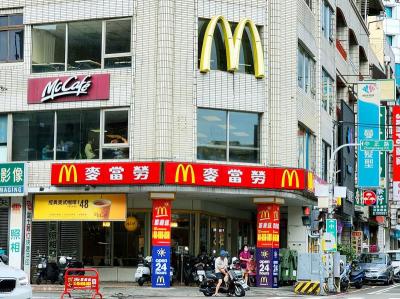
Fast food chain McDonald's is to raise prices by up to NT$5 on some products at its restaurants across Taiwan, starting on Wednesday next week, the company announced today. The prices of all extra value meals and sharing boxes are to increase by NT$5, while breakfast combos and creamy corn soup would go up by NT$3, the company said in a statement. The price of the main items of those meals, if ordered individually, would remain the same. Meanwhile, the price of a medium-sized lemon iced tea and hot cappuccino would rise by NT$3, extra dipping sauces for chicken nuggets would go up
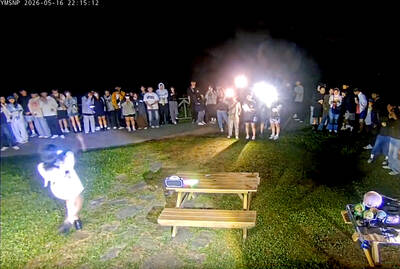
Yangmingshan National Park’s Qingtiangang (擎天崗) nature area has gone viral after a park livestream camera observed a couple in the throes of intimate congress, which was broadcast live on YouTube, drawing large late-night crowds and sparking a backlash over noise, bright lights and disruption to wildlife habitat. The area’s livestream footage appeared to show a couple engaging in sexual activity on a picnic table in the park on Friday last week, with the uncensored footage streamed publicly online. The footage quickly spread across social media, prompting a tide of visitors to travel to the site to “check in” and recreate the

Minister of Digital Affairs Lin Yi-ching (林宜敬) yesterday cited regulatory issues and national security concerns as an expert said that Taiwan is among the few Asian regions without Starlink. Lin made the remarks on Facebook after funP Innovation Group chief executive officer Nathan Chiu (邱繼弘) on Friday said Taiwan and four other countries in Asia — China, North Korea, Afghanistan and Syria — have no access to Starlink. Starlink has become available in 166 countries worldwide, including Ukraine, Malaysia, the Philippines and Vietnam, in the six years since it became commercial, he said. While China and North Korea block Starlink, Syria is not
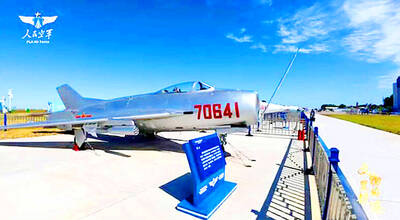
GROUNDED: A KMT lawmaker proposed eliminating drone development programs and freezing funding for counterdrone systems, despite China’s adoption of the technology China has deployed attack drones at air bases near the Taiwan Strait in a strategy aimed at overwhelming Taiwan’s air defense systems through saturation attacks, the Mainland Affairs Council (MAC) said. The council’s latest quarterly report on China said that satellite imagery and open-source intelligence indicate that the Chinese People’s Liberation Army (PLA) had converted retired J-6 fighter jets into J-6W drones, which the PLA has stationed at six air bases near Taiwan, five in China’s Fujian Province and one in Guangdong Province. The report cited J. Michael Dahm, a senior fellow at the US-based Mitchell Institute, as saying that China has


 RSS
RSS