


The Cabinet yesterday approved an amendment to the Patent Act (專利法) to expand the scope of patent rights to include genetically modified plants and animals, bringing the rules in line with the US, Japan, Australia and South Korea.
Wang Mei-hua (王美花), in charge of the Ministry of Economic Affairs’ (MOEA) Intellectual Property Office, said the amendment would offer incentive for research and development in the genetic transformation and cloning fields, in which Taiwan has had significant success.
The expansion would not include developments related to human cloning.
Another change suggests that parts of a new design be patented individually, rather than protecting the design as a whole, including its component parts, shape, appearance, color and other details.
Wang said the rule was revised to address a loophole.
“With the new rule in place, computer-generated icons and graphical user interfaces will all be under the patent umbrella,” Wang said, citing Windows “Recycle Bin” and “My Documents” icons as well as cellphone start-up screens as examples.
The proposal comes after Netherlands-based Royal Philips Electronics in 2007 accused the Intellectual Property Office of violating the WTO Agreement on Trade-related Aspects of Intellectual Property Rights for issuing a compulsory license in 2004 to Gigastorage for five patents related to Philips’ CD-R technology.
The amendment lists the terms and conditions for compulsory licensing and the application process involved to rectify lax regulations in the act.
If passed, an applicant being denied a license by a patent owner despite offering “reasonable” terms, as happened in the Philips case, will not constitute sufficient reason for compulsory licensing.
Meanwhile, the Cabinet approved a proposal calling for an injection of NT$2.1 billion (US$65.3 million) over the next five years to boost the nation’s e-book industry, with the aim of raising its output value to NT$100 billion by 2013.
The Industrial Development Bureau presented the proposal at the weekly Cabinet meeting yesterday.
Premier Wu Den-yih (吳敦義) said in a statement that Taiwan should take advantage of its edge in information and communications to bolster the industry.
“The premier asked the MOEA to help businesses in the industry [so they can] tap into the global e-reader market,” Executive Yuan Spokesman Su Jun-pin (蘇俊賓) said.
The ministry said in the proposal that the government had a goal of establishing two or three software and hardware platforms for rendering and displaying e-books to compete with Amazon’s Kindle, which offers about 100,000 e-books in Chinese.
Also at the meeting, to mark International Day of Persons with Disabilities, the Ministry of the Interior (MOI) proposed a report on the protection of the rights of people with disabilities.
More than 1 million people are living with disabilities nationwide, the ministry said.
In a press statement, Wu said the government would make Taiwan a “disability-friendly island” by meeting the needs of the disabled in terms of social welfare, medical treatment, education, employment, living environment and economic security.
The statement said the ministry had drawn up a plan to achieve this over the next 10 years.
Also yesterday, MOEA officials briefed Wu on the water supply in southern Taiwan, which may face water shortages over the next months.
Wu asked Vice Premier Eric Chu (朱立倫) to monitor the situation and tackle the problem.
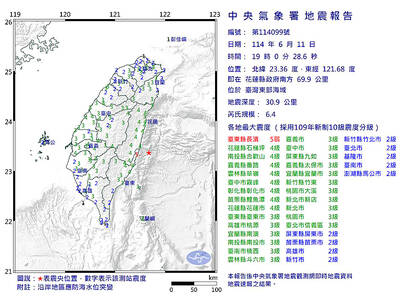
A magnitude 6.4 earthquake struck off the coast of Hualien County in eastern Taiwan at 7pm yesterday, the Central Weather Administration (CWA) said. The epicenter of the temblor was at sea, about 69.9km south of Hualien County Hall, at a depth of 30.9km, it said. There were no immediate reports of damage resulting from the quake. The earthquake’s intensity, which gauges the actual effect of a temblor, was highest in Taitung County’s Changbin Township (長濱), where it measured 5 on Taiwan’s seven-tier intensity scale. The quake also measured an intensity of 4 in Hualien, Nantou, Chiayi, Yunlin, Changhua and Miaoli counties, as well as
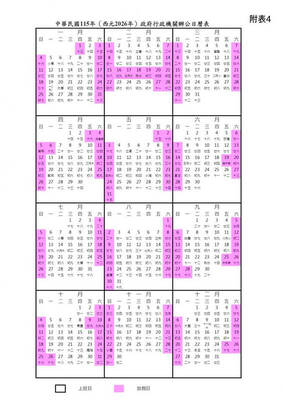
Taiwan is to have nine extended holidays next year, led by a nine-day Lunar New Year break, the Cabinet announced yesterday. The nine-day Lunar New Year holiday next year matches the length of this year’s holiday, which featured six extended holidays. The increase in extended holidays is due to the Act on the Implementation of Commemorative and Festival Holidays (紀念日及節日實施條例), which was passed early last month with support from the opposition Chinese Nationalist Party (KMT) and Taiwan People’s Party. Under the new act, the day before Lunar New Year’s Eve is also a national holiday, and Labor Day would no longer be limited
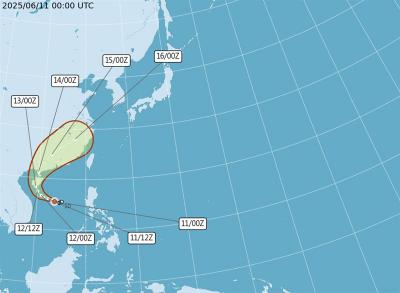
The first tropical storm of the year in the western North Pacific, Wutip (蝴蝶), has formed over the South China Sea and is expected to move toward Hainan Island off southern China, the Central Weather Administration (CWA) said today. The agency said a tropical depression over waters near the Paracel and Zhongsha islands strengthened into a tropical storm this morning. The storm had maximum sustained winds near its center of 64.8kph, with peak gusts reaching 90kph, it said. Winds at Beaufort scale level 7 — ranging from 50kph to 61.5kph — extended up to 80km from the center, it added. Forecaster Kuan Hsin-ping

COMMITMENTS: The company had a relatively low renewable ratio at 56 percent and did not have any goal to achieve 100 percent renewable energy, the report said Pegatron Corp ranked the lowest among five major final assembly suppliers in progressing toward Apple Inc’s commitment to be 100 percent carbon neutral by 2030, a Greenpeace East Asia report said yesterday. While Apple has set the goal of using 100 percent renewable energy across its entire business, supply chain and product lifecycle by 2030, carbon emissions from electronics manufacturing are rising globally due to increased energy consumption, it said. Given that carbon emissions from its supply chain accounted for more than half of its total emissions last year, Greenpeace East Asia evaluated the green transition performance of Apple’s five largest final


 RSS
RSS