


Following a recently expired plan to use container ships and passenger aircraft to monitor greenhouse gas emissions, the Environmental Protection Agency (EPA) said yesterday that a similar project could start early next year.
Officials said the project, which is currently in the bidding process, works by outfitting container ships and aircraft with equipment to collect climate change data in parts of the Pacific Ocean that have previously been neglected.
The data will be shared with institutions in the EU to demonstrate the nation’s commitment as a serious partner in combating global warming, officials said.
“Much of the EU data has been collected from [oceans other] than the Pacific Ocean. Because of Taiwan’s location, we can do our part in helping the EU gather information from parts of the Pacific,” said Chien Hui-jhen (簡慧貞), an EPA official who deals with greenhouse gas emissions.
In addition to the benefits of better understanding carbon dioxide emissions, the government hopes the plan can increase the nation’s exposure on the international stage, the EPA said.
Furthermore, the EPA said the plan would help the nation avoid being marginalized in global climate change talks.
Government representatives have not been invited to the UN Framework Convention on Climate Change (UNFCCC) taking place next month in Copenhagen. Instead, agencies will attend under the name of the Industrial Technology Research Institute, a non-governmental organization.
The EPA said equipment will be installed on ships running routes in the Pacific to Indian Ocean and Pacific to Atlantic Ocean.
The EPA said the data these gathered by these ships would be important, as there is a lack of data from those areas.
The project will also collaborate with the EU’s In-Service Aircraft for a Global Observing System project to install instruments on commercial aircraft to monitor atmospheric composition and aerosols and gather data, along with other projects from the US and Japan.
Chien said the project was part of the government’s ongoing efforts to learn more about and fight global warming.
Statistics from the EPA show that although Taiwan’s 4.1 percent reduction in emissions last year was the first since 1991, the country still ranks among the world’s top 20 polluters in terms of carbon dioxide emissions per capita and contributes around 1 percent of worldwide emissions.
The World Meteorological Organization warned earlier this week that carbon emissions are at their highest ever-recorded levels and continue to rise.
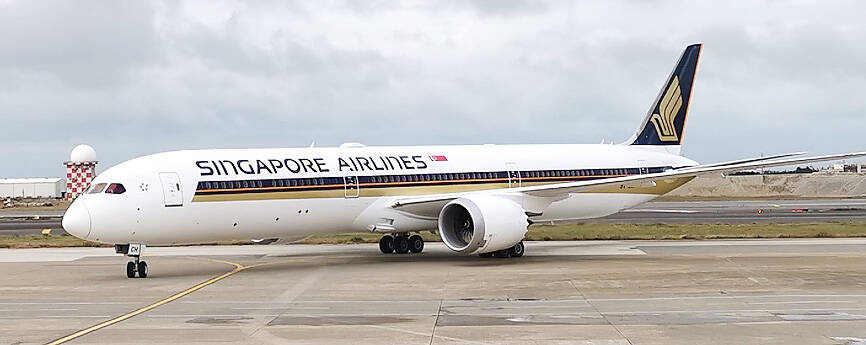
INCREASED CAPACITY: The flights on Mondays, Wednesdays, Fridays and Sundays would leave Singapore in the morning and Taipei in the afternoon Singapore Airlines is adding four supplementary flights to Taipei per week until May to meet increased tourist and business travel demand, the carrier said on Friday. The addition would raise the number of weekly flights it operates to Taipei to 18, Singapore Airlines Taiwan general manager Timothy Ouyang (歐陽漢源) said. The airline has recorded a steady rise in tourist and business travel to and from Taipei, and aims to provide more flexible travel arrangements for passengers, said Ouyang, who assumed the post in July last year. From now until Saturday next week, four additional flights would depart from Singapore on Monday, Wednesday, Friday

Taiwan’s three major international carriers are increasing booking fees, with EVA Airways having already increased the charge to US$28 per flight segment from US$25, while China Airlines (CAL) and Starlux Airlines are set to follow suit. Booking fees are charged by airlines through a global distribution system (GDS) and passed on to passengers. Carriers that apply the fees include CAL, EVA, Starlux and Tigerair Taiwan. A GDS is a computerized network operated by a company that connects airlines with travel agents and ticketing platforms, allowing reservations to be made and processed in real time. Major players include Amadeus, Sabre and Travelport. EVA Air began
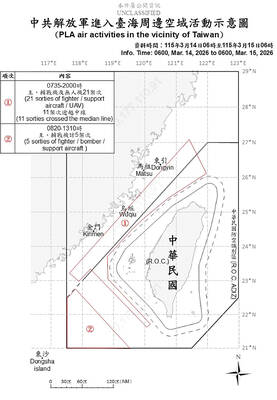
The Ministry of National Defense yesterday reported the return of large-scale Chinese air force activities after their unexplained absence for more than two weeks, which had prompted speculation regarding Beijing’s motives. China usually sends fighter jets, drones and other military aircraft around the nation on a daily basis. Interruptions to such routine are generally caused by bad weather. The Ministry of National Defense said it had detected 26 Chinese military aircraft in the Taiwan Strait over the previous 24 hours. It last reported that many aircraft on Feb. 25, when it spotted 30 aircraft, saying Beijing was carrying out another “joint combat

WATCH FOR HITCHHIKERS: The CDC warned those returning home from Japan to be alert for any contagious diseases that might have come back with them People who have returned from Japan following the World Baseball Classic (WBC) games during the weekend are recommended to watch for symptoms of infectious gastroenteritis, flu and measles for two weeks, the Centers for Disease Control (CDC) said. Flu viruses remain the most common respiratory pathogen in Taiwan in the past four weeks and the influenza B virus accounted for 55.7 percent of the tested cases, exceeding the percentage of influenza A (H3N2) infections and becoming the local dominant strain, CDC Epidemic Intelligence Center Deputy Director Lee Chia-lin (李佳琳) said at a news conference on Tuesday. There were 82,187 hospital visits for


 RSS
RSS