


The Taipei District Court on Thursday acquitted Democratic Progressive Party (DPP) Legislator Pan Meng-an (潘孟安) on charges of injuring former Department of Health (DOH) minister Yeh Ching-chuan (葉金川) in a scuffle at the legislature last year.
In the ruling, the district court judge ruled that Pan was innocent, saying that evidence such as video footage provided by TV news channels showed that former Chinese Nationalist Party (KMT) legislator Chang Sho-wen (張碩文) was the biggest offender in the scuffle.
The judge said that the prosecutors’ decision not to indict Chang raised doubts about their political neutrality.
On Oct. 3 last year, Yeh was caught in a scuffle as lawmakers tried to prevent him from leaving the legislature after a meeting with bakery owners over the government’s response to the health scare over melamine-contaminated food from China.
The KMT caucus accused Pan and DPP Legislator Su Chen-ching (蘇震清) of grabbing the former minister by the neck and choking him, but Pan accused KMT caucus whip Lin Yi-shih’s (林益世) wife Peng Ai-chia (彭愛佳), a TV reporter, of trying to mislead the public into thinking that DPP legislators had resorted to violence.
Yeh was later admitted to National Taiwan University Hospital with high blood pressure.
The judge wrote in his ruling that after examining the evidence, he found Pan not guilty because he did not purposely cause harm to Yeh, and that the pushing and shoving was caused by the massive crowd that was gathered around Yeh.
The judge also criticized prosecutors for using double standards in evaluating whether to indict or not indict, because based on the evidence, Chang grabbed Yeh by the neck with his left hand to stop the former department head from leaving. The judge said that Chang’s action could constitute coercion because he was depriving Yeh of the ability to exercise his free will.
The Taipei District Prosecutors’ Office declined to comment on the ruling, saying only that they have yet to decide whether to file an appeal.
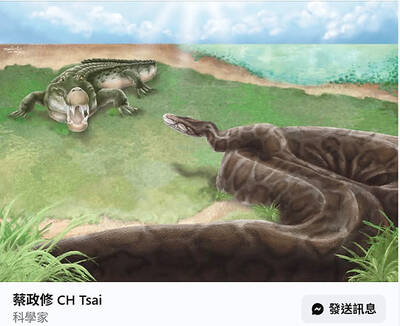
Taiwanese paleontologists have discovered fossil evidence that pythons up to 4m long inhabited Taiwan during the Pleistocene epoch, reporting their findings in the international scientific journal Historical Biology. National Taiwan University (NTU) Institute of Ecology and Evolutionary Biology associate professor Tsai Cheng-hsiu (蔡政修) led the team that discovered the largest snake fossil ever found in Taiwan. The single trunk vertebra was discovered in Tainan at the Chiting Formation, dated to between 400,000 and 800,000 years ago in the Middle Pleistocene, the paper said. The area also produced Taiwan’s first avian fossil, as well as crocodile, mammoth, saber-toothed cat and rhinoceros fossils, it said. Discoveries

Taiwanese paleontologists have discovered fossil evidence that pythons up to 4m long inhabited Taiwan during the Pleistocene epoch, reporting their findings in the international scientific journal Historical Biology. National Taiwan University (NTU) Institute of Ecology and Evolutionary Biology associate professor Tsai Cheng-hsiu (蔡政修) led the team that discovered the largest snake fossil ever found in Taiwan. A single trunk vertebra was discovered in Tainan at the Chiting Formation, dated to between 800,000 to 400,000 years ago in the Middle Pleistocene, the paper said. The area also produced Taiwan’s first avian fossil, as well as crocodile, mammoth, sabre-toothed cat and rhinoceros fossils, it said. Discoveries
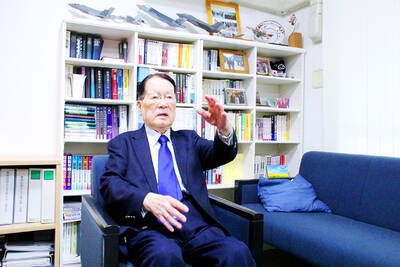
Whether Japan would help defend Taiwan in case of a cross-strait conflict would depend on the US and the extent to which Japan would be allowed to act under the US-Japan Security Treaty, former Japanese minister of defense Satoshi Morimoto said. As China has not given up on the idea of invading Taiwan by force, to what extent Japan could support US military action would hinge on Washington’s intention and its negotiation with Tokyo, Morimoto said in an interview with the Liberty Times (sister paper of the Taipei Times) yesterday. There has to be sufficient mutual recognition of how Japan could provide
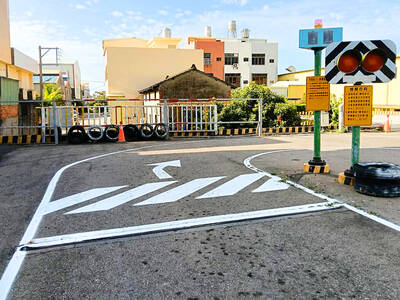
UPDATED TEST: The new rules aim to assess drivers’ awareness of risky behaviors and how they respond under certain circumstances, the Highway Bureau said Driver’s license applicants who fail to yield to pedestrians at intersections or to check blind spots, or omit pointing-and-calling procedures would fail the driving test, the Highway Bureau said yesterday. The change is set to be implemented at the end of the month, and is part of the bureau’s reform of the driving portion of the test, which has been criticized for failing to assess whether drivers can operate vehicles safely. Sedan drivers would be tested regarding yielding to pedestrians and turning their heads to check blind spots, while drivers of large vehicles would be tested on their familiarity with pointing-and-calling


 RSS
RSS