


Dozens of protesters from Changhua County turned out in force in Taipei yesterday to protest the government’s proposed science park in the county’s Erlin Township (二林).
Fearing pollution from the proposed facilities would affect their quality of life, the protesters said they were also concerned about jobs, the environment and the area’s already precarious water supply.
Scores of police stood in front of the Environmental Protection Administration (EPA) headquarters, where officials were deciding on the Environmental Impact Assessment (EIA) of the proposal.

PHOTO: LIU HSIN-DE, TAIPEI TIMES
The committee, led by EPA Minister Stephen Shen (沈世宏), later passed the assessment without major revisions.
Protesters said they wanted to keep Erlin, located in central Taiwan between Yunlin County and the Jhuoshuei River (濁水溪), as one of the few remaining un-industrialized coasts in western Taiwan.
“All this pollution from the science park is going to kill off our livelihood,” a protester named Lin Lien-tzung (林連宗) said. “[The government] doesn’t care about our farmers or our fishermen.”
Holding up pictures showcasing the already polluted river, protesters said that additional pollution from the science park would cripple the area’s fishing industry, affecting up to 20,000 people.
“Most of our fishermen do not have the ability to get a job in the high-tech industry,” Lin said. “Where will these people go?”
Despite Premier Wu Den-yih’s (吳敦義) promise last Tuesday to pump the waste water 3km away, the protesters said this solution was not enough.
They also said the proposal’s huge water demand would exasperate Erlin’s ground subsidence problem, adding that Erlin was already sinking 8.4cm per year, the worst subsidence in the nation.
They were joined by former EIA committee member Thomas Chan (詹順貴). Chan resigned three years ago to protest what he saw as the EPA’s lax attitude toward environmental regulations.
“If this assessment can pass just like that, we might as well get rid of the entire process altogether,” Chan said. “Many concerns and problems were raised, but the committee disregarded them all.”
While Shen said he would take into account the protesters’ concerns by ensuring that regulations and restrictions were rigorously upheld, the EPA remained steadfast in its decision.
Shen said the EPA’s assessment committee had already heard numerous times from a panel of experts. Each time it was told that this project should move forward as soon as possible.
In response to concerns raised about water supplies, representatives from the Central Taiwan Science Park — the government organization responsible for three other science parks — said that only 3 percent of the park’s water would be drawn from the area’s groundwater. The rest would come from the state-run Taiwan Water Corp.
Members of the assessment committee also said that water pollution was within “normal” standards and that it would not affect the fishing industry in the area, especially if it were pumped away from local rivers.
Changhua County Commissioner Cho Po-yuan (卓伯源) agreed, saying that Changhua has long been neglected by the high-tech industry.
Developing high-tech industries along the western coastline was one of President Ma Ying-jeou’s (馬英九) election promises last year.
“It’s not fair for Changhua to be left out of the country’s development … because of isolated protests,” Cho said. “This isn’t the first science park in Taiwan.”
Earlier reports have stated that more than 16 corporations have already pledged investments totaling NT$600 billion (US$18.5 billion) in the Erlin project.

FUKUOKA SITUATION: Japanese media reported that the pathogen is expected to be identified by the summer, while the CDC downplayed the idea that it was hMPV A “mysterious cold-like illness” reported in Japan’s Fukuoka Prefecture does not seem to be a new disease, but Japanese authorities have been asked about the situation, the Centers for Disease Control (CDC) said yesterday. The Fukuoka Prefectural Medical Association on Wednesday told a news conference that a “mystery cold” that has become a hot topic on social media is “highly likely to be caused by some kind of viral infection,” Japan’s KBC News reported. “Many people are experiencing symptoms starting with a sore throat, followed by a runny nose, phlegm and a severe cough,” KBC News reported, citing association officials. Health authorities are

Nvidia Corp CEO Jensen Huang (黃仁勳) arrived in Taiwan yesterday ahead of upcoming AI and technology events, saying he plans to meet with clients and Taiwan Semiconductor Manufacturing Co Chairman C.C. Wei (魏哲家) during his visit. After landing at Taipei Songshan Airport, Huang posed for photos with fans and handed out Yakult drinks to reporters and supporters waiting at the scene, saying he has “a lot to do” during the trip. Asked about reports that Nvidia’s planned headquarters site in Taipei’s Beitou Shilin Technology Park could break ground on May 27, Huang said that if the company holds an event, he would

The Ministry of Finance this afternoon announced the winning numbers for the March-April uniform invoice lottery. The winning number for the NT$10 million (US$318,060) special prize is 19531471, and the winning number for the NT$2 million grand prize is 85941329. Three numbers were drawn for the NT$200,000 first prize: 07225810, 20231230 and 83518781. Those with receipts matching the last seven digits of any of the first-prize numbers will win the NT$40,000 second prize, while those matching the last six digits will win the NT$10,000 third prize. Those whose receipts match the last five digits of the first-prize numbers can claim the NT$4,000 fourth prize,
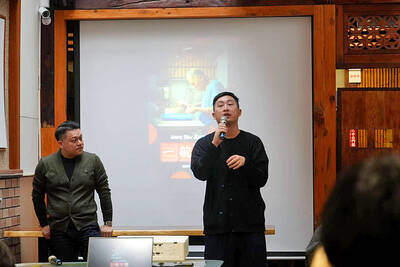
Taiwan Travelogue (臺灣漫遊錄), which earlier this week became the first Taiwanese novel to win the International Booker Prize, is to be adapted into a television series through a Taiwan-Japan coproduction, producer Chang Chen-yu (張辰漁) said yesterday. Chang, a producer at World Softest Production Film Co, wrote on Facebook that the company had been searching for projects with international appeal that retain a strong Taiwanese identity after colleagues and Japanese partners strongly recommended the novel. After reading the book, Chang said he immediately decided to pursue the screen rights. “A great story has the power to transcend time and borders, and connect countless people,”


 RSS
RSS