


■SOCIETY
Man bitten in sex assault
A man had to seek medical treatment after his genitals were bitten while forcing a homeless man to perform oral sex, local media reported yesterday. The incident occurred about 3am on Monday in Daya Park in Taichung County, the Apple Daily said. The man, surnamed Hou (侯), 31, who is homeless, was drunk and loitering in Taya Park when he saw a 60-year-old homeless man, identified only as Kuo (郭), sleeping under a pavilion. Hou woke Kuo up and asked him for money. When Kuo refused to give him money, Hou knocked Kuo to the ground. Kuo pulled himself up and walked into a toilet to urinate. Hou followed him into the toilet, grabbed Kuo’s head and forced Kuo to perform oral sex on him, the paper said. Kuo bit Hou’s genitals, drawing blood and causing Hou flee for help at a police station about 50m away. Police rushed Hou to Cheng Ching Hospital, where doctors said that Hou’s foreskin had several lacerations. Hou was given a tetanus shot and had his wounds treated. The function of his penis was not damaged. After police questioning, Hou was turned over for prosecution on sexual harassment charges.
■CULTURE
Wu mulls ‘Matsu Day’
Premier Wu Den-yih (吳敦義) said yesterday he planned to include Taiwan’s Matsu religious culture in celebrations for the nation’s 100th birthday. When fielding questions from Non-Partisan Solidarity Union Legislator Yen Chin-piao (顏清標), who doubles as chairman of the Da Jia Jenn Lann Temple — a major Matsu temple — the premier also promised to have the Ministry of the Interior consider designating the goddess’ birthday as a national memorial day. Matsu’s birthday falls on March 23 on the Lunar calendar.
■DIPLOMACY
MOFA pushes ‘digital’ ties
The Ministry of Foreign Affairs will continue to push for “digital diplomacy” by holding computer-related training sessions and expositions with its allies in Latin America, Weber Shih (施文斌), director-general of the ministry’s Department of Economic Affairs, said yesterday. Sharing Taiwan’s expertise in computers and information technology can help cement bilateral relations as well as bridge the digital gap, Shih said, citing as an example the Compu Expo held in the Dominican Republic early this month, which generated more than US$7.5 million in business opportunities. Taiwan also conducted a seminar on digital developments in Panama yesterday, he said, with more than 80 officials and computer experts from Taiwan, Guatemala, El Salvador, Nicaragua and Panama expected to attend.
■SOCIETY
Tianmu to hold tree festival
The Taipei City Government said yesterday that part of Tianmu, near Zhongcheng Rd Sec 2, will be closed to traffic on Saturday and Sunday in celebration of the Tianmu Flame Gold-rain Tree Festival. Initiated in 1996 by local businesses, the festival will run from 1pm to 6pm on Saturday and Sunday in front of Eslite Bookstore, featuring various performances and a make-up party. Benjamin Roan (阮燿斌), director of Tianmu Business Association, said the make-up party would be held at 4pm on Sunday, with participants invited to dress up according to the day’s theme — trees. Winners will also receive free coupons from local restaurants. The public is also encouraged to join a book donation activity. The festival takes its name from the approximately 1,600 flame gold-rain trees that stretch along Zhongcheng Road, with the leaves turning yellow and then red around September and October, Roan said.

NATIONAL SECURITY: Authorities are working to confirm the identities of the military personnel involved and investigating possible illegal conduct and regulatory violations Authorities are probing possible national security implications after Kinmen police and immigration officers on Sunday found a Chinese woman allegedly posing as a tourist while engaging in prostitution involving more than 10 military personnel. The woman, surnamed Chen (陳), has since been deported, authorities said, adding that investigators are still working to confirm the identities of those implicated, as the records only listed code names and aliases. The case stemmed from a report received by the Kinmen District Prosecutors’ Office on Friday last week from the Jinhu Precinct of the Kinmen County Police Bureau. On Sunday, police, along with the National Immigration

GLOBALGIVING: ‘ Caving to external pressure is not acceptable for an organization that has cultivated justice reform and human rights for 30 years,’ one NGO said A slew of non-government organizations (NGOs) have withdrawn from the GlobalGiving fundraising platform after it announced it would use “Chinese Taipei” instead of “Taiwan” from next month. The Taiwan Good Rice Association wrote on Facebook on Friday that it was informed on April 28 via a teleconference call of the change, which was made because the platform wanted to operate in China. Taiwan Good Rice is to terminate all cooperative relationships with GlobalGiving in response to the platform’s “unilateral and non-negotiable” decision to remove references to Taiwan, the NGO said. “Taiwan is in the official name of Taiwan Good Rice Association and the

HEAVY WEATHER: Typhoon Jangmi is due to crash straight into the Ryukyus as airlines look to shift flights to larger aircraft or cancel flights to Okinawa entirely Taiwan’s international air carriers announced flight adjustments over the weekend as Typhoon Jangmi is forecast to hit the Ryukyu Islands today and tomorrow. The Central Weather Administration (CWA) upgraded Jangmi from a tropical storm to a typhoon at 8am yesterday, with the eye located 580km south of Naha city. It was moving north at 19kph. Today, China Airlines’ CI-120, CI-121, CI-122 and CI-123 flights between Taoyuan and Naha, Okinawa, have been canceled as well as CI-132 and CI-133 between Kaohsiung and Naha. EVA Air’s BR-112, BR-113, BR-186 and BR-185 flights between Taoyuan and Naha are also canceled. Low-cost carrier Tigerair Taiwan canceled IT-230,
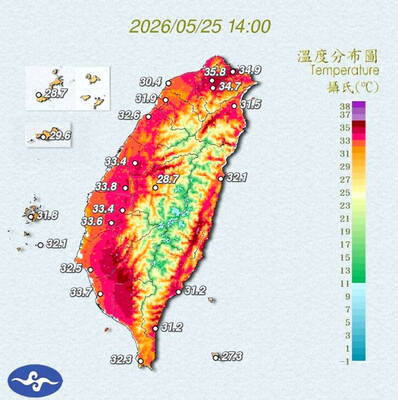
STAY COOL: The HPA recommended that people stay hydrated, use air-conditioning or fans while indoors, wear loose-fitting clothes and walk in the shade while outdoors Employers must implement measures such as installing cooling equipment, and providing drinking water and rest breaks for outdoor workers starting from Monday next week, the Taipei Department of Labor said on Sunday. Employers who fail to comply could face fines of NT$30,000 to NT$300,000 under the Occupational Safety and Health Act (職業安全衛生法), the department said. Businesses in Taipei employing fewer than 100 workers, as well as registered self-employed workers with labor insurance coverage, could receive on-site assessments and guidance from occupational safety consultants to help them apply for central government subsidies to implement or improve heat-protection measures, it said. Under the Ministry of


 RSS
RSS