

A group of local HIV patients are appealing a US court decision that bars them from suing pharmaceutical giant Bayer, their lawyer said yesterday.
The hemophiliac patients say they contracted the virus from blood products sold in Taiwan in the 1980s by US-headquartered Cutter, owned by Bayer, their lead attorney, Michael Baum, said.
The Illinois Federal Court recently ruled that the Taiwan cases were barred by the statute of limitations, although the Taiwanese patients won a motion to proceed in California in January.
“We have filed notices of appeal,” said Baum, of Los Angeles-based law firm Baum, Hedlund, Aristei and Goldman, which has represented 41 Taiwanese hemophiliacs and their relatives since 2003.
At the center of the dispute is a blood product called Koate, used in the early 1980s to make the blood of hemophilia patients clot in the event of injury.
Koate was made by Cutter, which was bought by Bayer in the 1970s.
TAINTED
Taiwanese health authorities banned the product in 1985 after it was found that the product had not been heat-treated and could be tainted with HIV.
But by that time, thousands of people had been affected worldwide, among them at least 53 patients in Taiwan, the Department of Health said.
“I was three years old when I contracted HIV,” said one of the patients, now 27. “My mom told me I took the drug only three times.”
DEATHS
Altogether 36 of the original 53 local patients have died, the patient said.
Cutter and most of the local hemophiliac patients reached an agreement in 1999, with each patient receiving up to NT$2 million (US$62,000).
The money was provided as humanitarian aid since Cutter said it had done nothing wrong.
However, the event developed a twist after the New York Times reported in 2003 that Cutter had continued to market the blood products in Asia even though it was aware of the risk, an allegation Bayer denied.
Bayer Taiwan declined to comment when contacted by reporters.
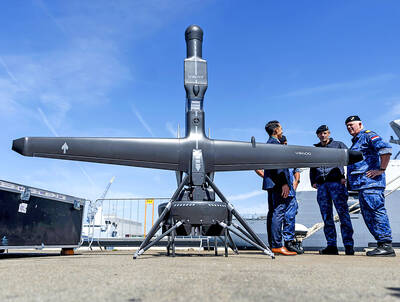
DEFENSE PROCUREMENT: Taiwan could become the largest operator of V-BAT drones outside the US once they are delivered, the Ministry of National Defense said The navy and the coast guard are acquiring 292 units of MQ-35A V-BAT vertical takeoff and landing (VTOL) surveillance drones manufactured by US-based defense technology company Shield AI, making Taiwan one of the largest buyers of the drone. The Coast Guard Administration budgeted NT$1.2 billion (US$37.1 million) to buy 12 drones, which have been delivered, Shield AI said in a report on Oct 13. The navy is planning to spend NT$36 billion under a four-year program code-named Project Yuan Xiao (遠鴞) to acquire 280 V-BAT drones, the Ministry of National Defense’s fiscal 2027 report showed. The combined procurement is expected

The government would continue monitoring online rumors that a pneumonic plague outbreak has spread from Russia into China and could enhance existing quarantine measures, Premier Cho Jung-tai (卓榮泰) said today. During a legislative meeting, Democratic Progressive Party Legislator Wang Ting-yu (王定宇) said rumors were circulating that the disease had spread across several Chinese provinces. He asked Cho whether the government was prepared to prevent the disease from spreading to Taiwan, given the frequent exchanges between Taiwan and China, and how concerned the government was about the alleged outbreak. The Ministry of Health and Welfare implemented border quarantine measures after briefing the Executive Yuan

MAYORAL RACE: Su Chiao-hui made gains by persuading undecided voters and winning over voters in KMT-leaning districts, a pollster said Legislator Su Chiao-hui (蘇巧慧), the Democratic Progressive Party’s (DPP) candidate for New Taipei City mayor, has a 13.1 percentage point lead over her Chinese Nationalist Party (KMT) rival Lee Shu-chuan (李四川), a poll released yesterday showed. The poll, commissioned by the Taipei Trust in Democracy Association, showed that 43.1 percent of respondents said they would vote for Su, up 7.9 percentage points from a poll conducted in late August, while support for Lee was at 30 percent, down 4.7 percentage points. It showed that 48.6 percent of respondents thought Su would make a suitable mayor, compared with 35.9 percent for Lee. Independent candidate

A Chinese People's Liberation Army (PLA) Navy aircraft carrier group was being monitored after entering the western Pacific, the Ministry of National Defense said today, after Beijing yesterday criticized Taiwan for using a water cannon against a Chinese fishing boat near the Pratas Islands (Dongsha Islands, 東沙群島). A Chinese naval task group led by the aircraft carrier Liaoning (遼寧) yesterday sailed to the western Pacific for training, Chinese state-run Xinhua news agency quoted the PLA Navy as saying. “The drill is part of the annual routine training plan aimed at testing and improving the troops’ combat readiness and enhancing their ability to


 RSS
RSS