


President Ma Ying-jeou’s (馬英九) promise to clean up Chinese Nationalist Party (KMT) assets to transform the KMT into a clean party could be empty words as the problems of illicit party assets, election bribery and factional infighting continue to cloud the party, analysts said.
Ma took over for the second time as KMT chairman at the party’s 18th national convention yesterday morning. He promised to deal with party assets and reexamine the role of local factions in an effort to clean up the KMT’s “black gold” image.
Critics, however, cast doubts on Ma’s ability to clean up the KMT because he failed to fulfill the same goal when he served as party chairman in 2005.
Lee Hsiao-feng (李筱峰), a political critic and a professor from National Taipei University, said the KMT had a long history of engaging in election bribery, embezzling money from the government and acting against democracy, and it would be difficult for Ma to eliminate his party’s culture of “black gold.”
“The KMT has counted on organized crime and local factions to operate and win elections. It would be almost impossible for Ma to eradicate black gold and risk losing major elections,” he said.
National Chengchi University political science professor Ku Chung-hua (顧忠華) said Ma already failed on his first attempt to solve the issue of illicit party assets, and it will cost him public support if he fails to fulfill the promise again.
Ma served as KMT party chairman in 2005, but stepped down in 2006 over allegedly embezzling a special allowance fund during his tenure as Taipei mayor. The Taipei District Court found him not guilty in 2007.
Cleaning up party assets was a major goal for Ma when he took over as KMT chairman in 2005 after he pledged to make the party “asset-free.”
The KMT started unloading its illicit assets later that year, selling the building housing the Institute on Policy Research and Development for NT$4.3 billion (US$133.6 million) and three media assets — the China Television Co (CTV), the Broadcasting Corporation of China (BCC) and the Central Motion Picture Co (CMPC) — to the China Times Group for NT$9.3 billion.
Ma, however, failed to sell the Central Investment Co (中央投資公司), which is valued at more than NT$20 billion, during his one-year term. The Democratic Progressive Party challenged the KMT for rushing those sales at lower prices in exchange for cash to pay for election campaigns and for the lack of transparency during the process.
Ku acknowledged Ma’s efforts to clean up party assets, but said just getting rid of the assets would not convince the public because of the messy dealings related to the sale of CMPC, BCC and CTV, while details on what happened to the huge sums of money made from these asset sales have been carefully concealed.
Ma had said the party would pay off debts and put the rest of the money from the transactions into pensions for retired workers. However, in 2006, the year after the party sold the assets for more than NT$13 billion, the KMT claimed it had spent all the money and could not even pay party workers’ year-end bonuses.
Placating the party’s old guard and overhauling its local factions, as well as its decision-making bodies headed by the central standing committee, are also daunting for Ma’s party reform attempts, he said.
Ku said recent bribery allegations at the party’s central standing committee election and alleged under-the-table deals in the Taitung County commissioner election put Ma in an embarrassing position as the party continues to rely on vote-buying and influence peddling among local factions in elections.
The party elected 32 central standing committee members last week amid allegations of bribery. The KMT promised to annul the election of any member found guilty of bribing voters, but no actions have been made. As to the Taitung County commissioner election, the party’s nominee Justin Huang (黃健庭) resigned as KMT legislator last week to focus on the upcoming battle.
It is speculated, however, that the KMT made an under-the-table deal with Taitung County Commissioner Kuang Li-chen (鄺麗貞) when it dissuaded her from running for re-election by promising to nominate her or her ex-husband, former Taitung County commissioner Wu Chun-li (吳俊立), for the legislative by-election.
“It’s like a slap in the face for Ma. It is extremely difficult to bring fundamental change to the party when he has to count on local factions to win the year-end elections,” Ku said.
The party is also scrambling to deal with splits in Yunlin, Hualien, Hsinchu, Chiayi, Nantou and Kinmen.
“Ma will make some compromises because no party can afford to lose the elections,” Lee said.
Wang Kun-yi (王崑義), a professor at National Taiwan Ocean University, said Ma also doubled as KMT chairman to facilitate the implementation of his cross-strait policies.
The Ma administration could become authoritarian and push through cross-strait policies without supervision if the Democratic Progressive Party (DPP) fails to keep the KMT’s performance in check, Wang said.

STAY AWAY: An official said people should avoid disturbing snakes, as most do not actively attack humans, but would react defensively if threatened Taitung County authorities yesterday urged the public to stay vigilant and avoid disturbing snakes in the wild, following five reported snakebite cases in the county so far this year. Taitung County Fire Department secretary Lin Chien-cheng (林建誠) said two of the cases were in Donghe Township (東河) and involved the Taiwan habus, one person was bit by a Chinese pit viper near the South Link Railway and the remaining two were caused by unidentified snakes. He advised residents near fields to be cautious of snakes hiding in shady indoor areas, especially when entering or leaving their homes at night. In case of a
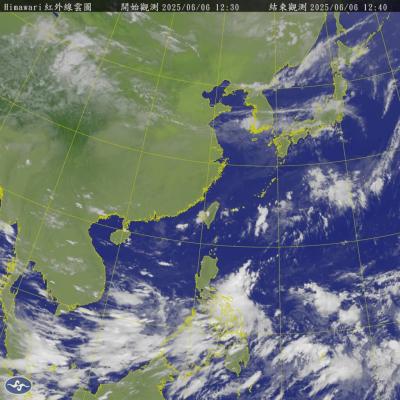
A tropical disturbance off the southeastern coast of the Philippines might become the first typhoon of the western Pacific typhoon season, the Central Weather Administration (CWA) said. The system lacks a visible center and how it would develop is only likely to become clear on Sunday or Monday, the CWA said, adding that it was not yet possible to forecast the potential typhoon's effect on Taiwan. The American Meteorological Society defines a tropical disturbance as a system made up of showers and thunderstorms that lasts for at least 24 hours and does not have closed wind circulation.

ENERGY RESILIENCE: Although Alaska is open for investments, Taiwan is sourcing its gas from the Middle East, and the sea routes carry risks, Ho Cheng-hui said US government officials’ high-profile reception of a Taiwanese representative at the Alaska Sustainable Energy Conference indicated the emergence of an Indo-Pacific energy resilience alliance, an academic said. Presidential Office Secretary-General Pan Men-an (潘孟安) attended the conference in Alaska on Thursday last week at the invitation of the US government. Pan visited oil and gas facilities with senior US officials, including US Secretary of the Interior Doug Burgum, US Secretary of Energy Chris Wright, Alaska Governor Mike Dunleavy and US Senator Daniel Sullivan. Pan attending the conference on behalf of President William Lai (賴清德) shows a significant elevation in diplomatic representation,

Credit departments of farmers’ and fishers’ associations blocked a total of more than NT$180 million (US$6.01 million) from being lost to scams last year, National Police Agency (NPA) data showed. The Agricultural Finance Agency (AFA) said last week that staff of farmers’ and fishers’ associations’ credit departments are required to implement fraud prevention measures when they serve clients at the counter. They would ask clients about personal financial management activities whenever they suspect there might be a fraud situation, and would immediately report the incident to local authorities, which would send police officers to the site to help, it said. NPA data showed


 RSS
RSS