


One of the nation’s top weather forecasters will retire early next month in a move that some say could be the result of the heavy criticism the bureau has faced recently, media reports said yesterday.
After 30 years of service at the Central Weather Bureau (CWB), senior forecaster and chief of the weather forecast center Daniel Wu (吳德榮) is set to retire.
“Wu’s retirement is not only a loss for the bureau, but for the country as well,” bureau Director Shin Tzay-chyn (辛在勤) said as he confirmed news of Wu’s retirement yesterday.
“The public often accused the bureau of not providing accurate forecasts after Taiwan suffered serious damage from several typhoons in the past two years. This kind of atmosphere can be frustrating for forecasters,” he said.
Shin said that despite the bureau’s best efforts to provide accurate forecasts, continued criticism may have been the reason behind the 56-year-old Wu’s decision to leave the bureau nine years before his legal retirement age.
Wu first tendered his resignation when the bureau was criticized for making inaccurate forecasts after Typhoon Kalmaegi devastated parts of southern and central Taiwan in July last year, the United Evening News said.
He stayed because then-bureau chief Hsin Chiang-lin (辛江霖) did not approve his resignation.
However, Wu applied for retirement again when the bureau was criticized by President Ma Ying-jeou (馬英九), academics and the public regarding its forecasts for Typhoon Morakot in August, which brought rainfall that far surpassed predictions by the bureau, causing landslides and flooding that killed more than 700 people.
Wu’s mother had just passed away at the time, but he stayed on the job and only took care of his mother’s funeral after Morakot had departed.
Even more frustrating for Wu was the Control Yuan’s investigation of forecasters, the report said.
After attempts to convince Wu to stay, Shin approved his retirement application, effective on Nov. 2.
Packing his personal belongings in the office on Tuesday, Wu did not say much about his early retirement, saying he wanted to spend more time with his family.

LOUD AND PROUD Taiwan might have taken a drubbing against Australia and Japan, but you might not know it from the enthusiasm and numbers of the fans Taiwan might not be expected to win the World Baseball Classic (WBC) but their fans are making their presence felt in Tokyo, with tens of thousands decked out in the team’s blue, blowing horns and singing songs. Taiwanese fans have packed out the Tokyo Dome for all three of their games so far and even threatened to drown out home team supporters when their team played Japan on Friday. They blew trumpets, chanted for their favorite players and had their own cheerleading squad who dance on a stage during the game. The team struggled to match that exuberance on the field, with
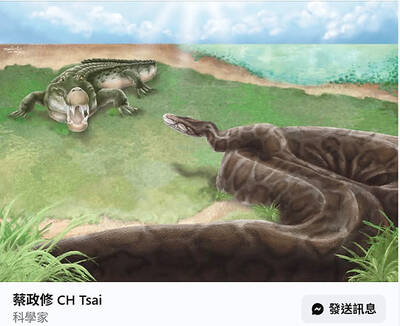
Taiwanese paleontologists have discovered fossil evidence that pythons up to 4m long inhabited Taiwan during the Pleistocene epoch, reporting their findings in the international scientific journal Historical Biology. National Taiwan University (NTU) Institute of Ecology and Evolutionary Biology associate professor Tsai Cheng-hsiu (蔡政修) led the team that discovered the largest snake fossil ever found in Taiwan. The single trunk vertebra was discovered in Tainan at the Chiting Formation, dated to between 400,000 and 800,000 years ago in the Middle Pleistocene, the paper said. The area also produced Taiwan’s first avian fossil, as well as crocodile, mammoth, saber-toothed cat and rhinoceros fossils, it said. Discoveries

Taiwanese paleontologists have discovered fossil evidence that pythons up to 4m long inhabited Taiwan during the Pleistocene epoch, reporting their findings in the international scientific journal Historical Biology. National Taiwan University (NTU) Institute of Ecology and Evolutionary Biology associate professor Tsai Cheng-hsiu (蔡政修) led the team that discovered the largest snake fossil ever found in Taiwan. A single trunk vertebra was discovered in Tainan at the Chiting Formation, dated to between 800,000 to 400,000 years ago in the Middle Pleistocene, the paper said. The area also produced Taiwan’s first avian fossil, as well as crocodile, mammoth, sabre-toothed cat and rhinoceros fossils, it said. Discoveries

Whether Japan would help defend Taiwan in case of a cross-strait conflict would depend on the US and the extent to which Japan would be allowed to act under the US-Japan Security Treaty, former Japanese minister of defense Satoshi Morimoto said. As China has not given up on the idea of invading Taiwan by force, to what extent Japan could support US military action would hinge on Washington’s intention and its negotiation with Tokyo, Morimoto said in an interview with the Liberty Times (sister paper of the Taipei Times) yesterday. There has to be sufficient mutual recognition of how Japan could provide


 RSS
RSS