


On the 10th anniversary of the massive earthquake that struck the nation at 1:47am on Sept. 21, 1999, employees at the Chu Shan Show Chwan Hospital, which was badly damaged in one of the worst affected areas, recalled the difficulties they faced during the aftermath and reflected on the lessons learned.
The head nurse on duty, Su Chen-hua and the nursing staff rushed about trying to evacuate the 147 patients and salvage what they could of life-support equipment. The only things they could see, however, were warped doors and corridors, gaping ceilings, rubble, broken fire hydrants spouting water and collapsed walls.
The two-year-old private hospital, located just 65m from the Chelungpu Fault (車籠埔斷層) in central Taiwan — the epicenter of the magnitude 7.3 quake — was heavily damaged. Some thought it was beyond salvage.
Initial estimates showed that repairing or rebuilding the 13-story hospital would cost NT$150 million (US$4.62 million). None of the shareholders was willing to invest any more than they already had.
Chuang Pi-kun (莊碧焜), the hospital’s vice president, said that when senior government officials visited the hospital during post-quake inspection tours, they promised government aid — offers that never materialized.
“Gradually, we came to understand that we would have to rely on ourselves,” he said.
The main task was to make the hospital functional again so it could provide care for earthquake survivors, while charting a path for its survival.
A week after the earthquake, the hospital managed to set up a field unit in nearby Putou (埔頭), near Jhushan (竹山), but this was not enough to put the hospital back online. Hsieh Hui-lung (謝輝龍), president of Show Chwan, said he was tempted to give up his goal of restoring the hospital, but his resolve to rebuild the hospital grew firmer when a surprising donation came weeks after the earthquake from a patient who handed Hsieh a check for NT$200,000. The patient, surnamed Wu (吳), had obtained the money from a government compensation program for his house.
Other offers of help came from hospitals in Changhua, Taoyuan, Yunlin, Tainan and other parts of the country that donated medical equipment and other items to help Show Chwan Hospital resume operations.
Hwang Ming-ho (黃明和), founder and chairman of the Show Chwan Hospitals Group, donated a 130-ping (430m³) prefabricated building, while Yang Ming Marine Transport Corp (陽明海運) and Evergreen Marine Corp (長榮海運) rented 58 containers to be used by the hospital as makeshift facilities.
On Nov. 1, 1999, the “container hospital” — likely the first of its kind in the world — opened to the public.
However, Show Chwan could not continue indefinitely to operate from a cluster of containers. After inspections and assessments by structural and civil engineers and geologists, it was determined that the main structure of the hospital could be repaired. The restoration project was completed in 2000 and the hospital reopened the same year.
Years later, Hsieh said the 921 Earthquake underscored the need to make hospitals disaster proof.
“Major emergencies and disasters can be compounded if health facilities fail,” he said.
For reconstruction, high-end materials that can absorb seismic shocks were used to reduce the risk of sudden collapse, he said.
The hospital now has backup power and water systems and special designs and devices to ensure that critical medical facilities remain functional after a major earthquake, Hsieh said, adding that the hospital has prioritized disaster emergency training with its medical and paramedical staff because a community-based hospital must be able to offer first-aid treatment after major disasters.
A communication network with other healthcare providers in the area has also been developed so that a strong support system is in place in the event of a disaster, Hsieh said.
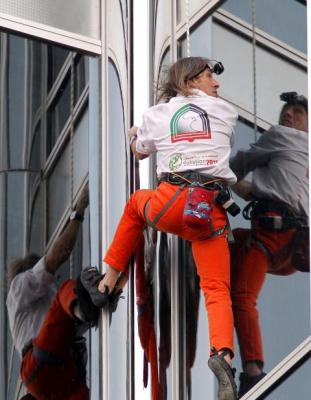
Alain Robert, known as the "French Spider-Man," praised Alex Honnold as exceptionally well-prepared after the US climber completed a free solo ascent of Taipei 101 yesterday. Robert said Honnold's ascent of the 508m-tall skyscraper in just more than one-and-a-half hours without using safety ropes or equipment was a remarkable achievement. "This is my life," he said in an interview conducted in French, adding that he liked the feeling of being "on the edge of danger." The 63-year-old Frenchman climbed Taipei 101 using ropes in December 2004, taking about four hours to reach the top. On a one-to-10 scale of difficulty, Robert said Taipei 101
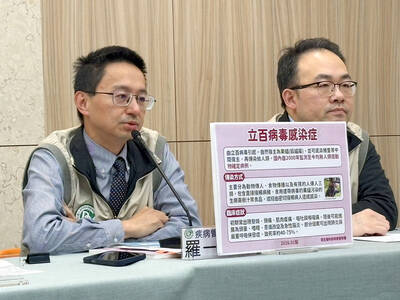
Nipah virus infection is to be officially listed as a category 5 notifiable infectious disease in Taiwan in March, while clinical treatment guidelines are being formulated, the Centers for Disease Control (CDC) said yesterday. With Nipah infections being reported in other countries and considering its relatively high fatality rate, the centers on Jan. 16 announced that it would be listed as a notifiable infectious disease to bolster the nation’s systematic early warning system and increase public awareness, the CDC said. Bangladesh reported four fatal cases last year in separate districts, with three linked to raw date palm sap consumption, CDC Epidemic Intelligence

Two Taiwanese prosecutors were questioned by Chinese security personnel at their hotel during a trip to China’s Henan Province this month, the Mainland Affairs Council (MAC) said yesterday. The officers had personal information on the prosecutors, including “when they were assigned to their posts, their work locations and job titles,” MAC Deputy Minister and spokesman Liang Wen-chieh (梁文傑) said. On top of asking about their agencies and positions, the officers also questioned the prosecutors about the Cross-Strait Joint Crime-Fighting and Judicial Mutual Assistance Agreement, a pact that serves as the framework for Taiwan-China cooperation on combating crime and providing judicial assistance, Liang
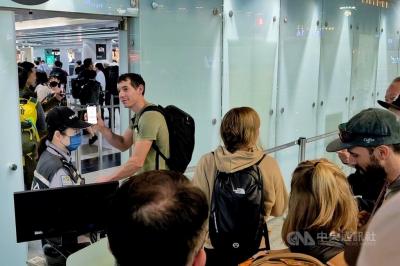
US climber Alex Honnold left Taiwan this morning a day after completing a free-solo ascent of Taipei 101, a feat that drew cheers from onlookers and gained widespread international attention. Honnold yesterday scaled the 101-story skyscraper without a rope or safety harness. The climb — the highest urban free-solo ascent ever attempted — took just more than 90 minutes and was streamed live on Netflix. It was covered by major international news outlets including CNN, the New York Times, the Guardian and the Wall Street Journal. As Honnold prepared to leave Taiwan today, he attracted a crowd when he and his wife, Sanni,


 RSS
RSS