


Transportation experts have suggested that the government factor in climate change and reconsider construction methods used for transportation infrastructure when repairing or rebuilding highways and bridges devastated by Typhoon Morakot.
Professor Jason Chang (張學孔) of the civil engineering department at National Taiwan University said the Ministry of Transportation and Communications (MOTC) should raise construction standards for highways and bridges to counter challenges brought on by climate change.
“Many of the nation’s transportation facilities were built with the premise that big floods will only occur once every 100 years or 200 years,” Chang said. “But given the changing rainfall patterns nowadays, we might have to change that premise by shortening the presumed frequency to perhaps once every 50 years.”
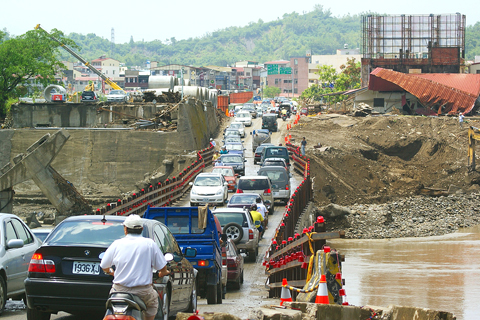
PHOTO: HUANG CHIA-LIN, TAIPEI TIME
“Each transportation facility must be built with a stronger structure to withstand such floods,” he said.
Aside from challenges brought by extreme weather conditions, Chang said that the methods used to construct highways or bridges would also have to change.
“In the past, we liked to straighten supposedly meandering routes to reduce travel time for people,” Chang said. “So if we could use any method to shorten the route, we just went ahead and did it.”
“After the damage suffered this time, we should start building bridges or roads by yielding to the form of natural terrain as much as possible,” Chang said.
>
“This means that it might take longer to build. But there is always a tradeoff. Do we want something that was built fast and is potentially unsafe, or do we sacrifice expediency to build something that can coexist with nature and last longer?” he asked.
When rebuilding damaged infrastructure in new locations, the MOTC will have to be very careful in choosing the sites and avoid geologically sensitive zones, Chang said.
“The problem has already occurred when they constructed the Hsuehshan Tunnel, with the route they chose passing through several water veins in northern regions,” Chang said.
Professor Wang Jung-yue (王仲宇) of National Central University is one of a number of consultants recruited by the Public Construction Commission (PCC) to draw up a set of guidelines for rebuilding damaged bridges. Wang also stressed the importance of climate change.
“Any bridge reconstruction that fails to take into account climate change would only be a waste of money and labor,” Wang said.
Earlier this year, the Directorate General of Highways (DGH) completed a comprehensive inspection on bridges of provincial and county highways nationwide and listed 50 bridges that need to be repaired.
The directorate’s general secretary Mile Chen (陳茂南) said the DGH had to not only conduct a new nationwide inspection of bridges, but also had to review the conditions previously set for closing the bridges.
“We have learned something this time from the Shuangyuan Bridge (雙園大橋), which collapsed before the water in the river rose to the height that had been deemed dangerous enough to shut down the bridge,” Chen said.
Chen said the bridge is located at the mouth of a river, which makes it difficult to gauge the real water level because of tidal differences.
“We cannot use the water level as the only indicator to decide if we should close the bridge anymore,” Chen said. “When we set the standards, we also need to consider other factors, such as the speed of the river flow, the characteristics of the river basin and the extent to which the water scours the bridge piers.”
Meanwhile, Chen said, there was a need to set up an alarm system that monitors changes in water level upstream during stormy weather.
The engineers at the DGH also have to be trained to interpret various data provided by the Water Resources Agency to make better judgments on how it could take proactive action to protect bridges.
The MOTC has estimated that it needs a total of approximately NT$31 billion (US$942 million) to repair damaged facilities under its administration. Among them, about NT$29 billion will be appropriated to the DGH to restore devastated highways.
The Central Weather Bureau has identified the towns in southern Taiwan that received the highest accumulated rainfall when the nation was hit by Morakot between Aug. 7 and Aug. 10: Dapu (大埔), Alishan (阿里山) and Juci (竹崎) in Chiayi, Liouguei (六龜), Jiasian (甲仙) and Taoyuan (桃源) in Kaohsiung and Sandimen (三地門) in Pingtung.
These towns received an average of 74 percent of their usual annual rainfall during the three days.
Liouguei, Jiasian and Juci were also on the nation’s top 10 accumulated rainfall list when Tropical Storm Kalmaegi hit last year.
Liu Chung-ming (柳中明), director of the Global Change Research Center at National Taiwan University, said the nation had to get used to extreme weather.
“We just had the highest temperature ever recorded, 39.5˚C, in Hsinchu the week before Morakot came,” Liu said. “The next thing you know we receive the heaviest rainfall so far this year.”
Liu said that between 1960 and 2000, an average of 30 typhoons and tropical storms formed in the Northwest Pacific Ocean per year. Between 2000 and last year, the number dropped to an average of 24 per year.
Before 2000, only about 4.5 typhoons would actually affect Taiwan, but from 2000 to last year, an average of 7.1 typhoons hit the nation each year.
So far, three typhoons have made landfall this year and only nine tropical storms and typhoons have formed in the Northwest Pacific Ocean.

LOUD AND PROUD Taiwan might have taken a drubbing against Australia and Japan, but you might not know it from the enthusiasm and numbers of the fans Taiwan might not be expected to win the World Baseball Classic (WBC) but their fans are making their presence felt in Tokyo, with tens of thousands decked out in the team’s blue, blowing horns and singing songs. Taiwanese fans have packed out the Tokyo Dome for all three of their games so far and even threatened to drown out home team supporters when their team played Japan on Friday. They blew trumpets, chanted for their favorite players and had their own cheerleading squad who dance on a stage during the game. The team struggled to match that exuberance on the field, with
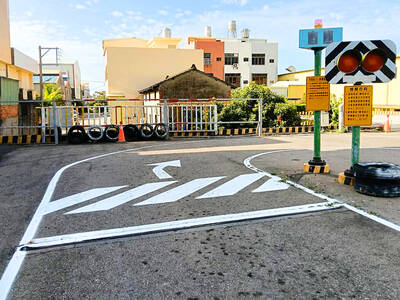
UPDATED TEST: The new rules aim to assess drivers’ awareness of risky behaviors and how they respond under certain circumstances, the Highway Bureau said Driver’s license applicants who fail to yield to pedestrians at intersections or to check blind spots, or omit pointing-and-calling procedures would fail the driving test, the Highway Bureau said yesterday. The change is set to be implemented at the end of the month, and is part of the bureau’s reform of the driving portion of the test, which has been criticized for failing to assess whether drivers can operate vehicles safely. Sedan drivers would be tested regarding yielding to pedestrians and turning their heads to check blind spots, while drivers of large vehicles would be tested on their familiarity with pointing-and-calling

Whether Japan would help defend Taiwan in case of a cross-strait conflict would depend on the US and the extent to which Japan would be allowed to act under the US-Japan Security Treaty, former Japanese minister of defense Satoshi Morimoto said. As China has not given up on the idea of invading Taiwan by force, to what extent Japan could support US military action would hinge on Washington’s intention and its negotiation with Tokyo, Morimoto said in an interview with the Liberty Times (sister paper of the Taipei Times) yesterday. There has to be sufficient mutual recognition of how Japan could provide

A Taiwanese man apologized on Friday after saying in a social media post that he worked with Australia to provide scouting reports on Taiwan’s team, enabling Australia’s victory in this year’s World Baseball Classic (WBC), saying it was a joke and that he did not hold any position with foreign teams or Taiwan’s sports training center. Chen Po-hao (陳柏豪) drew the rage of many Taiwan baseball fans when he posted online on Thursday night, claiming credit for Australia’s 3-0 win over Taiwan in the opening game for Pool C, saying he worked as a physical therapist with the national team and


 RSS
RSS