


The nation’s religious groups expressed mixed views over the visit of the Dalai Lama, who is scheduled to arrive tonight and will tour disaster areas in southern Taiwan to hold religious services for Typhoon Morakot victims.
“This is not an appropriate time for the Dalai Lama to come,” said Master Ching Liang (淨良法師), chairman of the Buddhist Association of the Republic of China.
He said that while the government and public were busy with relief efforts for Morakot victims, the visit of an international celebrity such as the Dalai Lama would not help much. He also said part of the much-needed manpower and resources may be moved for the Dalai Lama’s convenience, adding that it would be much better to put all the resources into relief efforts.
Cheng Ming-kun (鄭銘坤), vice chairman of the Jenn Lann Temple (鎮瀾宮) in Taichung County’s Dajia Township (大甲), criticized the invitation issued by seven Democratic Progressive Party (DPP) county heads as a move to use typhoon victims for political gain.
Cheng said that while many local religious groups have been working diligently to help victims, the move “erases local religious groups’ credit.”
He questioned how much a religious service by the Dalai Lama could do to help in reconstruction, and said it was a waste of precious resources to take care of the Dalai Lama on his visit.
“The Taiwanese should believe in the Taiwanese,” he said, noting that the Jenn Lann Temple held a religious service for the victims as well. “Don’t let politicians use helping victims as an excuse to invite someone from abroad.”
Fo Guang Shan Monastery (佛光山), a Kaohsiung-based Buddhist monastery that helped many storm victims, declined to comment, while the spokesman for the Buddhist Compassionate Relief Tzu Chi Foundation (慈濟), another organization that has been helping victims, could not be reached for comments as of press time.
While the vice-chairman disagreed with the Dalai Lama’s visit, Jenn Lann Temple’s chairman Yen Chin-piao (顏清標) said yesterday that religious services for victims were a good thing, whether it’s hosted by local or foreign religious figures, as long as they stay religious and do not get too political.
On the other hand, Christians in Taiwan seem to be more welcoming.
Hsu Cheng-tao (許承道), a pastor and spokesman for the Presbyterian Church in Taiwan, said religious diversity should be respected.
He said that instead of turning the Dalai Lama’s visit into a war of words, religious organizations in Taiwan should think about how to turn the visit into a helping force.
Catholic Cardinal Paul Shan (單國璽), who is scheduled to meet with the Dalai Lama on Tuesday, held a similar view.
“I hope the visit [by the Dalai Lama] would not be complicated and politicized as the visit is purely [from] a religious figure who wishes to soothe the victims’ spirits and give them blessings,” he said when reached by the Taipei Times for comment.
“In the face of the disaster, one should transcend partisanship and religious and ethnic differences,” he said. “The most important thing is to comfort and encourage the victims so they have the strength to rebuild their homes.”
ADDITIONAL REPORTING BY STAFF WRITER
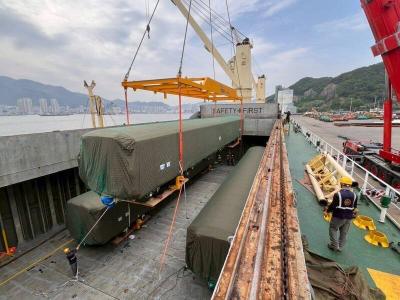
The first of 10 new high-capacity trains purchased from South Korea’s Hyundai Rotem arrived at the Port of Taipei yesterday to meet the demands of an expanding metro network, Taipei Rapid Transit Corp (TRTC) said yesterday. The train completed a three-day, 1,200km voyage from the Port of Masan in South Korea, the company said. Costing NT$590 million (US$18.79 million) each, the new six-carriage trains feature a redesigned interior based on "human-centric" transportation concepts, TRTC said. The design utilizes continuous longitudinal seating to widen the aisles and optimize passenger flow, while also upgrading passenger information displays and driving control systems for a more comfortable
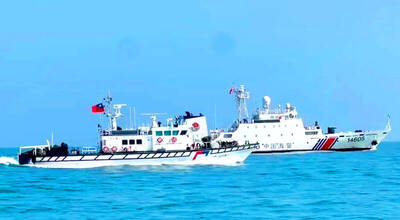
Instead of focusing solely on the threat of a full-scale military invasion, the US and its allies must prepare for a potential Chinese “quarantine” of Taiwan enforced through customs inspections, Stanford University Hoover fellow Eyck Freymann said in a Foreign Affairs article published on Wednesday. China could use various “gray zone” tactics in “reconfiguring the regional and ultimately the global economic order without a war,” said Freymann, who is also a nonresident research fellow at the US Naval War College. China might seize control of Taiwan’s links to the outside world by requiring all flights and ships entering or leaving Taiwan
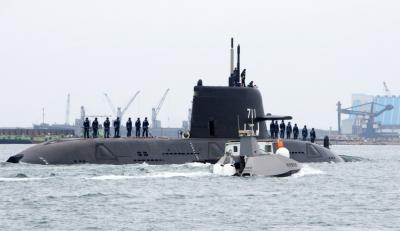
Taiwan's first indigenous defense submarine, the SS-711 Hai Kun (海鯤, or Narwhal), departed for its 13th sea trial at 7am today, marking its seventh submerged test, with delivery to the navy scheduled for July. The outing also marked its first sea deployment since President William Lai (賴清德) boarded the submarine for an inspection on March 19, drawing a crowd of military enthusiasts who gathered to show support. The submarine this morning departed port accompanied by CSBC Corp’s Endeavor Manta (奮進魔鬼魚號) uncrewed surface vessel and a navy M109 assault boat. Amid public interest in key milestones such as torpedo-launching operations and overnight submerged trials,
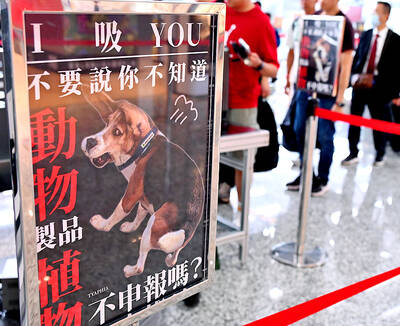
Quarantine awareness posters at Taiwan Taoyuan International Airport have gone viral for their use of wordplay. Issued by the airport branch of the Animal and Plant Health Inspection Agency, the posters feature sniffer dogs making a range of facial expressions, paired with advisory messages built around homophones. “We update the messages for holidays and campaign needs, periodically refreshing materials to attract people’s attention,” quarantine officials said. “The aim is to use the dogs’ appeal to draw focus to quarantine regulations.” A Japanese traveler visiting Taiwan has posted a photo on X of a poster showing a quarantine dog with a


 RSS
RSS