


The Tourism Bureau estimates that Typhoon Morakot caused approximately NT$10.4 billion (US$315 million) in losses to the nation’s tourism industry.
“The estimates include losses caused by a decrease in the numbers of both overseas and domestic tourists, as well as damage to the nation’s tourist attractions,” said the bureau’s director general Janice Lai (賴瑟珍).
“We issued a press release on Aug. 11, in Chinese, English and Japanese, and sent it to our offices overseas,” she said. “We want to assure our friends in the international community that except for Alishan, which remains inaccessible at this point, a majority of the nation’s tourist attractions are intact.”
The Alishan National Scenic Area Administration has decided to relocate the venue for Aboriginal dance performances from the Alishan National Forest Recreation Area to a location near Wufeng Temple (吳鳳廟), which is in Chiayi’s Jhongpu Township (中埔).
It also plans to repair damaged hiking trails near several towns around Alishan that were only slightly affected by the typhoon, such as Rueili (瑞里) in Chiayi.
The Tourism Bureau will launch a series of promotional events from next month to December aimed at helping small businesses in Alishan.
The Sunrise Concert on Alishan, traditionally held on New Year’s Day, will also be a memorial concert for the victims, Lai said.
“We will also provide updated information on construction work on Highway 18 [to Alishan] on our home page,” she said.
The Directorate General of Highways has estimated that it will take at least two years to completely repair Highways 18 and 21 to allow them to be accessed by large tour buses.
Lai said bureau officials are scheduled to attend travel fairs in Malaysia, Singapore and Japan next month. The bureau will also hold a special event for tourists from Hong Kong to allow about 600 of them to visit tourist attractions in southern Taiwan.
“The bureau will also invite Chinese travel agents to check out well-known tourist attractions like Sun Moon Lake that have not been damaged by the typhoon and scout for non-traditional travel routes for Chinese tourists,” Lai said.
The annual Hot Spring Festival was supposed to be held by Taipei City this year, but Lai said the city voluntarily gave up the opportunity to allow it to be held in Chipen (知本) in Taitung County instead.
According to the Bureau, visits by international tourists have dropped by about 10 percent because of Morakot. The number of Chinese tourists, in particular, has declined from an average of 2,000 per day last month to an average of about 700 this week.
The numbers of domestic tourists has also decreased by 10 percent to 15 percent.

The military has spotted two Chinese warships operating in waters near Penghu County in the Taiwan Strait and sent its own naval and air forces to monitor the vessels, the Ministry of National Defense (MND) said. Beijing sends warships and warplanes into the waters and skies around Taiwan on an almost daily basis, drawing condemnation from Taipei. While the ministry offers daily updates on the locations of Chinese military aircraft, it only rarely gives details of where Chinese warships are operating, generally only when it detects aircraft carriers, as happened last week. A Chinese destroyer and a frigate entered waters to the southwest
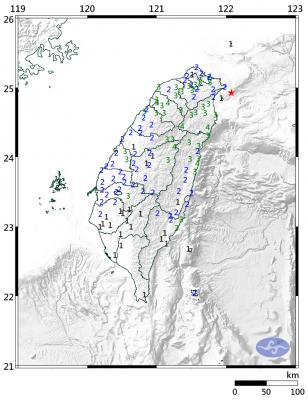
A magnitude 6.1 earthquake struck off the coast of Yilan County at 8:39pm tonight, the Central Weather Administration (CWA) said, with no immediate reports of damage or injuries. The epicenter was 38.7km east-northeast of Yilan County Hall at a focal depth of 98.3km, the CWA’s Seismological Center said. The quake’s maximum intensity, which gauges the actual physical effect of a seismic event, was a level 4 on Taiwan’s 7-tier intensity scale, the center said. That intensity level was recorded in Yilan County’s Nanao Township (南澳), Hsinchu County’s Guansi Township (關西), Nantou County’s Hehuanshan (合歡山) and Hualien County’s Yanliao (鹽寮). An intensity of 3 was

Japanese Prime Minister Sanae Takaichi’s comment last year on Tokyo’s potential reaction to a Taiwan-China conflict has forced Beijing to rewrite its invasion plans, a retired Japanese general said. Takaichi told the Diet on Nov. 7 last year that a Chinese naval blockade or military attack on Taiwan could constitute a “survival-threatening situation” for Japan, potentially allowing Tokyo to exercise its right to collective self-defense. Former Japan Ground Self-Defense Force general Kiyofumi Ogawa said in a recent speech that the remark has been interpreted as meaning Japan could intervene in the early stages of a Taiwan Strait conflict, undermining China’s previous assumptions
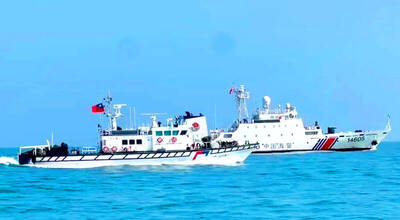
Instead of focusing solely on the threat of a full-scale military invasion, the US and its allies must prepare for a potential Chinese “quarantine” of Taiwan enforced through customs inspections, Stanford University Hoover fellow Eyck Freymann said in a Foreign Affairs article published on Wednesday. China could use various “gray zone” tactics in “reconfiguring the regional and ultimately the global economic order without a war,” said Freymann, who is also a nonresident research fellow at the US Naval War College. China might seize control of Taiwan’s links to the outside world by requiring all flights and ships entering or leaving Taiwan


 RSS
RSS