


■ DIPLOMACY
AIT chief arriving in August
The Ministry of Foreign Affairs said yesterday that the new director of the American Institute in Taiwan (AIT) would assume his post late next month, but the exact date would be announced by Washington. Harry Tseng (曾厚仁), director-general of the ministry's Department of North American Affairs, said that before the new US envoy, William Stanton, heads to Taiwan, he would meet local correspondents and media today in Washington. Stanton is expected to give a short on-the-record talk and then answer questions off the record, Tseng said. Tseng also reiterated Taiwan's support for Stanton's appointment. “The foreign ministry welcomes the designation of Stanton, who is very familiar with Asian affairs and is closely following current developments across the Taiwan Strait. We believe that he is the right person for the post,” Tseng said.
■ FESTIVALS
Canada holding Taiwan fest
The 20th annual Taiwan Fest in Canada will start on Aug. 25 in Toronto and on Aug. 27 in Vancouver. Called the “New Journey,” the festival will feature different aspects of Taiwanese arts and cultures, ranging from fashion to music, movies, cuisines and the performing arts. Several popular Taiwanese indie bands will play at the two events and participants will also be treated to an exhibition of the latest Taiwanese fashion. A film festival will showcase many recent Taiwanese features, including Cape No. 7 and Blue Brave. For more information, visit www.taiwanfest.ca.
■ ENVIRONMENT
Whale-watching tours drop
The number of whale and dolphin watchers in Hualien is estimated to drop by between 20 percent and 30 percent compared with last year because of the economic downturn, industry workers said. Groups of visitors used to flock to Hualien in summer for cetacean-watching tours, except in bad weather conditions such as typhoons, a worker in the whale-watching business said. But while the number of visitors increased year-on-year early this month, it did not rise after the middle of this month — which is traditionally the peak season. Workers in the industry are worried that the decline could persist for the rest of the year, saying the economic slump seems to have dissuaded people from visiting. A worker said that the number of whales and dolphins observed this year had also dropped, attributing the decline to an effect of damage to the ecosystem.
■ CRIME
Murder probe concludes
The Taipei District Prosecutors Office yesterday concluded its investigation into the 1981 death in Taipei of US-based Taiwanese academic Chen Wen-chen (陳文成) believed to be a political murder during the White Terror era, but did not name suspects. Chen's battered body was discovered on July 2, 1981, on the campus of National Taiwan University one day after he was taken away by Taiwan Garrison Command. The office said prosecutors did not have solid evidence to indict Wang Ching-hsu (汪敬煦), the head of the garrison command, Kuo Hsueh-chou (郭學周), its division director, Tsuo Hsiao-han (鄒小韓), and its cadres Wang Wen-bin (王文繽) and Wang Yi-hua (王憶華). Chen, then an associate professor at Carnegie Mellon University, had returned to Taiwan to visit his family. He was taken from his house by three Garrison Command officers for questioning over his support for the anti-government Formosa Magazine. He was 31.

FUKUOKA SITUATION: Japanese media reported that the pathogen is expected to be identified by the summer, while the CDC downplayed the idea that it was hMPV A “mysterious cold-like illness” reported in Japan’s Fukuoka Prefecture does not seem to be a new disease, but Japanese authorities have been asked about the situation, the Centers for Disease Control (CDC) said yesterday. The Fukuoka Prefectural Medical Association on Wednesday told a news conference that a “mystery cold” that has become a hot topic on social media is “highly likely to be caused by some kind of viral infection,” Japan’s KBC News reported. “Many people are experiencing symptoms starting with a sore throat, followed by a runny nose, phlegm and a severe cough,” KBC News reported, citing association officials. Health authorities are

Nvidia Corp CEO Jensen Huang (黃仁勳) arrived in Taiwan yesterday ahead of upcoming AI and technology events, saying he plans to meet with clients and Taiwan Semiconductor Manufacturing Co Chairman C.C. Wei (魏哲家) during his visit. After landing at Taipei Songshan Airport, Huang posed for photos with fans and handed out Yakult drinks to reporters and supporters waiting at the scene, saying he has “a lot to do” during the trip. Asked about reports that Nvidia’s planned headquarters site in Taipei’s Beitou Shilin Technology Park could break ground on May 27, Huang said that if the company holds an event, he would

The Ministry of Finance this afternoon announced the winning numbers for the March-April uniform invoice lottery. The winning number for the NT$10 million (US$318,060) special prize is 19531471, and the winning number for the NT$2 million grand prize is 85941329. Three numbers were drawn for the NT$200,000 first prize: 07225810, 20231230 and 83518781. Those with receipts matching the last seven digits of any of the first-prize numbers will win the NT$40,000 second prize, while those matching the last six digits will win the NT$10,000 third prize. Those whose receipts match the last five digits of the first-prize numbers can claim the NT$4,000 fourth prize,
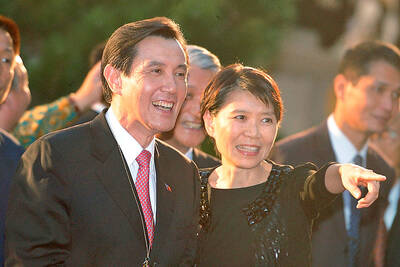
Former president Ma Ying-jeou (馬英九) yesterday expressed “shock and regret” over a statement issued by his wife without his consent, and rejected her assertion that his eldest sister, Ma Yi-nan (馬以南), would manage his medical care or act as his spokesperson amid an ongoing embezzlement probe into his foundation. Ma Ying-jeou in a statement said he was shocked by a statement by his wife, Chou Mei-ching (周美青), regarding his affairs. Ma Yi-nan “must not” be in charge of his healthcare and other personal affairs, nor can she be allowed to represent the Ma family, the former president said. He said he was also


 RSS
RSS