


For Taiwanese, the number “921” represents a day of devastation and heartbreak, fear and for many, the tragic loss of loved ones.
Measuring 7.6 on the Richter scale, a fatal temblor on Sept. 21, 1999, rattled the entire country when the Chenglongpu Fault, which stretches along the foothills of the Central Mountain Range in Nantou and Taichung counties, shifted. The quake and its aftershocks shook Taiwan throughout the night, leaving behind a death toll that made 921 one of Taiwan’s deadliest natural disasters.
According to the National Fire Agency, the earthquake killed more than 2,400 people and left 11,443 severely wounded. Around 150 children were orphaned.
The total cost of damage to buildings and infrastructure was NT$300 billion (US$9.2 billion).
The quake devastated more than 40,000 homes, but did not shatter the country’s spirit. In the wake of the tragedy, communities united to help those in need and the expatriate community was no exception. In central Taiwan, expats were especially active in reaching out to their neighbors.
Ten years later, the American Chamber of Commerce in Taichung (AmCham Taichung) is still helping ensure the welfare of the 921 orphans and other needy children in the area.
Established in 1993, AmCham Taichung, which seeks to serve all foreign nationals and not just Americans, functions as a bridge between the expatriate and local business communities and Taichung City Government.
In addition to offering standard services to the community and businesses, AmCham Taiwan has made a name for itself through its KIDZ program.
Established six years ago by then-chairman Jack McDowell, who spent six years of his childhood in an orphanage in Tennessee, the KIDZ program began with a full-day Christmas party for the city’s disadvantaged children.
The project has since evolved, providing juice and milk daily to Christian Herald Orphanage (台中光音育幼院) and special needs children at the Daniel A. Poling Babies Home. It also offers high school scholarships to all the orphans at the Christian Herald Orphanage, which includes some of those who lost their parents in the 921 quake.
“The philosophy behind the program is that if we can help those children to have a better future by making sure they receive an excellent education, they could move forward and have a more productive life and pursue a professional career,” AmCham Taichung chairman Nathan Hines said.
These individuals could eventually help others in need or make other contributions to their communities, Hines said.
The first group of students to receive the scholarships are expected to graduate next year. In September, another 21 teenagers from the orphanage start high school with financing from AmCham.
Depending on whether a child attends a private or public high school, tuition per semester ranges from NT$20,000 to NT$60,000.
“If the kids can test into high schools, we want to make sure the funds are available for them. But right now it is a struggle to come up with enough funds to cover the expenses,” he said, adding that this had become more difficult with time because many of those orphaned in the 921 quake are high school age now.
Douglas Habecker, the chamber’s secretary-general, expressed gratitude to all the donors who have supported the program, but said more was needed. Donations of any sum are appreciated, he said.
“We could go out and bang doors and try to get random donations and that could work. But at the end of the day, the one thing that makes charities like this successful is when larger corporate donors give large chunks of money,” he said.
Those people who might not be able to donate money but would still like to contribute can help as volunteers, Habecker said. AmCham Taiwan holds fundraising events throughout the year, including a golf tournament and a chili cook-off. This November it will also hold a casino night.
Every dollar of proceeds from the events goes to the KIDZ program fund, Habecker said.
To learn more about the KIDZ program, visit www.amchamtaichung.org or call (04)2471-8133.
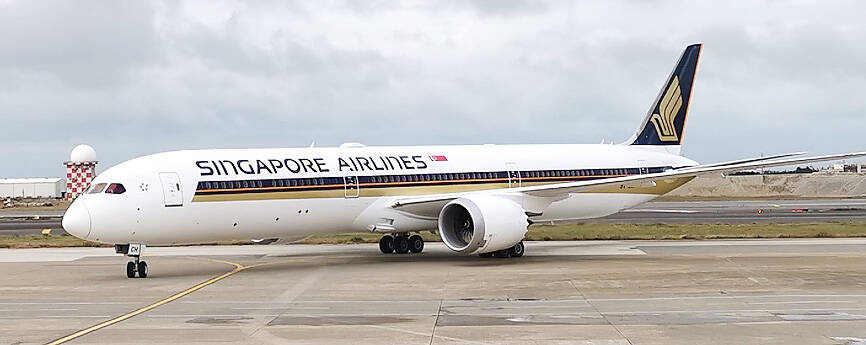
INCREASED CAPACITY: The flights on Mondays, Wednesdays, Fridays and Sundays would leave Singapore in the morning and Taipei in the afternoon Singapore Airlines is adding four supplementary flights to Taipei per week until May to meet increased tourist and business travel demand, the carrier said on Friday. The addition would raise the number of weekly flights it operates to Taipei to 18, Singapore Airlines Taiwan general manager Timothy Ouyang (歐陽漢源) said. The airline has recorded a steady rise in tourist and business travel to and from Taipei, and aims to provide more flexible travel arrangements for passengers, said Ouyang, who assumed the post in July last year. From now until Saturday next week, four additional flights would depart from Singapore on Monday, Wednesday, Friday
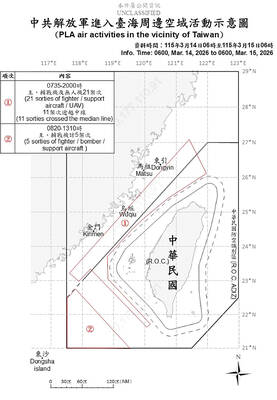
The Ministry of National Defense yesterday reported the return of large-scale Chinese air force activities after their unexplained absence for more than two weeks, which had prompted speculation regarding Beijing’s motives. China usually sends fighter jets, drones and other military aircraft around the nation on a daily basis. Interruptions to such routine are generally caused by bad weather. The Ministry of National Defense said it had detected 26 Chinese military aircraft in the Taiwan Strait over the previous 24 hours. It last reported that many aircraft on Feb. 25, when it spotted 30 aircraft, saying Beijing was carrying out another “joint combat

Taiwan successfully defended its women’s 540 kilogram title and won its first-ever men’s 640 kg title at the 2026 World Indoor Tug of War Championships in Taipei yesterday. In the women’s event, Taiwan’s eight-person squad reached the final following a round-robin preliminary round and semifinals featuring teams from Ukraine, Japan, Thailand, Vietnam, the Basque Country and South Korea. In the finals, they swept the Basque team 2-0, giving the team composed mainly of National Taiwan Normal University students and graduates its second championship in a row, and its fourth in five years. Team captain
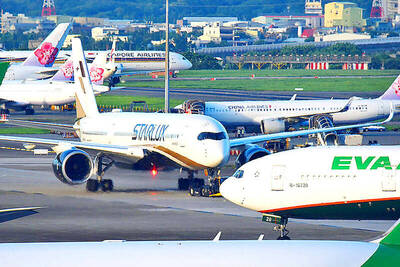
Taiwan’s three major international carriers are increasing booking fees, with EVA Airways having already increased the charge to US$28 per flight segment from US$25, while China Airlines (CAL) and Starlux Airlines are set to follow suit. Booking fees are charged by airlines through a global distribution system (GDS) and passed on to passengers. Carriers that apply the fees include CAL, EVA, Starlux and Tigerair Taiwan. A GDS is a computerized network operated by a company that connects airlines with travel agents and ticketing platforms, allowing reservations to be made and processed in real time. Major players include Amadeus, Sabre and Travelport. EVA Air began


 RSS
RSS