


Six artists will receive this year’s National Award for Arts, the country’s highest tribute to those working in culture and the arts, the National Cultural and Arts Foundation announced on Monday.
Foundation chairman Huang Ming-chuan (黃明川) said this year’s winners were distinguished contemporary Taiwanese cultural and art workers who used the power of life as the basis for their creations.
The six are architect Wang Da-hong (王大閎), conductor David Liao (廖年賦), visual artist Chen Chieh-jen (陳界仁), theater performer Chin Shih-chieh (金士傑), senior film editor Bowen Chen (陳博文) and writer Wang Wen-hsing (王文興).
Wang Da-hong, 92, is considered the pioneer of Taiwan’s modern architecture movement. His works include the National Sun Yat-sen Memorial Hall in Taipei City.
Liao, 77, founded the Taipei Century Symphony Orchestra and is the first conductor to win the national honor since its inception in 1997.
Chen Chieh-jen, 47, is the youngest recipient this year. His works, which often raise public awareness and debates on issues concerning less privileged groups, are currently in Italy representing Taiwan at the 53rd Venice Biennale.
Chin Shih-chieh, 58, has been praised for his lasting devotion to the promotion of Taiwan’s contemporary theater movement.
His unique performing style has become a model of Taiwan’s contemporary performing arts, the foundation said.
Bowen Chen has edited numerous films, including several by the late Taiwanese filmmaker Edward Yang (楊德昌) such as Yi Yi.
Wang, 70, is the author of Family Catastrophe and Backed Against the Sea.

The military has spotted two Chinese warships operating in waters near Penghu County in the Taiwan Strait and sent its own naval and air forces to monitor the vessels, the Ministry of National Defense (MND) said. Beijing sends warships and warplanes into the waters and skies around Taiwan on an almost daily basis, drawing condemnation from Taipei. While the ministry offers daily updates on the locations of Chinese military aircraft, it only rarely gives details of where Chinese warships are operating, generally only when it detects aircraft carriers, as happened last week. A Chinese destroyer and a frigate entered waters to the southwest

A magnitude 6.1 earthquake struck off the coast of Yilan County at 8:39pm tonight, the Central Weather Administration (CWA) said, with no immediate reports of damage or injuries. The epicenter was 38.7km east-northeast of Yilan County Hall at a focal depth of 98.3km, the CWA’s Seismological Center said. The quake’s maximum intensity, which gauges the actual physical effect of a seismic event, was a level 4 on Taiwan’s 7-tier intensity scale, the center said. That intensity level was recorded in Yilan County’s Nanao Township (南澳), Hsinchu County’s Guansi Township (關西), Nantou County’s Hehuanshan (合歡山) and Hualien County’s Yanliao (鹽寮). An intensity of 3 was

Instead of focusing solely on the threat of a full-scale military invasion, the US and its allies must prepare for a potential Chinese “quarantine” of Taiwan enforced through customs inspections, Stanford University Hoover fellow Eyck Freymann said in a Foreign Affairs article published on Wednesday. China could use various “gray zone” tactics in “reconfiguring the regional and ultimately the global economic order without a war,” said Freymann, who is also a nonresident research fellow at the US Naval War College. China might seize control of Taiwan’s links to the outside world by requiring all flights and ships entering or leaving Taiwan
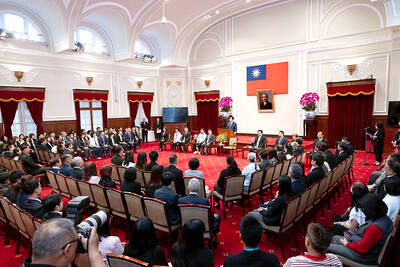
The next minimum wage hike is expected to exceed NT$30,000, President William Lai (賴清德) said yesterday during an award ceremony honoring “model workers,” including migrant workers, at the Presidential Office ahead of Workers’ Day today. Lai said he wished to thank the awardees on behalf of the nation and extend his most sincere respect for their hard work, on which Taiwan’s prosperity has been built. Lai specifically thanked 10 migrant workers selected for the award, saying that although they left their home countries to further their own goals, their efforts have benefited Taiwan as well. The nation’s industrial sector and small businesses lay


 RSS
RSS