


A Taiwanese saltwater ornamental fish research team is working to unlock some of the mysteries surrounding the fish’s breeding process and hopes that by sharing the technology, the clownfish trade will emerge as another success story in Taiwan’s aquaculture industry, following in the footsteps of advances made in raising shrimp and grouper.
The research team estimates that by 2011, Taiwan could breed 2 million clownfish and generate NT$100 million (US$3 million) in the lucrative ornamental fish market, while helping save the species in the wild.
The team is led by Ho Yuan-hsing (何源興), an associate researcher with the Fisheries Research Institute of the Eastern Marine Biology Research Center in Taitung County, who has been actively engaged in fish breeding programs for nearly two decades. In 1997, Ho published the world’s first report on the artificial breeding of the giant grouper (Epinephelus lanceolatus), but later turned to research on saltwater ornamental fish and edible fish like abalone because he wanted “to do something more important and that has greater influence on Taiwan.”
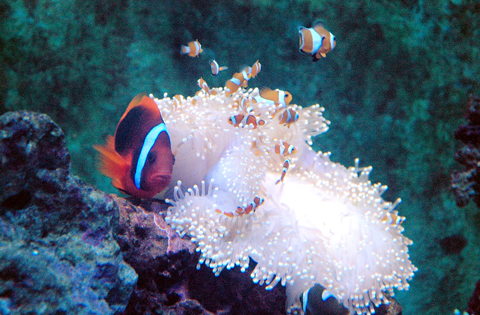
PHOTO: CNA
His change in interest was largely motivated by pursuing an area that few had entered because he has always wanted to be a “trailblazer,” he said.
The captive breeding of saltwater ornamental fish has a high entry threshold because of technology barriers and the difficulty of obtaining sea water, which is why an overwhelming 98 percent of saltwater ornamental fish are still caught in the sea rather than artificially bred.
Taiwan is ideally positioned, Ho said, to reverse the disturbing trend, especially for clownfish. The country’s warm weather and waters provide a perfect habitat for the prized fish, and its large fish farming population (127,000 in 2007) has traditionally excelled in the field.
“Taiwan has artificially bred the most fish species in the world,” Ho said.
Taiwan has also broken considerable ground in the development of live bait as a food source for clownfish fry, a critical advancement since finding suitable food and mass producing it is essential to the artificial breeding process.
Ho’s center inaugurated a clownfish fry production farm last November, which Ho estimated could produce 100,000 clownfish this year and potentially double that next year.
The center actually began researching clownfish in 2002, but the Fry Production Model Farm only became a reality because Ho’s team was finally able to master several core technologies.
For one, pairing the clownfish is not easy. Though clownfish are strictly monogamous, that does not mean that “they will mate automatically if a male and female are put together,” Ho said.
“We have to see to it that the two see eye to eye and will not attack each other, especially because the fish is very fierce and protective of its own territory and attacks any fish, even of its own species, that encroaches into its territory,” he said.
The farm now has 150 seed pairs, with half of them spawning.
The center also controls the spawning, Ho said. In their natural habitat at sea, clownfish lay from 500 to more than 1,000 fertilized eggs once per month, but the center has been able to get the fish to spawn twice a month.
After the eggs hatch, the next challenge is to prepare the right food for the fry, Ho said. This is a potentially difficult step because the fry are only about 0.4mm in size at birth.
The center has solved the problem by providing live bait and also micro-organisms, such as rotifers and copepods, to suit the needs of the fry. Pellet diet is only fed to the fry after they are 20 days old.
Baby clownfish are also more vulnerable to disease in the winter when the water temperature is low, and the center will install a water heating system this year to solve the problem.
“Clownfish could be one of the easiest fish species to breed if you can master those core technologies,” Ho said.
Having mastered the process, the center plans to hand these technologies and the planning and management of the farm model to 10 selected breeders next year, and Ho estimates that the breeders will each be able to produce 200,000 clownfish and generate NT$10 million in revenue annually.
The many years of research by Ho’s team also culminated in the opening last month of the world’s first aquarium devoted solely to clownfish adjacent to the center.
The Aquarium of Anemonefish will soon house the center’s basic clownfish breeding program as it recently has shifted its focus to raising ornamental fish with added value, concentrating on two new approaches, Ho said, adding that one involves breeding “hybrid” species while the other emphasizes selecting unique fish within the same species, such as those with more exotic or brighter patterns, and trying to reproduce them after repeated trials.
Andrew Fang (方祖豪), executive director of saltwater ornamental fish exporter Taikong Co, said saltwater ornamental fish are more prized than freshwater species because of their bright and beautiful colors, but fish harvested from the wild often succumb to weakness when kept in tanks, making them dicey commercial propositions even if they are highly sought after.
“The captive bred fish could easily make inroads into [EU] markets,” he said.

POLAM KOPITIAM CASE: Of the two people still in hospital, one has undergone a liver transplant and is improving, while the other is being evaluated for a liver transplant A fourth person has died from bongkrek acid poisoning linked to the Polam Kopitiam (寶林茶室) restaurant in Taipei’s Far Eastern Sogo Xinyi A13 Department Store, the Ministry of Health and Welfare said yesterday, as two other people remain seriously ill in hospital. The first death was reported on March 24. The man had been 39 years old and had eaten at the restaurant on March 22. As more cases of suspected food poisoning involving people who had eaten at the restaurant were reported by hospitals on March 26, the ministry and the Taipei Department of Health launched an investigation. The Food and

The long-awaited Taichung aquarium is expected to open next year after more than a decade of development. The building in Cingshui District (清水) is to feature a large ocean aquarium on the first floor, coral display area on the second floor, a jellyfish tank and Dajia River (大甲溪) basin display on the third, a river estuary display and restaurant on the fourth, and a cafe and garden on the fifth. As it is near Wuci Fishing Port (梧棲漁港), many are expecting the opening of the aquarium to bring more tourism to the harbor. Speaking at the city council on Monday, Taichung City Councilor

A fourth person has died in a food poisoning outbreak linked to the Xinyi (信義) branch of Malaysian restaurant chain Polam Kopitiam (寶林茶室) in Taipei, Deputy Minister of Health and Welfare Victor Wang (王必勝) said on Monday. It was the second fatality in three days, after another was announced on Saturday. The 40-year-old woman experienced multiple organ failure in the early hours on Monday, and the family decided not to undergo emergency resuscitation, Wang said. She initially showed signs of improvement after seeking medical treatment for nausea, vomiting and diarrhea, but her condition worsened due to an infection, he said. Two others who

Taiwanese should be mindful when visiting China, as Beijing in July is likely to tighten the implementation of policies on national security following the introduction of two regulations, a researcher said on Saturday. China on Friday unveiled the regulations governing the law enforcement and judicial activities of national security agencies. They would help crack down on “illegal” and “criminal” activities that Beijing considers to be endangering national security, according to reports by China’s state media. The definition of what constitutes a national security threat in China is vague, Taiwan Thinktank researcher Wu Se-chih (吳瑟致) said. The two procedural regulations are to provide Chinese


 RSS
RSS