


Washington sources say that Wang Yi (王毅), director of China’s Taiwan Affairs Office, will be in the US next week for talks with the US State Department about potential future arms sales to Taiwan.
The visit comes amid speculation that the administration of US President Barack Obama is on the verge of deciding to sell F-16 fighter aircraft and diesel submarines to Taipei.
“While I have not been specifically told, I presume that he is coming to object to arms sales to Taiwan and to say that such a move would damage US-China relations,” a US diplomatic source said. “We need Chinese cooperation on a number of fronts right now — not least North Korea — but I doubt that Wang Yi will have a lot of impact.”
The State Department refused to confirm Wang’s visit, a Taiwanese official in Washington said that he had not been informed about it and the Chinese embassy in Washington did not respond to inquiries on the subject.
However, a source with close ties to the State Department and Taiwan said that Wang would visit and that the weapons sales would be high on his agenda.
Another source said that President Ma Ying-jeou (馬英九) had greatly pleased the Obama administration with his pro-China policies that have reduced tensions across the Taiwan Strait and there was an inclination to help him because China continues a massive arms buildup and it has not reduced the number of missiles it has pointed at Taiwan.
In April, during a well-publicized video conference call with China experts in Washington in April, Ma stressed the need for Taiwan to continue acquiring weapons.
Then late last month, Ma called US politicians from his hotel in Los Angeles — during an overnight stopover on his way to Central America — to push for Washington to sell F-16C/D fighters to Taiwan.
He talked with Republican Senator John McCain and at least nine Congressmen who were all sympathetic to his plea. Later they said Ma had argued that he had been able to improve relations with China even after last October’s announcement by former US president George W. Bush that he was selling more weapons to Taipei. Ma said the new fighter sales would not undermine the current policy or dramatically increase tensions with Beijing.
In addition to the F-16s, Taiwan also wants eight diesel submarines, but may be ready to build the vessels in Taiwan from US plans and with US-supplied weapons and communications equipment.
There has been speculation that an announcement on the diesel submarines may come in August.
Beijing may have decided to send Wang to Washington following reports earlier this month that there was a general consensus on Capitol Hill in favor of selling F-16s to Taiwan.
Congresswoman Ileana Ros-Lehtinen, the ranking member of the House Foreign Affairs Committee, said on June 9 that she wished that Taiwan already had the diesel submarines.
“I have always been a strong advocate legislatively in the Congress of making those weapons systems vital to the defense of Taiwan readily available, as called for in the Taiwan Relations Act,” Ros-Lehtinen said. “I also advocate the provision of a new generation of F-16 aircraft for the defense of Taiwan and hope that the Obama Administration will act expeditiously on this matter.”
For its part, the Obama administration has remained very quiet on the subject.
However, Kurt Campbell, speaking during his Senate confirmation hearing last week as assistant secretary of state for East Asian affairs, said there were “discussions under way right now” on the outstanding request for arms sales to Taiwan.
Democratic Senator Jim Webb, chairman of the Foreign Relations Asia subcommittee, asked Campbell what he thought about supplying Taiwan with F-16 fighters, Black Hawk helicopters and design assistance for diesel electric submarines.
“There are specifics — discussions under way right now. I’m not in the Department of State, so I’m not going to comment on them,” Campbell said.
His remarks were the first official confirmation that the Obama administration is working on future arms sales to Taiwan.

The Ministry of Finance this afternoon announced the winning numbers for the March-April uniform invoice lottery. The winning number for the NT$10 million (US$318,060) special prize is 19531471, and the winning number for the NT$2 million grand prize is 85941329. Three numbers were drawn for the NT$200,000 first prize: 07225810, 20231230 and 83518781. Those with receipts matching the last seven digits of any of the first-prize numbers will win the NT$40,000 second prize, while those matching the last six digits will win the NT$10,000 third prize. Those whose receipts match the last five digits of the first-prize numbers can claim the NT$4,000 fourth prize,

SIX SUBSIDIES: The monthly allowance for older farmers is to increase to NT$10,000, and NT$5,000 is to be given to homemakers under the national pension system, Lai said The government is to implement major welfare policies for disadvantaged groups, including raising the monthly allowance for older farmers to NT$10,000 and providing homemakers with NT$5,000 per month, President William Lai (賴清德) said yesterday. Lai made the remarks during a visit to Wangling Temple in Chiayi County, saying that the planned increases were being introduced amid economic growth and an increase in tax revenue. Touting a policy, in which the government plans to provide a monthly allowance of NT$5,000 for every child under the age of 18 in a bid to address Taiwan’s low birthrate, Lai said that if received for the
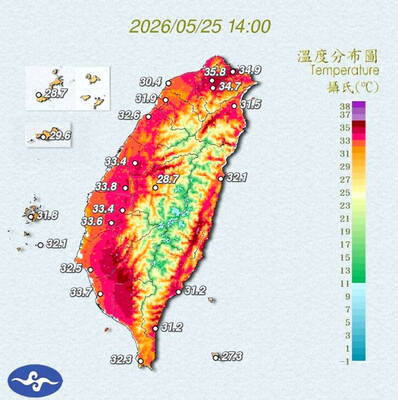
STAY COOL: The HPA recommended that people stay hydrated, use air-conditioning or fans while indoors, wear loose-fitting clothes and walk in the shade while outdoors Employers must implement measures such as installing cooling equipment, and providing drinking water and rest breaks for outdoor workers starting from Monday next week, the Taipei Department of Labor said on Sunday. Employers who fail to comply could face fines of NT$30,000 to NT$300,000 under the Occupational Safety and Health Act (職業安全衛生法), the department said. Businesses in Taipei employing fewer than 100 workers, as well as registered self-employed workers with labor insurance coverage, could receive on-site assessments and guidance from occupational safety consultants to help them apply for central government subsidies to implement or improve heat-protection measures, it said. Under the Ministry of
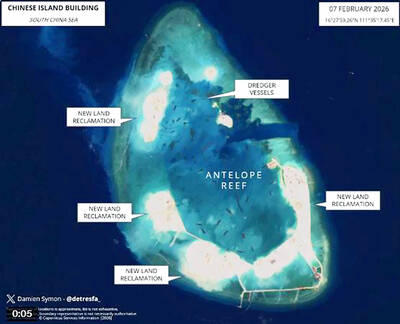
ISOLATION: The outposts would serve as support and backup bases, forcing US forces to either face China head-on or reroute, increasing travel time and operational costs China’s outposts in the South China Sea could be used to delay and constrain foreign forces during a conflict in the Taiwan Strait, giving Beijing a critical window to carry out amphibious landing and blockade operations, a report said. The Chinese Communist Party’s (CCP) forward operating bases on islands and reclaimed features in the South China Sea could delay foreign forces long enough for the Chinese People’s Liberation Army (PLA) to secure a key 48-to-72-hour window in the Taiwan Strait, a report commissioned by the Mainland Affairs Council found. The report, conducted by the Institute for National Defense and Security Research, examined


 RSS
RSS