


About 200 people who live within the boundaries of Kenting National Park in Pingtung County forced their way into the Legislative Yuan yesterday as an Internal Administration Committee meeting was in progress to protest against the National Park Act (國家公園法).
Holding signs that read “We want our right to survival” and “The National Park Act is illegitimate and unjust,” the residents forced their way through a side gate and tried to get into the meeting room as soon as they learned that the Internal Administration Committee had begun an article-by-article review of revisions to the act.
In recent weeks, the Internal Administration Committee has been reviewing amendment proposals made by both the Cabinet and lawmakers to the National Park Act, the first since it was enacted in 1972.
However, Kenting residents — many of whom lived in the area before it was designated a national park in 1982 — worry that the stricter regulations in the proposed amendments could limit their freedoms.
While in its current form Article 17 stipulates that construction or demolition of public or private buildings must obtain government approval, the proposed revision adds that repairs must also be approved by the authorities.
“My house is very old and I need to do repair work on it from time to time. Will I have to wait for my house to collapse if my application to renovate it is rejected?” a protester asked through a loudspeaker.
“We want lawmakers to hear what we have to say,” local borough chief Tsai Cheng-jung (蔡正榮) said. “There have been too many restrictions on our daily lives since Kenting National Park was created. It doesn’t make sense to make the laws even more strict.”
Tsai said the Ministry of the Interior (MOI) — which manages national parks — had not organized public hearings to hear residents’ opinions before making the proposals.
Police officers guarding the legislature attempted to prevent the protesters from entering the compound, but as there were only about a dozen police at the scene, the demonstrators were able to go in.
When protesters discovered that the doors to the meeting room were locked, they tried to get in through a connecting room next door, but were pushed back by police.
Protesters finally agreed to leave after Chinese Nationalist Party (KMT) Legislator Wu Yu-sheng (吳育昇), who presided over the meeting, called it off and asked the MOI to hold public hearings before any further reviews.
Democratic Progressive Party Legislator Tien Chiu-chin (田秋堇) said national parks should be divided into “urban” and “natural reserves.”
“In urban national parks, such as Kenting and Yangmingshan, where people have lived for generations, we should loosen restrictions to make it easier for residents,” she said. “For national parks with little human activity, such as Yushan National Park, however, we could make laws more strict to protect the ecosystem.”

The military has spotted two Chinese warships operating in waters near Penghu County in the Taiwan Strait and sent its own naval and air forces to monitor the vessels, the Ministry of National Defense (MND) said. Beijing sends warships and warplanes into the waters and skies around Taiwan on an almost daily basis, drawing condemnation from Taipei. While the ministry offers daily updates on the locations of Chinese military aircraft, it only rarely gives details of where Chinese warships are operating, generally only when it detects aircraft carriers, as happened last week. A Chinese destroyer and a frigate entered waters to the southwest
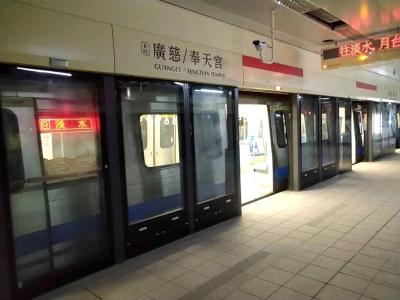
The eastern extension of the Taipei MRT Red Line could begin operations as early as late June, the Taipei Department of Rapid Transit Systems said yesterday. Taipei Rapid Transit Corp said it is considering offering one month of free rides on the new section to mark its opening. Construction progress on the 1.4km extension, which is to run from the current terminal Xiangshan Station to a new eastern terminal, Guangci/Fengtian Temple Station, was 90.6 percent complete by the end of last month, the department said in a report to the Taipei City Council's Transportation Committee. While construction began in October 2016 with an
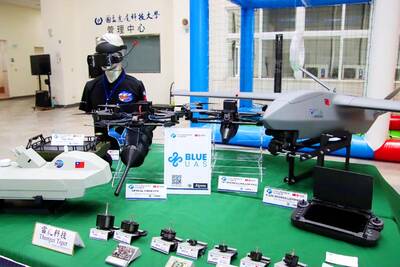
NON-RED SUPPLY: Boosting the nation’s drone industry is becoming increasingly urgent as China’s UAV dominance could become an issue in a crisis, an analyst said Taiwan’s drone exports to Europe grew 41.7-fold from 2024 to last year, with demand from Ukraine’s fight against Russian aggression the most likely driver of growth, a study showed. The Institute for Democracy, Society and Emerging Technology (DSET) in a statement on Wednesday said it found that many of Taiwan’s uncrewed aerial vehicle (UAV) sales were from Poland and the Czech Republic. These countries likely transferred the drones to Ukraine to aid it in its fight against the Russian invasion that started in 2022, it said. Despite the gains, Taiwan is not the dominant drone exporter to these markets, ranking second and fourth

Japanese Prime Minister Sanae Takaichi’s comment last year on Tokyo’s potential reaction to a Taiwan-China conflict has forced Beijing to rewrite its invasion plans, a retired Japanese general said. Takaichi told the Diet on Nov. 7 last year that a Chinese naval blockade or military attack on Taiwan could constitute a “survival-threatening situation” for Japan, potentially allowing Tokyo to exercise its right to collective self-defense. Former Japan Ground Self-Defense Force general Kiyofumi Ogawa said in a recent speech that the remark has been interpreted as meaning Japan could intervene in the early stages of a Taiwan Strait conflict, undermining China’s previous assumptions


 RSS
RSS