


While President Ma Ying-jeou (馬英九) has called for the speedy passage of the government’s restructuring bills during this legislative session, amendments to the law governing the Cabinet’s organization were criticized by some experts during a public hearing yesterday.
The Judiciary and Organic Laws and Statutes Committee held a hearing on the Organic Act of the Executive Yuan (行政院組織法) as requested by the Democratic Progressive Party (DPP).
Research, Development and Evaluation Commission (RDEC) Minister Jiang Yi-huah (江宜樺) said the commission planned to set the number of civil servants in the central government at 173,000 for now and hoped to cut it by 7,000 or 8,000.
The commission also proposed to reduce the Executive Yuan’s subordinate agencies from 37 to 29 — 13 ministries, nine commissions, three independent agencies and four subordinate bodies.
Jay Shih (施能傑), a professor of public administration at National Chengchi University and former RDEC chief, criticized the amendments proposed by the RDEC as an “unreasonable regression.” The logic behind the proposal “violated the fundamentals of government reorganization” and the regulations stipulated in the Organic Standard Act of Central Government Agencies (中央行政機關組織基準法), he said.
“If passed, the government is unlikely to be more efficient,” he said.
Shih said the ministries should be kept at around 15 and that the commissions’ main function is to integrate and negotiate, not to carry out policies. The RDEC’s version, however, mixed up the functions of ministries and commissions, making the 13 ministries and nine commissions do the jobs of 22 ministries, he said.
While the power of the premier’s office should be strengthened, Shih said, the RDEC proposed establishing an accounting department and a personnel department, weakening the authority of the Executive Yuan.
The number of agencies targeted at specific groups should be as few as possible, but the RDEC’s proposal was just the opposite, Shih said. If overseas compatriots and retired soldiers can have a commission of their own, Shih said, would it also make sense to establish commissions for the elderly, youth or social groups?
Shih also said that independent agencies were vaguely defined and the amendments were designed to evade legislative supervision by empowering the Executive Yuan to establish more subsidiary agencies with administrative decrees.
A law professor at National Taiwan University and former RDEC chief Yeh Jiunn-rong (葉俊榮) urged both the governing and opposition parties to show their sincerity for the government restructuring project with concrete actions rather than lip service.
Yeh said he thought 13 ministries was a good number but he was disappointed that the functions of the premier’s office and commissions were crippled. He also thought the Overseas Compatriot Affairs Commission should be merged with the Ministry of Foreign Affairs and the Veterans Affairs Commissions should be integrated into the Ministry of National Defense.
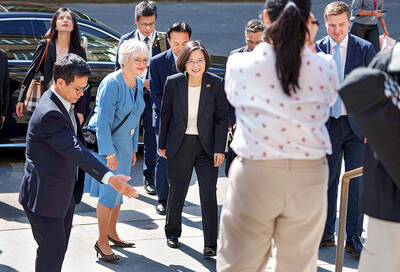
Former president Tsai Ing-wen (蔡英文) on Monday called for greater cooperation between Taiwan, Lithuania and the EU to counter threats to information security, including attacks on undersea cables and other critical infrastructure. In a speech at Vilnius University in the Lithuanian capital, Tsai highlighted recent incidents in which vital undersea cables — essential for cross-border data transmission — were severed in the Taiwan Strait and the Baltic Sea over the past year. Taiwanese authorities suspect Chinese sabotage in the incidents near Taiwan’s waters, while EU leaders have said Russia is the likely culprit behind similar breaches in the Baltic. “Taiwan and our European

The Taipei District Court sentenced babysitters Liu Tsai-hsuan (劉彩萱) and Liu Jou-lin (劉若琳) to life and 18 years in prison respectively today for causing the death of a one-year-old boy in December 2023. The Taipei District Prosecutors’ Office said that Liu Tsai-hsuan was entrusted with the care of a one-year-old boy, nicknamed Kai Kai (剴剴), in August 2023 by the Child Welfare League Foundation. From Sept. 1 to Dec. 23 that year, she and her sister Liu Jou-lin allegedly committed acts of abuse against the boy, who was rushed to the hospital with severe injuries on Dec. 24, 2023, but did not
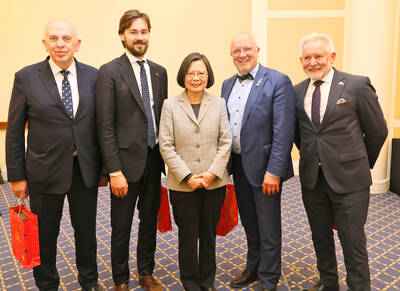
LIKE-MINDED COUNTRIES: Despite the threats from outside, Taiwan and Lithuania thrived and developed their economies, former president Tsai Ing-wen said Former president Tsai Ing-wen (蔡英文) on Saturday thanked Lithuania for its support of Taiwan, saying that both countries are united as partners in defending democracy. Speaking at a reception organized by the Lithuania-Taiwan Parliamentary Friendship Group welcoming her on her first visit to the Baltic state, Tsai said that while she was president from 2016 to last year, many Lithuanian “friends” visited Taiwan. “And I told myself I have to be here. I am very happy that I am here, a wonderful country and wonderful people,” Tsai said. Taiwan and Lithuania are in similar situations as both are neighbors to authoritarian countries, she

Taiwanese indie band Sunset Rollercoaster and South Korean outfit Hyukoh collectively received the most nominations at this year’s Golden Melody Awards, earning a total of seven nods from the jury on Wednesday. The bands collaborated on their 2024 album AAA, which received nominations for best band, best album producer, best album design and best vocal album recording. “Young Man,” a single from the album, earned nominations for song of the year and best music video, while another track, “Antenna,” also received a best music video nomination. Late Hong Kong-American singer Khalil Fong (方大同) was named the jury award winner for his 2024 album


 RSS
RSS