


Former president Chen Shui-bian (陳水扁) returned to the Taipei Detention Center yesterday morning after spending three days in the hospital.
TV footage showed Chen being wheeled out of the Banciao branch of Taipei County Hospital covered with a blanket and wearing a facemask.
He arrived at the detention center at about 8:15am.
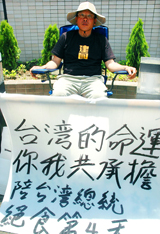
PHOTO: CNA
Chen signed a disclaimer after midnight yesterday agreeing to leave the hospital and return to the detention center, Taipei Detention Center Deputy Director Lee Ta-chu (李大竹) said.
“[Chen] still refuses to eat anything, but he drank some water,” Lee said.
Chen has been receiving treatment from doctors at the detention center because he is coughing and has phlegm in his left lung, he said.
The former president has been on hunger strike since Thursday after he returned to the Taipei Detention Center following his detention hearing. He appeared weak in court and later that day issued a statement saying he would not appeal any verdict in the case, immediately dismiss his attorneys and stop calling witnesses.
He was hospitalized on Saturday with dehydration.
The hospital performed various examinations, including a blood test, an x-ray, an electrocardiogram and an ultrasound.
On Monday, the Taipei District Court ruled that Chen would remain in detention, citing fears he would collude with witnesses or abscond.
The court also canceled a court date Chen had yesterday because of his poor physical condition.
The court date had been scheduled to summon Su Chih-cheng (蘇志誠), a top aide to former president Lee Teng-hui (李登輝), and former Presidential Office deputy secretary-general Ma Yung-cheng (馬永成) in the trial over Chen’s alleged embezzlement of the presidential “state affairs” fund.
Chen has said he will not eat or drink until Sunday to show his support for the Democratic Progressive Party’s (DPP) rally scheduled for that day to protest against the government’s China-leaning policies.
Chen has been on two hunger strikes since his incarceration, but ended them after pressure from his family.
Meanwhile, DPP Chairperson Tsai Ing-wen (蔡英文) said yesterday the extension of Chen’s detention was a political decision that was manipulated by the Chinese Nationalist Party (KMT) government.
“We did not see proper legal procedure in the ruling to extend Chen’s detention. This is a political decision that damages the credibility and independence of Taiwan’s judiciary, and it is a warning to Taiwan’s society,” Tsai told reporters yesterday.
DPP Spokesman Cheng Wen-tsang (鄭文燦) said the court had detained Chen for five months and that the party and the public believed the detention was a “punishment detention” meant to humiliate his supporters.
DPP caucus whip Kao Jyh-peng (高志鵬) said the court made up its mind to detain Chen and then fabricated reasons for his custody.
“The court wants to detain the sick Chen until he dies,” Kao said.
Former premier Su Tseng-chang (蘇貞昌) of the DPP said yesterday that because Chen is not in good health, he would not abscond if he were free and the court should release him.
KMT legislators lauded the court’s decision to extend Chen’s detention. KMT Legislator Lee Ching-hua (李慶華) gave Presiding Judge Tsai Shou-hsun (蔡守訓) a thumbs up for “standing up to pressure from the DPP.”
Lee urged Chen to “learn how historical figure [Chinese poet and minister] Qu Yuan (屈原) dedicated himself to his nation and people” now that Chen has to spend the Dragon Boat Festival inside the detention center. The festival is partly held in commemoration of Qu.
“The public now hopes Mr Chen will fully cooperate with the judiciary,” KMT caucus secretary-general Yang Chiung-ying (楊瓊瓔) said when asked for comment.
KMT Legislator Lin Hung-chih (林鴻池) said Chen had set a poor example by trying to stall his trial by launching hunger strikes.
ADDITIONAL REPORTING BY FLORA WANG

FUKUOKA SITUATION: Japanese media reported that the pathogen is expected to be identified by the summer, while the CDC downplayed the idea that it was hMPV A “mysterious cold-like illness” reported in Japan’s Fukuoka Prefecture does not seem to be a new disease, but Japanese authorities have been asked about the situation, the Centers for Disease Control (CDC) said yesterday. The Fukuoka Prefectural Medical Association on Wednesday told a news conference that a “mystery cold” that has become a hot topic on social media is “highly likely to be caused by some kind of viral infection,” Japan’s KBC News reported. “Many people are experiencing symptoms starting with a sore throat, followed by a runny nose, phlegm and a severe cough,” KBC News reported, citing association officials. Health authorities are

Nvidia Corp CEO Jensen Huang (黃仁勳) arrived in Taiwan yesterday ahead of upcoming AI and technology events, saying he plans to meet with clients and Taiwan Semiconductor Manufacturing Co Chairman C.C. Wei (魏哲家) during his visit. After landing at Taipei Songshan Airport, Huang posed for photos with fans and handed out Yakult drinks to reporters and supporters waiting at the scene, saying he has “a lot to do” during the trip. Asked about reports that Nvidia’s planned headquarters site in Taipei’s Beitou Shilin Technology Park could break ground on May 27, Huang said that if the company holds an event, he would

The Ministry of Finance this afternoon announced the winning numbers for the March-April uniform invoice lottery. The winning number for the NT$10 million (US$318,060) special prize is 19531471, and the winning number for the NT$2 million grand prize is 85941329. Three numbers were drawn for the NT$200,000 first prize: 07225810, 20231230 and 83518781. Those with receipts matching the last seven digits of any of the first-prize numbers will win the NT$40,000 second prize, while those matching the last six digits will win the NT$10,000 third prize. Those whose receipts match the last five digits of the first-prize numbers can claim the NT$4,000 fourth prize,
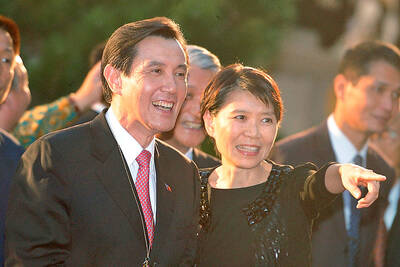
Former president Ma Ying-jeou (馬英九) yesterday expressed “shock and regret” over a statement issued by his wife without his consent, and rejected her assertion that his eldest sister, Ma Yi-nan (馬以南), would manage his medical care or act as his spokesperson amid an ongoing embezzlement probe into his foundation. Ma Ying-jeou in a statement said he was shocked by a statement by his wife, Chou Mei-ching (周美青), regarding his affairs. Ma Yi-nan “must not” be in charge of his healthcare and other personal affairs, nor can she be allowed to represent the Ma family, the former president said. He said he was also


 RSS
RSS