

Civic groups yesterday slammed the government over a proposed amendment to the Assembly and Parade Act (集會遊行法) that would require demonstrators to notify authorities of any demonstration ahead of time, saying that it violated international conventions.
The Taiwan Association for Human Rights said the amendment was not only a violation of human rights, but that it also violated the UN’s International Convenant on Civil and Political Rights (ICCPR) which was ratified by the legislature last month.
The amendments proposed by the Cabinet state that organizers must notify police of a protest’s time, location and parade route five days in advance of any protest and that violators could be fined up to NT$50,000.

PHOTO: CNA
Police would have the right to ban a rally or change its route if they believed it would jeopardize national security, social order or the public interest. The amendment would also give police the right to order the break up of any rally that was blocking traffic.
“If the Cabinet’s proposed amendment to the act is passed by the legislature, it would violate Article 21 [of the ICCPR],” said Wu Hao-jen (吳豪人), an executive member of the Taiwan Association for Human Rights.
Article 21 of the ICCPR states: “The right of peaceful assembly shall be recognized. No restrictions may be placed on the exercise of this right,” except for cases where the national interest, public security and public heath may be threatened.
Son Yu-lian (孫友聯), secretary-general of the Taiwan Labour Front, said it was “ridiculous” to require demonstrators to notify authorities ahead of time because it meant that police could strip people of the right to assembly.
He said rising unemployment rates in recent months had caused many workers to suffer and that “workers have no way of voicing their concerns to the government other than by taking to the streets.”
“We will call on everyone to begin a period of civil disobedience,” he said.
Lin Feng-jeng (林峰正), executive director of the Judicial Reform Foundation, said police brutality during the visit of Association for Relations Across the Taiwan Strait Chairman Chen Yunlin (陳雲林) last year had not been forgotten.
Prosecutors announced last week that they would not indict former Beitou Police Precinct chief Lee Han-ching (李漢卿), who was accused of forcibly closing a record store during protests against Chen’s visit. Their investigation concluded that a sales clerk at the store had voluntarily turned down the music and pulled down the shutters after being asked to do so by police, prosecutors said.
“Is it possible that a store, during normal business hours, would voluntarily pull down its shutters?” said Lin, who remained skeptical of the prosecutors’ decision.
He said the amendment would give police power to control even the kind of music played in record stores and that it posed a threat to the nation’s hard-won human rights.
The association predicted that the amendment would be passed by the legislature today and it has scheduled a march around the Legislative Yuan this morning.
In related news, President Ma Ying-jeou (馬英九) yesterday expressed the hope that the legislature would quickly pass the amendments to the Act.
Presidential Office Spokesman Wang Yu-chi (王育琦) said that Ma hoped to see his campaign promise realized and that the revisions would meet the expectations of the public that the law be made more relaxed and reasonable.
While some have proposed stripping police of the right to break up demonstrations, Wang said Ma was against the idea because he thought it was necessary to preserve such a right so police could prevent any disturbances to traffic flow or social order.
ADDITIONAL REPORTING BY KO SHU-LING
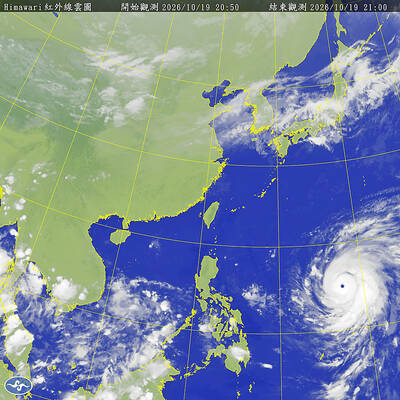
Typhoon Champi is forecast to turn northward earlier than previously expected, sparing Taiwan a direct hit but still bringing heavy rain to the north of the country on Friday and Saturday, the Central Weather Administration (CWA) said yesterday. Typhoon Champi had strengthened and increased in size over the past 12 hours, and as of yesterday afternoon, was packing sustained winds of 198kph near its center, CWA forecaster Cheng Chieh-jen (鄭傑仁) said. However, due to the weakening of a Pacific high-pressure system the storm is now expected to turn northward earlier than initially forecast, likely around Japan’s Ishigaki Island, Cheng said. As Champi brushes
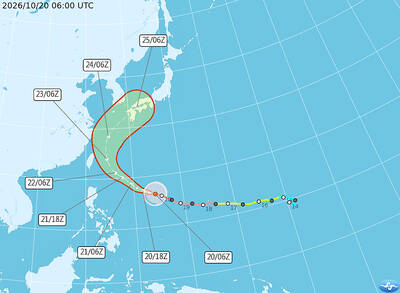
A sea warning for Typhoon Champi might be issued tonight, while the storm’s trajectory would determine whether a land warning is to be issued tomorrow night, the Central Weather Administration (CWA) said yesterday. As of 2pm yesterday, Champi was about 1,536km east-southeast of Taiwan proper’s southernmost point, Oluanpi (鵝鑾鼻), packing maximum sustained winds of 198kph, CWA forecaster Tseng Chao-cheng (曾昭誠) said. The storm was moving west-northwest at 23kph and was expected to strengthen over the next 24 hours before weakening slightly as it approaches cooler waters east of Taiwan, Tseng said. Champi is expected to turn north tomorrow, with the angle of the

Starbucks Taiwan’s decision to charge for drink customization, which had been free, has sparked consumer backlash, highlighting the challenge of raising prices without making customers feel they are losing value, experts said. Since Oct. 12, customers who order drinks with less or no ice and ask to have the volume topped up with milk or other liquid have been charged an additional NT$15. Topping off drinks without ice was previously free, and disgruntled customers posted photos on social media showing that iced drinks ordered without ice were only half full if the extra NT$15 was not paid. The posts drew tens of thousands
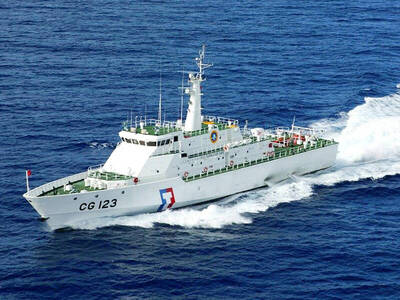
A patrol vessel donated by the Coast Guard Administration (CGA) to the Philippines would not be used in waters near Taiwan or areas where Taiwanese fishing vessels operate, Premier Cho Jung-tai (卓榮泰) said yesterday. The vessel, formerly the CGA's 500-tonne-class Kinmen (金門), was commissioned into the Philippine Coast Guard on Oct. 2. Speaking at the Legislative Yuan, Cho said the Philippines had pledged during the donation process that the vessel would be used only for designated missions and would not operate in waters related to Taiwan. The vessel could even provide assistance to Taiwan if needed, he added. Responding to questions from Chinese


 RSS
RSS