


A motorist parks his car on a road in Tainan City, gets out and leaves the engine running. A remote-controlled model car with a miniature windmill attached on top sneaks up behind the idling car's exhaust pipe to measure the carbon dioxide emission, while an environmental inspector monitors and records data from a distance with the help of a video camera.
At a separate location in Tainan City, a factory illegally discharges wastewater into a river. A pair of volunteer environmental patrollers take note of the violation, inform city police and prosecutors who arrive to gather proof and arrest the factory owner.
The two scenarios outlined are award-winning environmental protection ideas from Tainan City's Environmental Protection Bureau. Winners of the competition, sponsored by the Environmental Protection Administration (EPA), were announced yesterday.
The windmill and remote-controlled car is Tainan bureau's award-winning innovation in the “Existing Policies” category to catch drivers who leave their cars idling for more than three minutes but do not turn off their engines, bureau director-general Chang Hwang-jen (張皇珍) said.
“After we introduced the policy that motorists must turn off their engines when they leave their cars idling for three or more minutes, we tried several ways to capture proof of drivers failing to do so,” Chang said.
After several experiments, the city came up with the gadget, Chang said.
With the help of the video camera, the bureau has issued 55 tickets in the past year to environmentally neglectful drivers.
“Many other countries have promoted the idea of turning off car engines when drivers temporarily park their cars, but no measuring equipment had been developed to catch drivers who violate this policy,” Chang said.
“When we used this equipment to issue the first ticket in this category in Asia, Japan's NHK television channel came to interview us,” Chang said
In the “New Ideas” category, Chang's team came up with the idea of combining the bureau's inspectors with the police and the city prosecutor's office to catch illegal waste dumping.
“Factories are generally unintimidated by environmental inspectors; however, they are afraid of police and inspectors,” Chang said. “We persuaded the police and prosecutors to work with us and so far it has improved our success rate in catching illegal dumping.
Other winners include Taipei County, which placed second in the New Ideas category for promoting a low-carbon eco-tour in Pinglin Township (坪林),where tourists walk or bike along the Jingualiau River (金瓜寮) and are offered local and organic foods.
Kinmen County won second place in the Existing Policies category for re-organizing its botanical garden, which has attracted three new types of insects to the park.

FUKUOKA SITUATION: Japanese media reported that the pathogen is expected to be identified by the summer, while the CDC downplayed the idea that it was hMPV A “mysterious cold-like illness” reported in Japan’s Fukuoka Prefecture does not seem to be a new disease, but Japanese authorities have been asked about the situation, the Centers for Disease Control (CDC) said yesterday. The Fukuoka Prefectural Medical Association on Wednesday told a news conference that a “mystery cold” that has become a hot topic on social media is “highly likely to be caused by some kind of viral infection,” Japan’s KBC News reported. “Many people are experiencing symptoms starting with a sore throat, followed by a runny nose, phlegm and a severe cough,” KBC News reported, citing association officials. Health authorities are

Nvidia Corp CEO Jensen Huang (黃仁勳) arrived in Taiwan yesterday ahead of upcoming AI and technology events, saying he plans to meet with clients and Taiwan Semiconductor Manufacturing Co Chairman C.C. Wei (魏哲家) during his visit. After landing at Taipei Songshan Airport, Huang posed for photos with fans and handed out Yakult drinks to reporters and supporters waiting at the scene, saying he has “a lot to do” during the trip. Asked about reports that Nvidia’s planned headquarters site in Taipei’s Beitou Shilin Technology Park could break ground on May 27, Huang said that if the company holds an event, he would

The Ministry of Finance this afternoon announced the winning numbers for the March-April uniform invoice lottery. The winning number for the NT$10 million (US$318,060) special prize is 19531471, and the winning number for the NT$2 million grand prize is 85941329. Three numbers were drawn for the NT$200,000 first prize: 07225810, 20231230 and 83518781. Those with receipts matching the last seven digits of any of the first-prize numbers will win the NT$40,000 second prize, while those matching the last six digits will win the NT$10,000 third prize. Those whose receipts match the last five digits of the first-prize numbers can claim the NT$4,000 fourth prize,
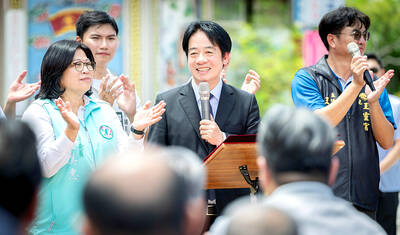
SIX SUBSIDIES: The monthly allowance for older farmers is to increase to NT$10,000, and NT$5,000 is to be given to homemakers under the national pension system, Lai said The government is to implement major welfare policies for disadvantaged groups, including raising the monthly allowance for older farmers to NT$10,000 and providing homemakers with NT$5,000 per month, President William Lai (賴清德) said yesterday. Lai made the remarks during a visit to Wangling Temple in Chiayi County, saying that the planned increases were being introduced amid economic growth and an increase in tax revenue. Touting a policy, in which the government plans to provide a monthly allowance of NT$5,000 for every child under the age of 18 in a bid to address Taiwan’s low birthrate, Lai said that if received for the


 RSS
RSS