


A Taiwanese environmentalist has organized a 15-member team to join his project to fight the expansion of the Taklamakan Desert in Xinjiang Province, China, through reforestation.
HIMA Foundation president Wender Yang (楊文德), the organizer of the New Loulan Project, and his team plan to leave for Xinjiang on April 25 to dig 15 wells in the Taklamakan Desert and plant more than 100 diversiform-leaved poplar trees, which are suitable for growth in arid regions.
The tree's roots can reach 10m down to the underground water table. They can help retain water and hold sand together.
Yang said it would cost NT$10,000 to grow a tree and NT$70,000 to dig a well in the desert. To support the work, he has raised funds from Tainan County Commissioner Su Huan-chih (蘇煥智), model Lin Chi-ling (林志玲), politicians, members of two local chapters of the Rotary Club and private enterprises.
Photographs of each tree and well will be posted on the foundation's Web site and identified by the names of individual donors. The public will be able to monitor the trees' growth on Google Earth, he said.
Yang said he hoped that more people would join the project to prevent the expansion of the Taklamakan Desert, which has been the source of dust storms affecting Asia.
Statistics show that the desert has been increasing by 168km² each year.
The Taklamakan Desert, the largest desert in China, swallowed Loulan (樓蘭) — a sprawling kingdom of 360,000km² on the Silk Road — in the 4th or 5th century.
It is believed that the ancient city of Loulan vanished during the Tang dynasty because of deforestation.
The Taklamakan Desert has been expanding and could soon merge with the Lop Desert to the west and become a much larger desert.
Yang gave up his well-paid job as an executive in the Asian operations of a listed Wall Street company in 2002 and launched the ambitious New Loulan Project to stop desertification in Xinjiang.
His HIMA Foundation has helped local Loulan descendants revegetate the desert around the historic region, hiring them to turn 5km² of desert into blooming flower beds of Apocynum venetum, also known as Indian hemp.
The plant is said to have medicinal value because its flowers and leaves can be made into tea that helps reduce blood pressure, while its fiber is good for making thread and weaving quality clothing.

Taiwanese can file complaints with the Tourism Administration to report travel agencies if their activities caused termination of a person’s citizenship, Mainland Affairs Council Minister Chiu Chui-cheng (邱垂正) said yesterday, after a podcaster highlighted a case in which a person’s citizenship was canceled for receiving a single-use Chinese passport to enter Russia. The council is aware of incidents in which people who signed up through Chinese travel agencies for tours of Russia were told they could obtain Russian visas and fast-track border clearance, Chiu told reporters on the sidelines of an event in Taipei. However, the travel agencies actually applied
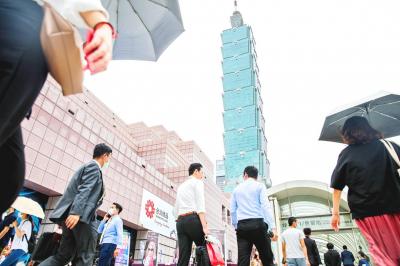
Japanese footwear brand Onitsuka Tiger today issued a public apology and said it has suspended an employee amid allegations that the staff member discriminated against a Vietnamese customer at its Taipei 101 store. Posting on the social media platform Threads yesterday, a user said that an employee at the store said that “those shoes are very expensive” when her friend, who is a migrant worker from Vietnam, asked for assistance. The employee then ignored her until she asked again, to which she replied: "We don't have a size 37." The post had amassed nearly 26,000 likes and 916 comments as of this

New measures aimed at making Taiwan more attractive to foreign professionals came into effect this month, the National Development Council said yesterday. Among the changes, international students at Taiwanese universities would be able to work in Taiwan without a work permit in the two years after they graduate, explainer materials provided by the council said. In addition, foreign nationals who graduated from one of the world’s top 200 universities within the past five years can also apply for a two-year open work permit. Previously, those graduates would have needed to apply for a work permit using point-based criteria or have a Taiwanese company

The Shilin District Prosecutors’ Office yesterday indicted two Taiwanese and issued a wanted notice for Pete Liu (劉作虎), founder of Shenzhen-based smartphone manufacturer OnePlus Technology Co (萬普拉斯科技), for allegedly contravening the Act Governing Relations Between the People of the Taiwan Area and the Mainland Area (臺灣地區與大陸地區人民關係條例) by poaching 70 engineers in Taiwan. Liu allegedly traveled to Taiwan at the end of 2014 and met with a Taiwanese man surnamed Lin (林) to discuss establishing a mobile software research and development (R&D) team in Taiwan, prosecutors said. Without approval from the government, Lin, following Liu’s instructions, recruited more than 70 software


 RSS
RSS