


Prosecutors yesterday said they would not appeal a verdict handed down by the Taiwan High Court Kaohsiung branch that dropped corruption charges against former Presidential Office deputy secretary-general Chen Che-nan (陳哲男) in connection with the Kaohsiung Rapid Transit Corp (KRTC) scandal.
The High Court verdict was finalized on Jan. 15 but prosecutors did not receive it until earlier this month. Appeals can be made within 10 days of receiving the verdict.
“To make a successful appeal, we would need to prove that the evidence is not valid or the verdict itself violates laws or decrees,” said a spokesman for the Taiwan High Court Kaohsiung branch’s Prosecutors’ Office, Chiang Hui-min (江惠民). “We decided not to appeal because we do not see anything like that in this case.”
Chen was accused of helping Huapan Co, the firm in charge of hiring and managing Thai laborers working on Kaohsiung’s MRT project, by winning contracts for the project in exchange for all-expenses paid trips to Thailand, Vietnam and South Korea. The case came to light after Thai workers rioted on Aug. 21, 2005, over working conditions.
On Nov. 21, 2005, Chen was indicted on corruption charges along with 22 other defendants, including officials, a brokerage company staffer and four Thai workers who were riot ringleaders.
Kaohsiung District Court handed down the first verdict for the case in 2007 when judges decided to drop corruption charges against Chen because prosecutors could not prove that the hospitality Chen received was related to his position as Presidential Office deputy secretary-general.
At the time, Huapan general manager Yen Shih-hua (嚴世華) and his wife Wang Tsai-pi (王彩碧) were sentenced to 42 months and four years in jail respectively for taking kickbacks.
Along with those against Chen, charges against them were dropped in the high court verdict on Jan. 15.

Kenting National Park service technician Yang Jien-fon (楊政峰) won a silver award in World Grand Prix Photography Awards Spring Season for his photograph of two male rat snakes intertwined in combat. Yang’s colleagues at Kenting National Park said he is a master of nature photography who has been held back by his job in civil service. The awards accept entries in all four seasons across six categories: architectural and urban photography, black-and-white and fine art photography, commercial and fashion photography, documentary and people photography, nature and experimental photography, and mobile photography. Awards are ranked according to scores and divided into platinum, gold and

More than half of the bamboo vipers captured in Tainan in the past few years were found in the city’s Sinhua District (新化), while other districts had smaller catches or none at all. Every year, Tainan captures about 6,000 snakes which have made their way into people’s homes. Of the six major venomous snakes in Taiwan, the cobra, the many-banded krait, the brown-spotted pit viper and the bamboo viper are the most frequently captured. The high concentration of bamboo vipers captured in Sinhua District is puzzling. Tainan Agriculture Bureau Forestry and Nature Conservation Division head Chu Chien-ming (朱健明) earlier this week said that the
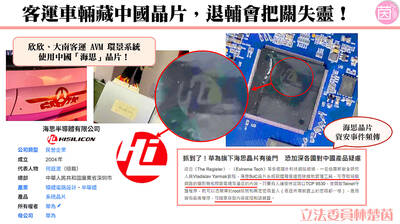
BREACH OF CONTRACT: The bus operators would seek compensation and have demanded that the manufacturer replace the chips with ones that meet regulations Two bus operators found to be using buses with China-made chips are to demand that the original manufacturers replace the systems and provide compensation for breach of contract, the Veterans Affairs Council said yesterday. Democratic Progressive Party Legislator Michelle Lin (林楚茵) yesterday said that Da Nan Bus Co and Shin-Shin Bus Co Ltd have fielded a total of 82 buses that are using Chinese chips. The bus models were made by Tron-E, while the systems provider was CYE Electronics, Lin said. Lin alleged that the buses were using chips manufactured by Huawei subsidiary HiSilicon Co, which presents a national security risk if the

The National Immigration Agency has banned two Chinese from returning to Taiwan, after they published social media content it described as disrespectful to national sovereignty. The agency imposed a two-month ban on a Chinese man surnamed Liang (梁) and a permanent ban on a woman surnamed Yang (楊), an influencer with 23 million followers, in October last year and last week respectively. Minister of the Interior Liu Shyh-fang (劉世芳) yesterday said on the sidelines of a legislative meeting that Chinese visitors to Taiwan are required to comply with the rules and regulations governing their entry permits. The government has handled the ban and


 RSS
RSS