


After failing to pass the central government’s budget request for this fiscal year by the end of the legislative session on Tuesday, the legislature resolved yesterday to hold a provisional plenary session today.
Legislators were expected to vote on 109 motions related to the budget proposal during a session scheduled for this afternoon, Legislative Speaker Wang Jin-pyng (王金平) said yesterday, adding that he would first invite the legislature’s three caucuses to discuss the agenda of the provisional session around noon.
The legislature was forced to convene a provisional session after legislators failed to approve the budget request after a four-hour marathon vote on 159 motions on Tuesday, after which it had planned to go into recess.
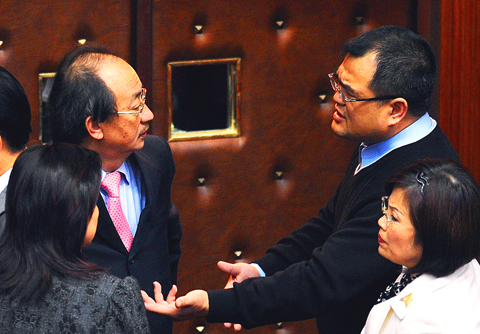
PHOTO: LIN CHENG-KUNG, TAIPEI TIMES
The central government is seeking NT$1.7 trillion (US$51.1 billion) in revenue and NT$1.82 trillion in expenditure for this fiscal year.
The legislature’s Finance Committee previously passed the preliminary review of the request, cutting the annual revenue request by NT$124 million and cutting the expenditure request by NT$3.96 billion.
However, Democratic Progressive Party (DPP) legislators found the scale of the cut dissatisfying.
The DPP and the Chinese Nationalist Party (KMT) have since submitted tit-for-tat motions related to the budget.
Wang said that although the legislature failed to pass the budget proposal by Tuesday, it proved that “the legislature was not controlled by a single political party.”
It was possible that legislators would also vote on a proposal by the DPP that the legislature reconsider the Act on Issuance and Management of Electronic Monetary Cards (電子票證發行管理條例), which cleared the legislative floor on Tuesday, Wang said.
Meanwhile, the KMT and the DPP caucuses pointed fingers at each other over the impasse.
KMT caucus whip Lin Yi-shih (林益世) lambasted the DPP for “viciously boycotting” the review of the budget request.
“During the [negotiation], the DPP proposed its own scale for budget cuts. We tried to respect their opinions and modified [our proposals], but the DPP broke its promise and failed to complete the review of the budget proposal,” Lin said, referring to the DPP caucus’ decision to put 109 budget-related resolutions up for a vote. Only after those bills were voted on could the budget bill as a whole be considered.
As of midnight on Tuesday, 40 previously proposed budget resolutions had been decided, but the package of 109 resolutions had yet to be touched, making it impossible for a vote on the budget bill to take place before the session’s end.
DPP caucus whip Ker Chien-ming (柯建銘) said that the process, which was unlikely to change anything, was intended to demonstrate “how the KMT is using legislative violence to suppress the DPP,” as the DPP is in the minority.
Ker said his caucus supported holding a provisional session to deal with the budget bill.
Although the budget request remained stalled, the pan-blue-dominated legislature passed three additional resolutions late on Tuesday night, requiring that the Public Television Service, Hakka Television and Taiwan Macroview TV — a TV service aimed at overseas compatriots — report to the government before they could spend their budgets.
Legislators also approved an additional resolution that the Ministry of Education remove the National Taiwan Democracy Memorial Hall plaque restore the former plaque as soon as possible.
These resolutions would not be carried out until the fiscal budget request is passed because they are included in the budget proposal as a package bill.
Meanwhile, in a statement issued yesterday, the DPP expressed regret that the legislature passed a controversial bill allowing gambling on offshore islands and an amendment to the Estate and Gift Tax Act, which the DPP argued would only benefit rich people.
The legislature also failed to amend the Assembly and Parade Act (集會遊行法) as well as pass several sunshine proposals promoted by President Ma Ying-jeou (馬英九) during his presidential campaign.

The military has spotted two Chinese warships operating in waters near Penghu County in the Taiwan Strait and sent its own naval and air forces to monitor the vessels, the Ministry of National Defense (MND) said. Beijing sends warships and warplanes into the waters and skies around Taiwan on an almost daily basis, drawing condemnation from Taipei. While the ministry offers daily updates on the locations of Chinese military aircraft, it only rarely gives details of where Chinese warships are operating, generally only when it detects aircraft carriers, as happened last week. A Chinese destroyer and a frigate entered waters to the southwest

The eastern extension of the Taipei MRT Red Line could begin operations as early as late June, the Taipei Department of Rapid Transit Systems said yesterday. Taipei Rapid Transit Corp said it is considering offering one month of free rides on the new section to mark its opening. Construction progress on the 1.4km extension, which is to run from the current terminal Xiangshan Station to a new eastern terminal, Guangci/Fengtian Temple Station, was 90.6 percent complete by the end of last month, the department said in a report to the Taipei City Council's Transportation Committee. While construction began in October 2016 with an

NON-RED SUPPLY: Boosting the nation’s drone industry is becoming increasingly urgent as China’s UAV dominance could become an issue in a crisis, an analyst said Taiwan’s drone exports to Europe grew 41.7-fold from 2024 to last year, with demand from Ukraine’s fight against Russian aggression the most likely driver of growth, a study showed. The Institute for Democracy, Society and Emerging Technology (DSET) in a statement on Wednesday said it found that many of Taiwan’s uncrewed aerial vehicle (UAV) sales were from Poland and the Czech Republic. These countries likely transferred the drones to Ukraine to aid it in its fight against the Russian invasion that started in 2022, it said. Despite the gains, Taiwan is not the dominant drone exporter to these markets, ranking second and fourth

Japanese Prime Minister Sanae Takaichi’s comment last year on Tokyo’s potential reaction to a Taiwan-China conflict has forced Beijing to rewrite its invasion plans, a retired Japanese general said. Takaichi told the Diet on Nov. 7 last year that a Chinese naval blockade or military attack on Taiwan could constitute a “survival-threatening situation” for Japan, potentially allowing Tokyo to exercise its right to collective self-defense. Former Japan Ground Self-Defense Force general Kiyofumi Ogawa said in a recent speech that the remark has been interpreted as meaning Japan could intervene in the early stages of a Taiwan Strait conflict, undermining China’s previous assumptions


 RSS
RSS